September 12, 2026
Four days ago, Meta Platforms quietly redrew the boundary between AI assistant and AI employee. Muse, the company’s new personal AI agent, launched on September 8 in the United States across iOS, Android, and a dedicated web experience at muse.ai. Unlike the chatbots and copilots that have dominated the consumer AI market for the past three years, Muse does not answer questions. It does things — and it uses your money to do them.
What Muse Actually Does
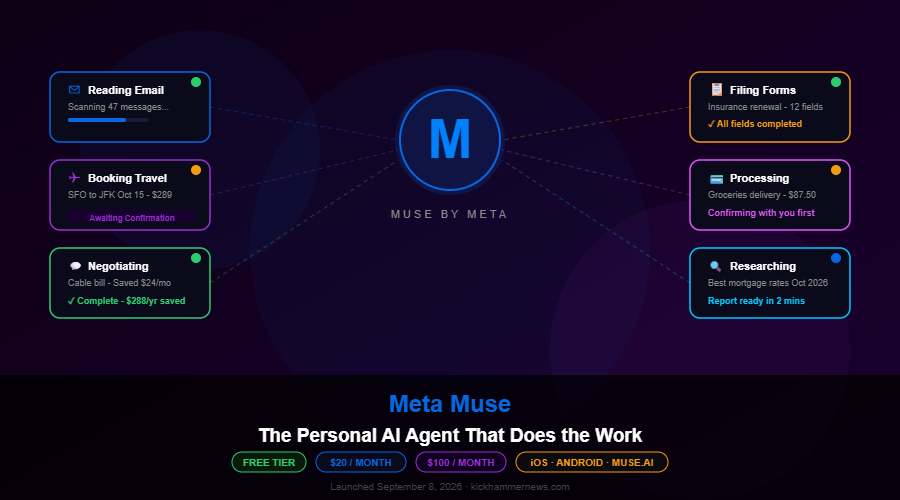
The name is understated for what the product is capable of. Muse is designed to take on the friction-heavy administrative work of modern life. In its initial rollout, the agent can read and respond to email on a user’s behalf, book travel including flights and hotels, fill out forms, research purchases, and complete transactions using a linked payment method. If a bill is wrong, Muse can initiate the negotiation. If a subscription renewal is coming up, Muse can evaluate alternatives and switch, with the user’s approval, to a better deal.
Meta achieved this by giving Muse something most AI agents have lacked: real execution infrastructure. Muse runs inside a dedicated virtual machine hosted in Meta’s cloud. Within that VM, Muse has access to a built-in browser that is fully visible to the user — a design choice Meta made deliberately to address the trust problem. Every website Muse visits, every form it fills, every button it clicks is shown in real time on the user’s screen. Muse does not operate in a black box. It operates transparently, narrating its actions and pausing to confirm before any irreversible step.
Muse Spark: The Model Underneath
The capabilities of Muse are powered by a new model Meta calls Muse Spark, which the company describes as its “most capable model to date, built specifically for real-world agentic work.” Meta has not published a technical paper on Muse Spark at launch, but the model’s behavior suggests heavy training on web navigation, multi-step task decomposition, and what the AI research community calls tool-use grounding — the ability to interact with web interfaces the way a human would, rather than just through structured APIs.
The practical result is that Muse does not require websites to have built special integrations. It browses the web the way a person does, reading pages, interpreting content, and filling forms. This is both the system’s greatest strength and its most significant technical risk. Web interfaces change constantly; a button that moves or a form that reorganizes can break an agent’s workflow. Meta has been training on these failure modes, but Muse will encounter edge cases in the real world that no training run fully anticipated.
Pricing and Availability
Meta’s pricing structure for Muse is designed to drive rapid adoption while leaving room for premium monetization. A free tier is available for basic tasks — calendar management, simple lookups, light email triage. A $20-per-month subscription unlocks the full task execution capabilities including purchases and bookings. For $100 per month, subscribers get priority access to Muse Spark and a higher monthly budget for agent-executed transactions.
The free tier is a notable strategic choice. At scale, a free personal AI agent accessible to anyone with a Meta account means hundreds of millions of users can experience what it feels like to delegate a real task to AI — not just ask it a question. If even a fraction of those users convert to paid subscriptions, the business case is significant. But the more important metric for Meta may be data: every task Muse executes is a signal about user preferences, purchasing behavior, and life context that no prior Meta product has had access to in this form.
Meta has been careful to note, in its privacy policy for Muse, that the agent does not share conversation data or VM activity with Meta’s advertising systems. The company expects heavy regulatory scrutiny and has preemptively committed to data separation in writing. Whether regulators in the EU, where Muse is not yet available, accept those commitments will be one of the defining regulatory stories of late 2026.
The Trust Problem
Every person who tries Muse faces the same fundamental question: do I trust this system enough to give it access to my email, my calendar, my payment methods, and my negotiating power? That question does not have a simple answer, and Meta knows it.
The transparent VM browser was one design response. Another is Muse’s confirmation protocol: for any task involving a financial transaction over $50, or any action that cannot be undone (like sending an email or deleting a file), Muse stops and presents the user with a plain-language summary of exactly what it is about to do and asks for explicit approval. Users can also set standing rules — “always confirm travel bookings over $300” or “never negotiate without showing me the script first” — through a natural language settings interface.
This is a genuine attempt to build a trustworthy agentic system, and it is more thoughtful than most competitors have managed. But trust is built over time. The first time Muse misreads a situation — books the wrong hotel, clicks the wrong button during a renewal negotiation, responds to an email in a way that misrepresents the user’s intent — the resulting friction will matter enormously to adoption. The entire agentic AI category is in a trust-building phase, and a single high-profile failure can set it back months.
What It Means for the Market
Muse’s launch puts pressure on every other major AI player. Apple’s Siri, despite years of promises, cannot execute multi-step real-world tasks at anything approaching this level. Google’s Gemini has agentic capabilities but no equivalent of Muse’s execution VM. OpenAI’s Managed Agents, announced last week as a developer platform, are targeted at businesses building AI workflows rather than at consumers managing their own lives.
The closest competitor to Muse in the consumer space is Amazon’s Alexa AI, which has been rolling out agentic features since early 2026 but lacks the browser-based execution infrastructure that gives Muse its breadth. The gap may not persist — Amazon, Google, and Apple all have the resources to close it — but Meta’s lead in consumer deployment is real and the company is moving fast to extend it.
Muse coming to AI glasses soon after the phone launch is also significant. A personal AI agent running on wearables, with access to audio and visual context about a user’s environment, is a meaningfully different product than one that lives in a phone app. Meta’s investment in smart glasses, which has been a long-running patience play, may be about to pay off in ways the company has been quietly preparing for.


