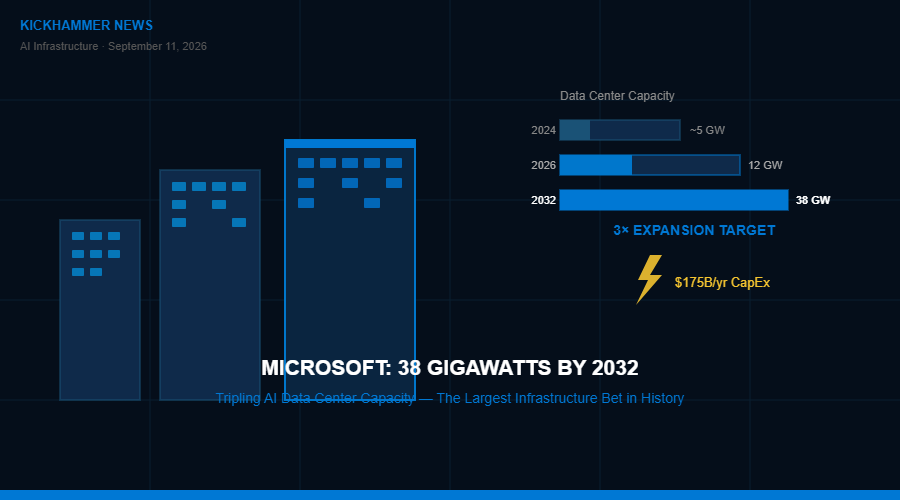
When Microsoft announced in a Bloomberg exclusive this week that it plans to expand its global data center capacity from roughly 12 gigawatts to more than 38 gigawatts by 2032, the headline figure sounded almost abstract. Thirty-eight gigawatts is enough electricity to power roughly 28 million American homes. It is more than the total power capacity of many mid-sized countries. It is not a number that belongs in a corporate infrastructure plan.
And yet, by the standards of where the AI infrastructure race appears to be heading, it may not even be enough.
How We Got Here
To understand why Microsoft is making this bet, it helps to understand what happened in the last several years. As demand for AI inference — running queries through large language models — exploded, Microsoft found itself in the uncomfortable position of turning away customers. Azure, its cloud division, was capacity-constrained. Developers and enterprises that wanted to run AI workloads on Microsoft’s infrastructure couldn’t always get the compute they needed, when they needed it.
That is a remarkable situation for the world’s most valuable technology company to be in. Microsoft’s current 12-gigawatt footprint is one of the largest private computing estates on the planet, and it was still not enough.
The company’s response is the plan announced this week: a six-year buildout that would more than triple total capacity, with roughly one-third of the 38-gigawatt target — approximately 12 to 13 gigawatts — dedicated specifically to AI workloads running on specialized accelerator chips.
The Financial Scale
The numbers are staggering even by the standards of big tech infrastructure spending. Microsoft’s capital expenditure reached $145 billion in its last fiscal year. The company is projecting $175 billion in CapEx across calendar year 2026, with the first quarter of fiscal 2027 alone expected to see $50 billion in spending.
To put that in perspective: Amazon spent about $78 billion on capex across all of 2024, a figure that was itself considered extraordinary at the time. Microsoft is now projecting that it will spend more than twice that amount in a single year.
This isn’t waste or overcorrection. It reflects a fundamental recalibration of what AI compute is worth. When AI inference becomes embedded in operating systems, productivity software, enterprise workflows, and eventually physical devices, the scale of demand becomes nearly impossible to overstate. Every time a Microsoft 365 user asks Copilot a question, a GPU cluster somewhere has to do the work. At a billion-plus user scale, that’s an enormous, continuous load.
What 38 Gigawatts Actually Means
Data center capacity is measured in watts because computing is fundamentally an energy problem. Every chip needs power to run, and every chip generates heat that needs to be removed — which requires more power. As AI chips have grown more powerful, they’ve also grown more power-hungry. An Nvidia H100 chip draws up to 700 watts under load. A rack of them can draw hundreds of kilowatts. A building full of racks draws megawatts. A large data center campus draws gigawatts.
Microsoft’s current 12-gigawatt footprint includes about 2 gigawatts dedicated to AI chips. The company is building and buying new sites across the United States, Europe, Asia, the Middle East, and Latin America. Its new campus in Pecos, Texas — announced earlier this year — is among the largest single data center developments in history.
The 38-gigawatt target implies a construction pace that the industry has never attempted. Data centers take years to build. They require vast amounts of land, water for cooling, power grid connections that sometimes require building new substations or even new transmission lines, and supplies of specialized hardware that themselves face production constraints.
The fact that Microsoft is announcing this plan publicly, and targeting a specific gigawatt figure, is itself a signal. It is a statement to chip suppliers, construction firms, power utilities, and potential customers: we are serious about this at a scale you may not have believed was real.
The Chip Question
Thirty-eight gigawatts of capacity is only useful if there are chips to fill it. Microsoft’s relationship with its chip suppliers is therefore a critical variable in whether this plan succeeds.
The company has long been one of Nvidia’s largest customers, and that relationship deepened substantially in 2024 and 2025 as AI demand accelerated. But Microsoft has also been developing its own AI chips — the Maia series — and has invested in partnerships with AMD and Intel. The goal is to reduce dependency on any single supplier for what is now, effectively, the most strategically important hardware in the global economy.
OpenAI, in which Microsoft holds a significant stake, is also developing its own chip (the Jalapeno, built with Broadcom), which could eventually run on Microsoft’s infrastructure. The vertical integration of AI software, inference, and hardware is a pattern that every major player in the industry is attempting to execute, with varying degrees of success.
Power and the Environment
Building 26 more gigawatts of data center capacity in six years raises questions that Microsoft has been reluctantly drawn into discussing. Where does the power come from?
The company has made commitments to run on 100% renewable energy and to be carbon negative by 2030. Those commitments are now under serious strain. Data centers consume power 24 hours a day, seven days a week, regardless of whether the wind is blowing or the sun is shining. Matching that kind of baseload demand with intermittent renewable sources requires either massive battery storage, significant overcapacity in renewable generation, or — as Microsoft and its peers have increasingly turned to — nuclear power.
Microsoft signed a landmark deal in 2024 to restart Three Mile Island’s Unit 1 reactor to power its data centers. The company has also invested in next-generation nuclear technologies, including small modular reactors, which it expects will be operational at some of its sites by the late 2020s. The 38-gigawatt plan almost certainly assumes significant nuclear power in the mix.
Competition and Context
Microsoft is not building in a vacuum. Amazon Web Services and Google Cloud are engaged in the same arms race, with their own multi-year infrastructure buildout plans running into the hundreds of billions. The three companies together are spending at a pace that is reshaping global energy markets, semiconductor supply chains, and real estate in data center corridors from Virginia to Singapore.
China, for its part, announced earlier this year a state-led plan to build 9,800 exaflops of AI computing capacity under its AI Five-Year Plan. The infrastructure race is not merely commercial; it has become a matter of strategic competition between nations.
What Microsoft’s announcement makes clear is that the companies building this infrastructure believe that the economic value of AI compute, for the foreseeable future, will continue to exceed the cost of building more of it. That belief — which now has $175 billion per year in annual spending behind it — is either one of the most prescient bets in the history of corporate investment, or one of the most spectacular.
We won’t know which for a while yet.
The Question of Demand
The implicit assumption behind all of this construction is that demand will materialize to fill it. That assumption is based on projections about how deeply AI will embed itself into daily computing — into word processors, spreadsheets, email clients, search engines, autonomous vehicles, medical devices, scientific instruments, and everything else that now runs on software.
If those projections are right — if AI inference becomes as ubiquitous and continuous as internet traffic — then 38 gigawatts may be remembered as the moment Microsoft understood the scale of what was coming before most others did.
If the projections are off — if AI adoption plateaus, if alternatives emerge that are radically more compute-efficient, if regulation constrains deployment — then the company will have built the world’s largest stranded asset.
The history of technology suggests that transformative platforms usually exceed even optimistic demand projections, eventually. Microsoft, it seems, is betting on “eventually” arriving faster than the timelines most analysts have penciled in.


