Something unusual happened in enterprise technology this year: the most powerful AI systems in history became widely available, and companies still couldn’t figure out how to use them.
That gap — between what frontier AI can do in a lab and what it actually delivers inside a real organization — has quietly become the defining problem of the AI era. And it has set off a gold rush unlike anything the industry has seen since the early days of cloud computing.
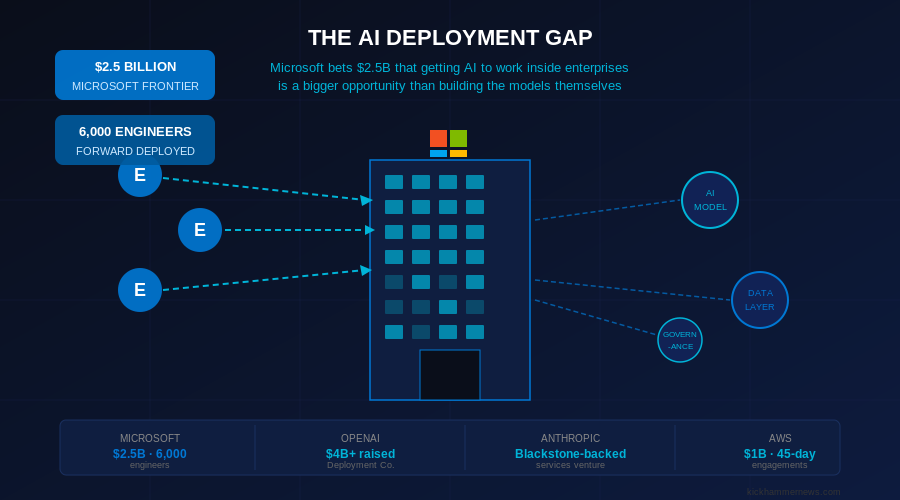
On October 22, Microsoft made the largest single bet yet on solving it. The company officially launched Frontier Company, a new business unit staffed by roughly 6,000 engineers and industry specialists who will embed directly inside enterprise customers to build, deploy, and operate AI systems that produce measurable results. The price tag: $2.5 billion.
“There is no societal permission for an AI future that eats the intelligence of the companies it supports,” Microsoft said in its launch statement — a line that reads less like marketing copy and more like a concession that AI, left to its own devices, tends to do exactly that.
The Deployment Gap Nobody Wanted to Talk About
For the past three years, the AI industry operated on a simple theory: build it and they will come. Release a sufficiently powerful model, give enterprises API access, and watch productivity soar. The model was seductive. It was also wrong.
Apollo Global Management reported earlier this month that it sees “little evidence of AI-driven financial gains outside major technology companies.” A Bloomberg survey found that 67 percent of enterprise executives say their AI investments have not yet delivered expected returns. The consultancy McKinsey, which has staked a significant portion of its own future on AI transformation work, estimates the gap between announced AI initiatives and measurable outcomes widened in 2026.
The problem is not the models. GPT-6 can reason across dozens of documents. Gemini 4 can write code that passes production review. Claude can synthesize a year of earnings calls into a one-page brief. The problem is everything else: integrating these systems with legacy databases that predate the internet, designing workflows that humans will actually adopt, governing outputs so that a hallucinated contract clause doesn’t end up in a binding agreement, and building the institutional knowledge to tell a useful AI output from a plausible-sounding mistake.
None of that is a software problem. It is an organizational problem. And organizational problems require people inside the organization to solve them.
The Palantir Playbook at Microsoft Scale
The model Microsoft is copying is not new. Palantir Technologies built its entire business around it more than fifteen years ago: embed engineers inside client organizations for months at a time, learn the company’s data and workflows intimately, and build systems that couldn’t be assembled from the outside.
Palantir called them “forward deployed engineers.” The FDE model was expensive, difficult to scale, and widely criticized as inefficient — right up until it wasn’t. Palantir’s US commercial revenue grew 55 percent year over year in Q2 2026. Its AI platform now has over 400 US commercial customers. Companies that once resisted the model are now copying it at a scale Palantir could never have reached alone.
Rodrigo Kede Lima, who will lead Microsoft’s Frontier Company, spent thirty years building enterprise relationships across the Americas and Asia. Judson Althoff, CEO of Microsoft’s commercial business and the executive who announced the unit, called it “the largest, most capable, outcome-driven engineering organization” focused on enterprise AI. The ambition is explicit: if Palantir built a profitable niche around forward deployed engineering, Microsoft intends to make it a standard feature of enterprise technology purchasing.
The unit will operate in two pillars. An intelligence platform uses customers’ proprietary data, expertise, and existing workflows to build AI systems that do something specific and verifiable. A trust platform covers the governance, security, and financial operations assessment that most enterprise AI projects lack entirely — the layer that answers the questions legal, compliance, and the CFO are actually asking.
Early customers include the London Stock Exchange Group, Land O’Lakes, Unilever, and Novo Nordisk. Partner firms Accenture, Capgemini, EY, KPMG, and PwC will extend the model globally.
Everyone Is Doing This Now
Microsoft is not alone. What is striking about the past six months is the degree to which every major AI company has simultaneously concluded that deployment is the real business.
In May, OpenAI quietly raised over $4 billion for its Deployment Company — a separate entity backed by 19 investors including TPG — to provide hands-on engineering support to enterprise customers. The unit has roughly 150 on-site engineers today, compared to Microsoft’s planned 6,000, but the ambition is the same: capture the gap between model access and actual results.
A week later, Anthropic announced its own services venture, backed by Blackstone, Hellman & Friedman, and Goldman Sachs, targeting mid-sized firms that can afford frontier AI but lack the technical staff to deploy it.
AWS moved in June with a $1 billion commitment to teams of five to six engineers running roughly 45-day engagements inside customer sites. Amazon’s version is shorter and more structured than Microsoft’s, designed to accelerate specific AI use cases rather than embed for the long term.
In total, across just four companies, over $8 billion has been committed to solving the same problem: making the AI that companies are already paying for actually work.
What This Means for the AI Business
The emergence of the deployment layer changes the economics of AI in ways the industry hasn’t fully absorbed yet.
For Microsoft, the Frontier Company is not primarily an altruistic service. It is a conversion engine. Microsoft’s AI annual recurring revenue reportedly reached $37 billion in 2026, up 123 percent year over year, and Azure is projected to grow at roughly 40 percent in constant currency. But that growth is constrained by how much AI enterprises are actually consuming — and enterprise consumption is constrained by how much of their AI investment is actually working. Every Frontier Company engagement that produces a measurable result is an argument to buy more Azure, more Copilot, more Frontier Suite licenses.
The strategic positioning is also revealing. Microsoft has explicitly described itself as platform-neutral — willing to deploy models from OpenAI, Anthropic, or Google depending on what the customer needs. This is a direct shot at OpenAI and Anthropic, whose deployment businesses are inevitably built around their own models. Whether an enterprise wants an independent integrator or a vendor-backed one will become one of the defining purchasing decisions of the next decade.
The model also puts Microsoft in an unusual competitive position relative to traditional integrators. Accenture, Infosys, Tata Consultancy Services, and Capgemini have collectively built their businesses on implementation work — the exact work Frontier Company intends to do. Microsoft has responded by partnering with them rather than competing, at least initially. Whether that détente holds as the deployment market grows will be one of the more interesting dynamics to watch.
The Uncomfortable Question Underneath All of This
There is a tension at the center of the deployment boom that nobody in the industry is eager to address directly.
If AI were as transformative as the industry claimed it would be by now, would any of this be necessary? Would the largest software company in the world need to send an army of engineers into client offices to get results? Would Goldman Sachs and Blackstone need to fund a professional services firm to help mid-sized companies deploy chatbots?
The honest answer is that frontier AI genuinely is transformative — but only when it is deployed well. The gap between a well-deployed AI system and a poorly deployed one is not marginal; it is the difference between a tool that becomes load-bearing infrastructure and a tool that gets quietly abandoned after the kickoff presentation.
What Microsoft and its competitors have recognized is that most enterprises cannot bridge that gap on their own. The technology is too new, the organizational changes required are too deep, and the failure modes are too subtle for a team without deep AI experience to navigate reliably.
That is a genuine market need. It is also, perhaps, the clearest sign yet that AI’s most important competitive frontier in the next few years will not be measured in benchmark scores or context windows. It will be measured in who can actually get it to work.


