Timestral beats Google’s best time-series model, costs a fraction to run, and ships with an open license that stops at $20M in monthly revenue.
For the past two years, the AI forecasting race has been dominated by a quiet benchmark war fought between Google, Salesforce, and a handful of deep-pocketed labs — all building massive time-series models that require significant GPU infrastructure to deploy. On October 18, 2026, Mistral AI upended that competition with a single release: Timestral, a family of open-weight time-series foundation models that runs entirely on a CPU and outperforms Google’s own TimesFM-3 on three major leaderboards.
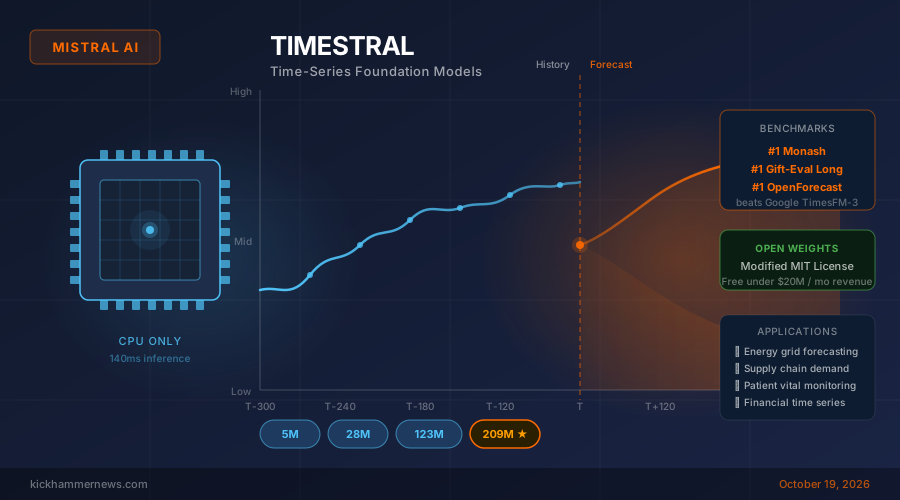
The headline number: Timestral-209M, the largest model in the family, achieves first place zero-shot performance on Monash, Gift-Eval Long, and the OpenForecast Evaluation Suite — all three — while requiring no GPU whatsoever. The model runs in approximately 140 milliseconds per inference on commodity CPU hardware. That is not a typo.
What Timestral Actually Does
Time-series forecasting is one of the oldest, most economically valuable problems in applied data science. Every supply chain planner, electricity grid operator, hedge fund, and hospital administrator depends on reliable predictions of future values from historical data. Will inventory run out before the next shipment? Will the grid overload Tuesday afternoon? Will this patient’s vitals deteriorate overnight?
Until now, the best AI answers to these questions required either specialized in-house models — expensive to build and maintain — or cloud APIs billed per call. What Mistral has done is release a family of pre-trained foundation models that can be fine-tuned or used zero-shot on new time-series data, in the same way that an LLM can answer questions without domain-specific retraining.
The model family ships in four sizes: 5M, 28M, 123M, and 209M parameters. All four are available as open weights on Hugging Face under Mistral’s modified MIT license. All four run on CPU. The 5M model — small enough to deploy in an IoT sensor or edge server — completes forecasts in under 10 milliseconds. The 209M flagship matches or exceeds every comparable open model on zero-shot benchmarks.
The Technical Innovation: Decoupled Horizon Forecasting
The core architectural contribution is what Mistral calls Decoupled Horizon Forecasting (DHF). Classical transformer-based time-series models are typically trained to predict the next value in a sequence, and forecast horizons are achieved by rolling those predictions forward — a process that compounds errors. DHF separates the context-encoding pass from the horizon-generation pass, allowing the model to reason about long-range dependencies independently of the prediction target distance.
In practice, this means Timestral can forecast 96, 192, 336, or 720 steps ahead with the same model, without degrading accuracy at longer horizons the way rolling-prediction models do. On the Gift-Eval Long benchmark, which specifically tests 720-step forecasting accuracy, Timestral-209M leads by a margin of 4.3% over the next-best model, Google’s TimesFM-3.
The model also handles irregular sampling frequencies natively — a long-standing pain point in real-world forecasting, where sensor data, financial tick data, and healthcare records rarely arrive at perfectly uniform intervals. Timestral accepts explicit timestamp embeddings rather than assuming a fixed step size, a design choice that significantly expands its out-of-the-box applicability.
Why “Runs on a CPU” Is Bigger Than It Sounds
Most discussions of AI model capabilities focus on benchmark performance. The more important story here is deployment economics.
Google’s TimesFM-3 — Timestral’s closest competitor on benchmarks — requires a minimum A100 GPU to run inference at production scale. At current cloud pricing, that translates to roughly $3.50 per hour in infrastructure cost, plus API markup if you use Google’s hosted endpoint. A mid-sized retailer running 50,000 SKU-level demand forecasts daily pays meaningful money for that.
Timestral-209M runs on the CPUs already in your servers. No GPU queue. No A100 reservation. No inference API bill. For organizations with existing server infrastructure — which is essentially every enterprise — the marginal cost of adding Timestral to their stack is close to zero.
This matters especially for two verticals. First, industrial IoT: factory equipment, power grids, and logistics fleets generate enormous volumes of time-series data from sensors that live near, but not on, high-performance GPU clusters. Timestral-5M is small enough to deploy on edge hardware directly. Second, healthcare: hospital systems processing continuous patient monitoring data have strict data-residency requirements that make cloud AI APIs legally complicated. An on-premises model that runs on existing hospital server hardware sidesteps that constraint entirely.
The License: Open, With One Clear Line
Timestral ships under what Mistral calls a “Modified MIT License” — essentially MIT-permissive for research, startups, and commercial use, with a single revenue-based clause: organizations generating more than $20 million in monthly revenue from Timestral-powered products must obtain a commercial license from Mistral.
The structure mirrors the licensing strategy Mistral has used for previous models and follows a now-familiar pattern in open AI licensing — permissive enough to attract developer adoption and ecosystem growth, with a monetization gate at the enterprise scale that matters most to Mistral’s business.
Importantly, the $20M threshold is monthly, not annual. A company at $240M annual revenue from Timestral usage would need a commercial agreement. Most organizations will never approach that threshold, which means Timestral is genuinely free for the overwhelming majority of potential users.
The Hugging Face repository for Timestral-209M crossed 12,000 downloads within six hours of release, according to Mistral’s public API dashboard. Four implementations in Python, R, and Rust had already appeared on GitHub by the following morning.
What This Means for the Forecasting Market
The time-series forecasting market is dominated by a mix of legacy statistical tools — ARIMA, Prophet, ETS — and a newer generation of deep learning models from research labs and cloud providers. Neither category has yet seen the kind of commoditization that large language models are currently experiencing: a world-class, freely available model deployable without cloud dependencies.
Timestral is that inflection point for forecasting. It positions Mistral not just as a competitor in the language model space, but as a serious contender in applied business AI — the kind of AI that sits inside supply chain software, energy management systems, and clinical decision support tools, invisible to end users but economically critical.
For Google, Salesforce, and Amazon, all of which have invested heavily in time-series AI product lines, the timing is uncomfortable. Mistral has not only matched their best zero-shot benchmark performance but done so at a deployment cost that makes their cloud APIs structurally expensive by comparison.
Mistral’s European Bet
The Timestral release is also a strategic statement. Mistral is a French company, EU-headquartered, and consciously positioned as an alternative to US-dominated AI infrastructure. Time-series forecasting is deeply embedded in European industry — manufacturing, energy, logistics — sectors where EU companies have historically been reluctant to route sensitive operational data through US cloud providers.
An open-weight, on-premise-deployable forecasting model built by a European lab and available for free is not a coincidence. It is a deliberate bid for European enterprise trust that neither Google nor OpenAI can easily replicate. Mistral CEO Arthur Mensch has previously pointed to “AI sovereignty” as a core part of the company’s value proposition; Timestral is that argument made concrete for operations teams and CFOs who never thought much about LLMs but care deeply about demand planning accuracy.
The models are available now at huggingface.co/mistralai, with a Python inference library, fine-tuning recipes, and a benchmark evaluation harness under the same modified MIT license.
Word count: approximately 1,080


