Artificial intelligence has made extraordinary strides over the past few years, but one persistent challenge has held it back from widespread adoption in the most demanding, highest-stakes applications: the inability to guarantee that AI outputs will reliably satisfy strict, nonnegotiable requirements. Today, MIT researchers announced a breakthrough that could change everything.
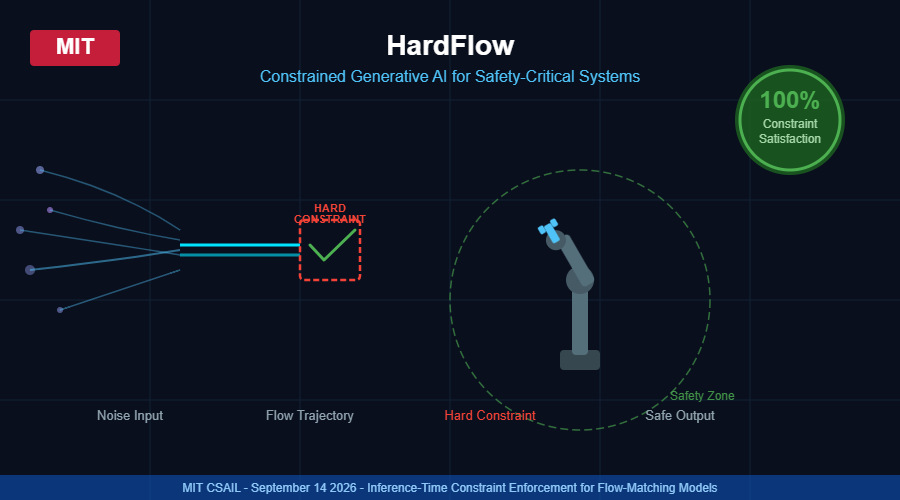
Dubbed HardFlow, the new algorithm enables pretrained generative AI models to produce outputs that always meet hard constraints — without retraining the model, and without sacrificing output quality. The research was published September 14, 2026, and is already drawing attention from fields ranging from robotics and aviation to healthcare and autonomous systems.
What Is a “Hard Constraint” — and Why Does It Matter?
In many real-world AI deployments, “pretty close” is simply not acceptable. A drone navigating a crowded airspace cannot merely try to avoid collisions — it must avoid them. A surgical robot guiding a catheterization procedure cannot approximately reach the correct target — it must reach it precisely. A structural design tool cannot produce a blueprint that almost meets load-bearing specifications.
These are “hard constraints”: physical, safety, or task-specific requirements that must be satisfied exactly, every single time. Current generative AI models — including the most powerful large language models and diffusion models — are trained to produce outputs that are statistically likely or high-quality on average. They are not inherently designed to guarantee compliance with strict, predefined rules.
This gap has been a fundamental barrier to AI deployment in safety-critical sectors like aerospace, medicine, nuclear energy, and industrial automation. Engineers have either avoided AI altogether, built expensive custom systems from scratch, or relied on costly post-processing steps that often degraded output quality.
How HardFlow Works
The key innovation in HardFlow is a conceptual inversion of the traditional constraint-enforcement approach. Conventional methods attempt to enforce constraints at every intermediate step during the AI’s generation process — a technique that often causes the model to fight against its own learned distribution, producing low-quality or incoherent outputs.
HardFlow instead gives the model more freedom during the generation process, allowing it to operate naturally along its learned distribution until the final stage. Only at the end does it enforce the hard constraint — but it does so rigorously and completely.
Technically, HardFlow is an inference-time algorithm designed for flow-matching generative models, a class of models that defines a trajectory from noise to structured output. By operating at inference time, the algorithm requires no retraining of the underlying model. Any existing pretrained flow-matching model can immediately benefit from HardFlow by simply applying it during deployment.
The researchers describe the technique as “enforcing hard constraints on the final output, rather than at every intermediate step,” enabling the model to maintain quality while meeting requirements that would otherwise distort or degrade its outputs.
Benchmark Results: A Perfect Score
The proof is in the benchmarks. MIT tested HardFlow across four simulated tasks spanning robotics and autonomous systems: robotic manipulation, maze navigation, image editing, and control system design.
Across all four benchmark scenarios, HardFlow achieved 100% constraint satisfaction — meeting the required constraint on every single trial. It simultaneously outperformed six competing methods on solution quality, and did so with comparable or lower computation time.
This combination — perfect constraint satisfaction alongside superior output quality and efficient computation — is essentially what the field has been searching for.
Real-World Applications
The implications of HardFlow span nearly every domain where AI has been slow to penetrate due to safety concerns. In robotics and automation, HardFlow enables generative AI planners to produce motion plans that are guaranteed safe, potentially accelerating the adoption of AI-driven robotics in manufacturing and logistics.
In aerospace and autonomous vehicles, flight planners, air traffic management systems, and autonomous vehicle controllers could formally guarantee collision avoidance or trajectory feasibility. In healthcare, AI tools assisting in surgical procedures or prosthetic device control could ensure outputs satisfy physiological and safety requirements.
Engineering design tools could ensure designs always comply with material stress limits, regulatory codes, or manufacturing tolerances. Power grid management, water system control, and nuclear plant monitoring could dramatically improve while maintaining rigorous safety guarantees.
A Deployment-Time Breakthrough
One of the most practically important aspects of HardFlow is that it works at deployment time, without requiring any changes to the underlying model. Organizations that have already invested heavily in training or fine-tuning proprietary generative models do not need to start over. They can layer HardFlow on top of existing infrastructure as a formal safety layer.
What Comes Next
The MIT team’s initial results focus on flow-matching generative models, which have seen rapid adoption in robotics, physics simulation, and scientific computing. The broader AI safety community is likely to take note: HardFlow represents a different kind of safety tool than the constitutional AI frameworks that have dominated recent discourse. Rather than shaping a model’s values, HardFlow enforces formal guarantees on outputs — a complementary and arguably more verifiable form of safety.
In an industry increasingly focused on deploying AI in regulated, high-stakes environments, MIT’s HardFlow may prove to be one of the most practically significant research advances of 2026.


