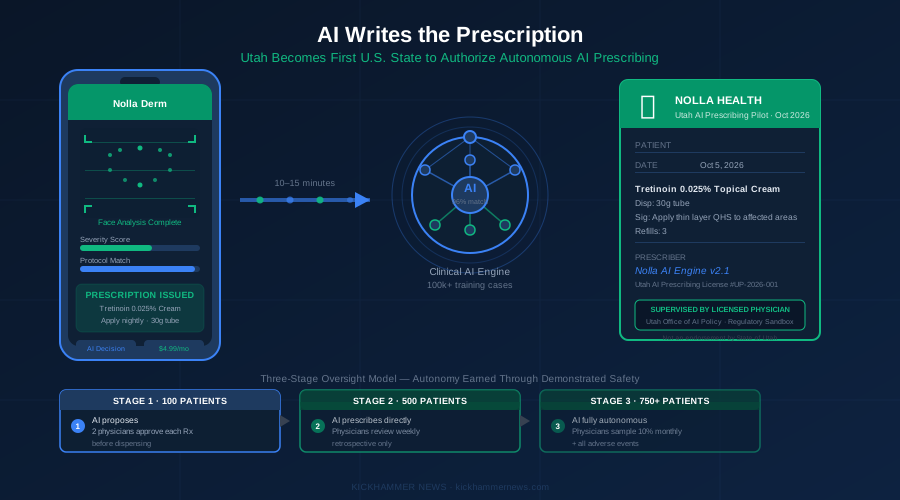
On Sunday, October 5, 2026, a 23-year-old in Salt Lake City downloaded an app, answered a questionnaire, snapped five photos of her face, and received a prescription for tretinoin — a pharmaceutical-grade acne treatment — without ever speaking to a physician. The prescription was written by software.
Her transaction was not a legal gray area or a telemedicine workaround. It was the deliberate result of the most significant authorization in American medical history: Utah has become the first U.S. state to permit an artificial intelligence system to issue initial prescriptions with minimal physician oversight. The startup behind the system, Nolla Health, officially launched the pilot on October 5 under a regulatory sandbox agreement with Utah’s Office of Artificial Intelligence Policy and Division of Professional Licensing.
America is now watching to see whether this is the beginning of a new era in healthcare access — or a cautionary tale waiting to happen.
A Problem Looking for a Solution
To understand why Utah said yes to something the rest of the country hasn’t dared, it helps to understand what Utah’s healthcare landscape actually looks like. The state faces a serious dermatological access crisis: average wait times for a dermatology appointment run approximately 61 days — nearly double the national median of 32 days. Eleven of Utah’s 29 counties have no practicing dermatologist at all. According to Nolla Health’s regulatory filing, roughly 100,000 Utahns suffer from active acne annually, and only about 10% ever see a specialist. When they do reach a physician, the cost ranges from $150 to $300 per visit, before medication.
Acne may sound trivial compared to oncology or cardiology, but its real-world impact isn’t. Untreated moderate-to-severe acne causes permanent scarring, clinically significant depression, social withdrawal, and reduced academic and professional performance. The dermatology wait is not a minor inconvenience — for teenagers and young adults, it can be life-altering. Nolla’s proposal to Utah regulators leaned heavily on this math: a six-figure population underserved by a shortage that isn’t going away, and a condition well-characterized enough that its treatment protocols have changed little in decades.
What the AI Actually Does
The Nolla Derm app, which launched nationally in summer 2025 and has since surpassed 175,000 downloads across 44 states, costs $4.99 per month during the Utah pilot. The patient experience takes approximately 10 to 15 minutes: identity verification via Stripe Identity (a government-issued ID photograph matched against a selfie), an intake questionnaire covering medical history, allergies, medications, and relevant conditions, and a five-angle facial scan. No free-text input is permitted at any stage — a deliberate design choice to prevent the AI from being prompted or manipulated outside its defined parameters.
The AI then analyzes the intake data and facial scans against a model the company says was trained on more than 100,000 labeled acne cases, achieving an R-squared of 0.947 on a held-out test set of 10,348 cases. In the most recent 1,000 real-world cases, licensed clinicians agreed with the AI’s treatment selections in approximately 96% of instances, with disagreements confined to single-step adjustments in medication strength.
The approved formulary is deliberately narrow: tretinoin, adapalene, clindamycin with benzoyl peroxide, benzoyl peroxide alone, azelaic acid, and compounded versions incorporating niacinamide or spironolactone. The AI cannot recommend isotretinoin (commonly sold as Accutane), oral antibiotics, or any systemic medication. Multiple hard stops automatically route patients to human physicians or terminate the process entirely: acne severity rated above 3.5 on the five-point Investigator Global Assessment scale, pregnancy, immunosuppression, severe kidney or liver disease, age under 18, and non-Utah residency.
For cases the AI handles, compounded medications from Nolla’s partner pharmacy run $49.99. Generic alternatives at retail pharmacies typically cost $10 to $40.
The Three-Stage Architecture of Trust
The most structurally interesting element of the Nolla pilot is not the AI itself but the staged oversight model that governs it. Rather than flipping a switch and letting the algorithm run, Utah and Nolla negotiated a tiered structure in which the AI earns autonomy incrementally through demonstrated performance.
Stage 1 covers the first 100 patients and at least four weeks of operation. Every AI-generated prescription must be independently reviewed and approved by two licensed physicians before it is dispensed. The AI proposes; humans decide. Nothing ships until a physician says it can.
Stage 2 covers the next 400 patients, running for at least eight weeks. The AI issues prescriptions directly — without prospective physician sign-off — but physicians conduct retrospective review of every prescription on a weekly basis. Advancement from Stage 1 to Stage 2 requires that clinicians agreed with at least 95% of AI recommendations during Stage 1, and that zero serious adverse events occurred.
Stage 3, covering 750 or more patients, reduces physician oversight further: licensed clinicians review a random sample of at least 10% of monthly automated prescriptions, plus all escalations and adverse events. The same 95% agreement threshold and zero serious adverse events must have been met in Stage 2.
The sandbox runs for 12 months from the official notification date, with potential extensions of two additional 12-month periods. Monthly data reports — covering prescription counts, clinician agreement rates, escalations, and patient demographics — are due to regulators by the 15th of the following month. Quarterly reports become publicly available. De-identified patient data flows to third-party auditors for independent validation.
Critically, the regulatory agreement includes explicit language that the state is not endorsing the product: “it is a grant of regulatory mitigation only, not an endorsement or approval by the State of Utah.” The four organizations that granted formal authorization — the Utah Office of Artificial Intelligence Policy, the Utah Division of Professional Licensing, the Utah Medical Association, and the American Academy of Dermatology — are betting on the process, not on the outcome.
What It Means for the Doctor-Patient Relationship
CEO Luis Wenus was direct about the line his company has crossed. “Until now,” he said at the launch, “a licensed clinician signed every single prescription before it went out. Our AI can now make that prescribing decision itself.”
That sentence is a watershed. The entire architecture of American medical licensing, liability, and malpractice law is built on the premise that a human physician is responsible for every prescription. What Nolla is doing — with Utah’s blessing, under strict conditions — is beginning to unwind that assumption, at least for a narrow category of low-acuity conditions.
Dr. Zaid Fadul, Nolla’s chief medical adviser, offered a characteristically unsentimental framing of the safety question: “The real test for AI in healthcare isn’t how smart it is. It’s whether someone other than the company can shut it off.” The multiple hard stops, the escalation pathways, the tiered oversight structure, and the public reporting requirements are all designed to answer that question in the affirmative. Regulators, not Nolla, hold the kill switch.
The American Academy of Dermatology’s endorsement is particularly notable given the profession’s institutional interest in preserving physician involvement in prescribing. Its sign-off suggests that the dermatology community sees a calculus here — that AI handling straightforward topical acne cases under tight supervision may free physicians for the complex and high-stakes work that genuinely requires their expertise.
Where the Guardrails Are and Why
The decision to limit Stage 1 to topical acne treatments is not arbitrary. Topical acne therapy is among the most protocol-driven domains in medicine: clinical guidelines are well-established, evidence bases are decades old, and outcomes are observable and measurable over weeks. The condition is common, low-mortality, and — crucially for AI training — visually assessable through images rather than through auscultation, lab values, or complex symptom inference.
Nolla’s chief medical adviser suggested potential future expansions might include flu treatment and uncomplicated urinary tract infections — both conditions where rapid diagnostic tests produce objective, binary data that reduce the need for clinical judgment. He specifically excluded stimulants, opioids, and benzodiazepines from any future autonomous prescribing pathway, citing the risk of patient manipulation.
The design reveals a philosophy: AI prescribing is not about replacing physician judgment across the board. It is about finding the narrow categories where protocol adherence is the primary clinical challenge, and access barriers are the primary patient challenge — and deploying AI precisely there.
The National Ripple Effect
No other state has gone this far. The FDA continues to regulate drugs at the federal level but has not addressed the question of who — or what — may prescribe them at the point of care; that authority has historically been a state licensing matter. California, New York, Texas, and Massachusetts all have active AI healthcare legislation, but none has yet authorized autonomous AI prescribing.
What Utah has done is create a data set. If Nolla Derm’s pilot produces 95% clinician agreement rates, zero serious adverse events, and measurable improvements in access for patients who previously waited two months to see a specialist, the argument for expansion becomes difficult to ignore. The twelve-month sandbox, with its public quarterly reports, is effectively a peer-reviewed experiment running in the open market.
The companies watching most closely are not just other telehealth startups. Pharmacy chains, insurance companies, and large health systems are all trying to answer the same question: at what point does AI-assisted prescribing become so reliable, so transparent, and so tightly supervised that restricting it is itself a harm?
For now, that question belongs to Utah — and to the 100 patients who will begin testing the system in Stage 1 over the coming weeks. Their outcomes, and the clinicians who review their AI-generated prescriptions, will do more to shape the future of American medicine than any legislative debate in the near term.
The prescription pad, one of medicine’s most enduring symbols of physician authority, is now shared — at least in one state, for one condition, under close supervision — with a machine. Whether that proves to be a cautious first step or a cautionary tale depends on what happens next.


