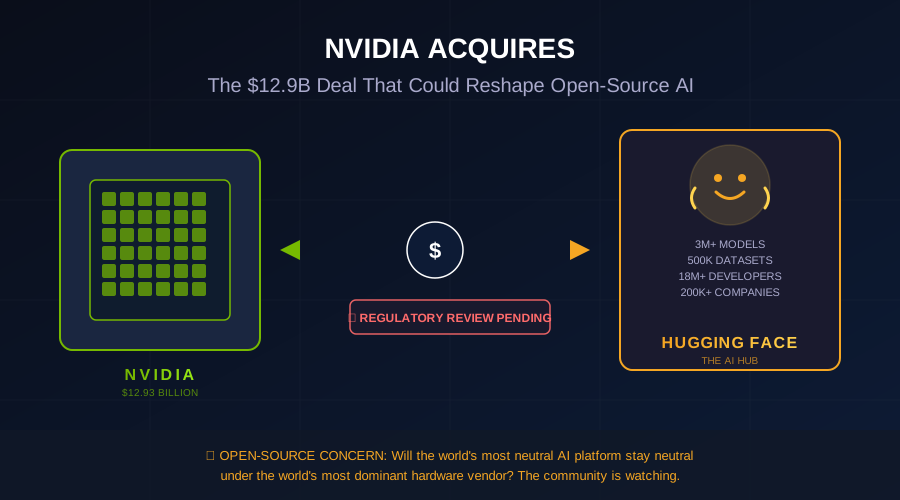
The company that makes the chips your AI runs on just bought the website where all your AI models live. On September 3, 2026, Nvidia confirmed it had agreed to acquire Hugging Face for $12.93 billion — the largest AI acquisition of the quarter, and one of the most consequential deals in the history of open-source software.
If you’re not in AI circles, the name Hugging Face might not ring a bell. But if you’ve used any AI tool in the last three years — a local chatbot, an image generator, a speech model, a custom fine-tune running on your laptop — there’s a good chance it passed through Hugging Face at some point. The platform hosts more than three million models, half a million datasets, and one million applications. More than 18 million developers and researchers use it. More than 200,000 companies depend on it. It is, in every meaningful sense, the GitHub of artificial intelligence: the central repository where the global AI community uploads, shares, discovers, and deploys its work.
Now one company owns it.
What Nvidia Gets
Jensen Huang’s pitch for the deal is straightforward: Nvidia has already been one of the biggest contributors to the Hugging Face ecosystem, releasing more than 500 models and 250 open datasets on the platform. Buying it doesn’t change what Nvidia is doing — it just means Nvidia now owns the town square where that work is showcased.
The strategic logic runs deeper than goodwill. Hugging Face earns an estimated $150 million in annualized revenue — a figure that implies Nvidia is paying roughly 86 times revenue, a multiple that looks steep in any sector except AI in 2026. But the value Nvidia is buying isn’t the revenue. It’s distribution. When a developer lands on Hugging Face to download a model, they’re a potential customer for Nvidia’s compute-rental business, for its inference services, for its enterprise AI stack. Owning Hugging Face means owning the moment of discovery — the page where a developer first finds a model and decides what to run it on.
Hugging Face previously rejected a $500 million offer from Nvidia, according to the Financial Times. The company’s last outside valuation was around $4.5 billion, set by a 2023 round led by Salesforce Ventures. The $12.93 billion price — structured as roughly $11.9 billion to shareholders plus up to $1 billion in employee retention equity — represents a near-tripling of that valuation in three years, achieved while Hugging Face was reportedly approaching profitability.
CEO Clem Delangue, who co-founded the company in 2016 as a chatbot startup before pivoting to become the spine of the open-source AI movement, framed the sale in terms of scale. “For it to happen at larger scale,” he said, “it needs more compute, more support, more collaboration, and more visibility.” In other words: the platform had outgrown what private capital could sustain.
The Promise That Will Be Tested
Nvidia’s single most important pledge to the AI community: “Nvidia compute will not be required to build on or deploy through Hugging Face.” Jensen Huang has made this commitment publicly, and it matters because the entire value of Hugging Face to the broader ecosystem is its neutrality. It’s the place where PyTorch and JAX models coexist, where Google’s Gemma sits alongside Meta’s Llama and Microsoft’s Phi, where AMD and Intel and Apple Silicon users download the same files as Nvidia customers.
That neutrality is now owned by a hardware vendor.
The concern isn’t that Nvidia will immediately flip a switch and require its GPUs. The concern is subtler: whether models start getting optimized first for Nvidia hardware, whether compute pricing for Hugging Face’s hosting tiers quietly shifts to favor Nvidia’s cloud partners, whether the platform’s search and recommendations start surfacing Nvidia-compatible formats. None of those things would violate any written commitment. All of them would tilt the ecosystem.
The AI community has seen this movie before — sort of. When Microsoft acquired GitHub in 2018 for $7.5 billion, the reaction was similar panic about a platform vendor owning developer infrastructure. GitHub’s neutrality has held, mostly. But Nvidia’s position in AI hardware is more dominant than Microsoft’s was in enterprise software in 2018: approximately 80–90% of AI model training happens on Nvidia GPUs. Owning the place where those models get distributed, too, is a different kind of leverage.
The Regulatory Gauntlet Ahead
The deal faces potential scrutiny in the US and Europe. Analysts point to two precedents that shape how regulators might approach it.
First: Nvidia’s $700 million acquisition of Run:ai, an AI workload management company. The EU reviewed that deal under Article 22(3) even though it fell below normal thresholds — a signal that regulators are watching Nvidia’s ecosystem expansion closely. The Commission ultimately cleared the deal unconditionally in March 2025, but the process itself showed that Brussels won’t wave through Nvidia acquisitions reflexively.
Second: Arm. Nvidia’s $40 billion bid to acquire the chip architecture company was abandoned in 2022 after the US Federal Trade Commission, UK Competition and Markets Authority, and European Commission all raised concerns about Nvidia gaining control of a platform that its competitors depended on. Hugging Face is arguably an even more central piece of infrastructure than Arm was at the time of that deal. If regulators draw the same analogy, the review could run into 2027 — and the outcome is genuinely uncertain.
The awkward irony for Hugging Face’s leadership is the optics. The company’s founders and executives have been among the most prominent voices arguing that open-weight models, built and shared freely by the global developer community, are critical to preventing any single company from controlling AI. That argument just led them to sell to the company that already supplies the hardware those models run on.
What Changes — and What Doesn’t (For Now)
Practically speaking: nothing changes for users today. Model pages, dataset downloads, the Spaces application hosting environment, community forums — all of it keeps running. The acquisition hasn’t closed, pending regulatory review, and even after it does, a sudden lurch away from openness would be commercially self-defeating. Hugging Face’s value to Nvidia is its community, and the community’s presence depends on it remaining neutral.
But the qualifier “for now” matters. The history of platform acquisitions is a history of gradual change: new pricing tiers, shifted incentives, preferred integrations, quiet deprecations. The AI community isn’t just worried about what Nvidia will do in October 2026. It’s worried about what Nvidia will do in October 2028.
For the open-source AI ecosystem, the Hugging Face acquisition is a stress test of a proposition that has never been formally tested: can the world’s most important open AI platform remain genuinely open once it belongs to the world’s most powerful hardware vendor? Nvidia says yes. The community is watching every commit to find out.


