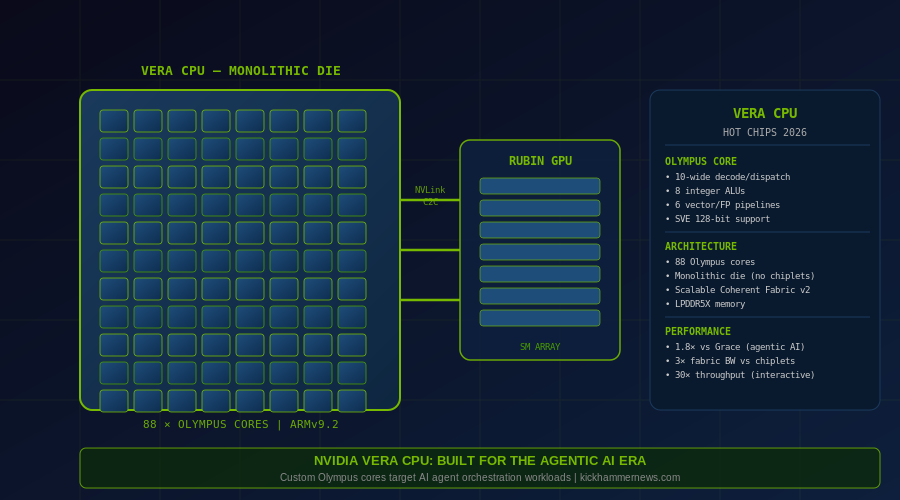
At Hot Chips 2026, Nvidia unveiled the full architecture of its Vera CPU — and the details reveal a company that has placed an enormous bet on agentic AI as the defining workload of the next decade.
The semiconductor industry gathered in Santa Clara this week for Hot Chips 2026, and Nvidia used the conference to deliver a rare and unusually detailed deep dive into its Vera CPU — the in-house processor at the heart of its forthcoming Vera Rubin AI systems. What emerged is a picture of a processor built from the ground up not for traditional cloud computing, but for the fast-emerging world of AI agents that reason, plan, and act autonomously across long, complex tasks.
A New Core for a New Era
At the center of the Vera CPU is a new microarchitecture Nvidia calls Olympus. Unlike the Grace CPU cores that preceded it — which were adapted from Arm’s Neoverse reference designs — Olympus is a fully custom Arm v9.2-compatible core, designed entirely within Nvidia’s own silicon engineering teams.
The specs are aggressive. Each Olympus core features a 10-wide decode and dispatch pipeline, eight integer arithmetic logic units, six vector and floating-point pipelines with 128-bit SVE support, four load units, and two store units. In practical terms, this is a CPU core optimized for high single-threaded performance and rapid context switching — two properties that matter enormously when an AI agent needs to orchestrate tool calls, manage memory, parse structured outputs, and make sequential decisions in real time.
Each Vera CPU packages 88 of these Olympus cores. And critically, Nvidia has chosen a monolithic die design rather than the chiplet architecture that AMD and Intel have embraced for their server CPUs. That decision has significant performance implications.
The Coherence Advantage
Nvidia’s argument for going monolithic centers on its second-generation Scalable Coherent Fabric — the interconnect that links all 88 cores and their shared cache hierarchy. The company claims this fabric delivers up to three times the core-to-core bandwidth of competing chiplet designs while eliminating the latency penalties that arise when data crosses die-to-die boundaries in multi-chiplet processors.
For agentic AI specifically, this matters more than it might seem. Agent orchestration is memory-intensive and latency-sensitive. An AI agent managing a complex workflow — say, browsing the web, writing code, executing tests, and revising its plan — doesn’t just need raw throughput. It needs fast, coherent access to shared state. Nvidia’s monolithic approach trades off the manufacturing yield advantages of chiplets in exchange for a tighter, lower-latency memory fabric that keeps all 88 cores in sync without the bottlenecks of inter-die crossings.
The Vera CPU also uses LPDDR5X memory and connects to Nvidia GPUs and other Vera CPUs via NVLink-C2C — the same high-bandwidth, low-latency chip-to-chip interconnect that links Grace and Hopper in existing Grace Hopper Superchips. This means Vera slots cleanly into Nvidia’s broader data center architecture, acting as the CPU substrate beneath Rubin-generation GPUs.
Benchmarks: Beating the Best from AMD
Nvidia shared SPEC CPU 2026 benchmark data at Hot Chips, and the numbers are striking. The Vera CPU outpaces AMD’s EPYC 9655P — one of the fastest x86 server processors available — in Linux kernel compilation benchmarks. Nvidia is also claiming roughly 1.8x speedup on agentic workloads compared to earlier Grace-based systems, and up to 30x throughput in specific interactive AI scenarios when compared to older Grace Blackwell configurations.
Those numbers carry the usual caveats: Nvidia selected the benchmarks, and real-world agentic workloads are notoriously heterogeneous. Still, the direction of the performance claims is unambiguous. Vera is not a CPU designed to compete with AMD EPYC in traditional virtualization or database workloads. It is purpose-built to sit beneath the GPU and handle the orchestration, preprocessing, and control-plane logic of AI inference pipelines at scale.
Why This Matters: The CPU Gap in AI Infrastructure
For years, AI infrastructure has been GPU-centric, with CPUs treated largely as host processors — useful but not the story. As AI models scale and inference architectures grow more complex, that dynamic is shifting. The rise of multi-step reasoning models, retrieval-augmented generation, and agentic frameworks has placed new and demanding requirements on the CPU side of the equation.
Orchestrating an AI agent running on a thousand-GPU cluster involves an enormous amount of CPU-side work: parsing requests, managing context windows, routing tool calls, aggregating results, and making branching decisions that determine what the agent does next. Legacy server CPUs were never designed with this traffic pattern in mind.
Nvidia recognized this gap. The original Grace CPU was a solid step — a move away from x86 dependence — but it was still a relatively conservative adaptation of existing Arm IP. Olympus is the company’s first clean-sheet answer to the question: what does a CPU look like when AI agents, not virtual machines, are the primary customer?
The Vera Rubin Ecosystem
Vera is not a standalone product. It is one pillar of the Vera Rubin platform — Nvidia’s next-generation AI computing architecture that pairs the Vera CPU with Rubin-generation GPUs and NVLink networking. The full Vera Rubin system is expected to begin shipping to hyperscale customers in 2026, with broader availability extending into 2027.
Nvidia has positioned Vera Rubin as the successor to Grace Blackwell, designed to handle the next order-of-magnitude increase in AI model complexity and inference demand. If the Hot Chips presentation is any indication, the Vera CPU will play a more central architectural role in that system than Grace ever did in Grace Blackwell — not just hosting GPU memory operations, but actively participating in the compute pipeline for agent-driven workloads.
What Comes Next
Nvidia’s willingness to share such detailed architectural information at a public conference is itself notable. The company rarely opens the kimono on unreleased silicon, and the Hot Chips disclosure suggests confidence that Vera is close enough to production that the competitive risk of disclosure is outweighed by the marketing value of signaling technical leadership.
The AI processor race is accelerating. AMD is pushing EPYC with integrated AI accelerators. Intel is doubling down on Gaudi and Xeon with custom workload optimizations. Custom silicon from Amazon, Google, Microsoft, and Meta continues to mature. Against that backdrop, Nvidia’s move into custom CPU design with Olympus represents a significant expansion of the competitive surface — one that will be watched closely as Vera Rubin systems start appearing in data centers later this year.
For now, the Hot Chips presentation confirms one thing clearly: Nvidia is not building the next GPU. It is building the next data center, and the Vera CPU is proof that it intends to own the full stack.


