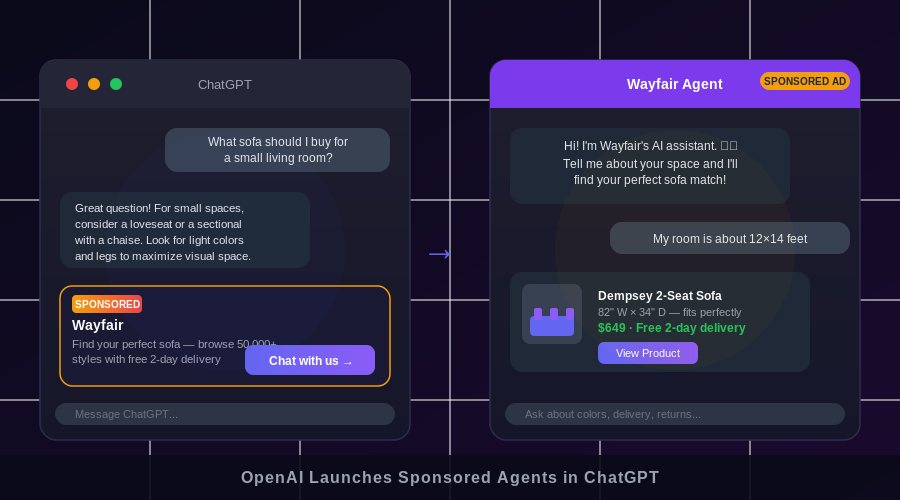
The AI giant’s first advertising format doesn’t send you to a website. It opens a branded AI conversation right inside ChatGPT.
On September 16, 2026, OpenAI formally launched a pilot program called Sponsored Agents, a new advertising format that fundamentally reimagines what an online ad can do. Instead of redirecting users to an external website when they click, a Sponsored Agent ad opens a live, branded AI conversation directly inside ChatGPT. For the first time, a company’s AI agent — trained on its own products, services, and policies — can respond to your questions, guide you through a purchase, and hand you off to a human representative, all without leaving the chat interface.
The launch marks a watershed moment for both the AI industry and digital advertising more broadly. OpenAI, long focused on subscription revenue from ChatGPT Plus and enterprise API contracts, is now moving to capture a share of the multi-hundred-billion-dollar global advertising market. The stakes could hardly be higher: ChatGPT reportedly serves hundreds of millions of users worldwide, making it one of the most trafficked platforms on the internet.
What Are Sponsored Agents?
The mechanics are straightforward but the implications are profound. When a user’s ChatGPT conversation touches on a relevant topic — say, searching for a home renovation contractor or shopping for a sofa — a clearly labeled Sponsored Agent card may appear alongside ChatGPT’s independent answer. The card displays the brand’s name, a short description, and a call-to-action such as “Chat with us.” Clicking it opens a separate, branded chat thread with that company’s AI agent.
OpenAI has been careful to underscore the transparency here. The sponsored exchange is visually distinct from ChatGPT’s own response, carries a clear “Sponsored” label, and appears as a separate conversation thread — not woven into the AI’s organic answer. The company says it will not allow Sponsored Agents to alter or influence ChatGPT’s independent recommendations.
Wayfair and Angi are the two confirmed launch partners. Wayfair’s agent can browse the furniture retailer’s catalogue, answer questions about dimensions and delivery timelines, and guide a user through checkout. Angi’s agent helps homeowners describe their project, estimate costs, and connect with pre-screened local tradespeople. Both companies confirmed they are participating in a limited US test with strict guardrails around accuracy, transparency, and handoff to human support when needed.
Why This Changes Everything
Traditional digital advertising works through interruption and redirection. A banner ad, a sponsored search result, or a social-media video all share the same basic logic: catch a user’s attention and send them somewhere else, usually a landing page optimized for conversion. The friction between click and purchase has driven decades of A/B testing, funnel optimization, and analytics investment.
Sponsored Agents collapse that funnel. The conversation, the product discovery, the objection-handling, and the transaction can all happen in one place, in natural language, guided by an AI that has been trained on the brand’s own data. For advertisers, this means reaching customers at precisely the moment of intent — when they’re already asking a question — with an agent capable of providing a genuinely useful, personalized answer.
For users, the experience is less intrusive than a pop-up and more capable than a chatbot widget bolted to the bottom of a corporate website. The agent knows the brand’s full product catalogue, current promotions, and return policies. It can answer edge-case questions that a static FAQ page never could.
For OpenAI, the financial opportunity is substantial. Digital advertising globally was projected to exceed $750 billion by 2026, with search advertising — the closest analogue to Sponsored Agents in terms of intent targeting — making up a significant slice. Even a modest share of that market could dwarf the revenues from ChatGPT’s subscription tiers.
A New Front in the AI Platform Wars
The move is not happening in a vacuum. Google has spent the past year deeply integrating advertising into its AI Overviews in Search, while Meta has embedded AI assistants across Facebook, Instagram, and WhatsApp — all supported by its advertising infrastructure. Amazon’s Rufus shopping assistant is already guiding millions of purchase decisions on the world’s largest e-commerce platform.
OpenAI entering the advertising arena formally — after years of insisting it was purely a subscription and API business — signals that the company believes it has achieved sufficient scale and user trust to monetize attention without alienating its user base. It is also an acknowledgment that the path to the kind of revenue needed to sustain frontier model development may require more than monthly subscription fees.
Critics are already raising questions. Chief among them: can OpenAI truly guarantee that Sponsored Agents will never influence ChatGPT’s independent answers? The company’s claim that the two are walled off from each other will face scrutiny as the pilot expands. Researchers studying AI systems have long noted that the line between “relevant information” and “advertiser influence” can be surprisingly porous.
There are also broader concerns about what commercialization does to user trust. ChatGPT’s rapid rise was built partly on the perception that it was a neutral, helpful assistant — a stark contrast to ad-riddled search engines. If users begin to see the platform as a venue for corporate persuasion rather than objective assistance, the reputational cost could outweigh the advertising revenue.
What Comes Next
OpenAI has not disclosed when the Sponsored Agents pilot will expand beyond its initial US test or which advertiser categories it plans to open up next. Industry observers expect high-intent verticals — travel, real estate, healthcare, financial services — to be early targets, given how naturally these map to the kind of detailed, conversational queries that ChatGPT already handles well.
The pilot also raises a question that will define AI platform strategy for the next decade: should AI assistants be funded by the people who use them, the companies that sell through them, or both? OpenAI is now betting on both. Whether users accept that bargain — and whether regulators allow it — will determine how this experiment ends.
For now, if you’re a US ChatGPT user asking about home improvement projects or furniture, you may find yourself in a conversation you didn’t quite expect: not with an AI trained to help you think, but with one trained to help a brand sell. The question is whether those two goals can coexist — or whether one will inevitably serve the other.
Sources: OpenAI announcement; Angi press release via GlobeNewswire; Wayfair spokesperson statement; AI Weekly September 16, 2026.


