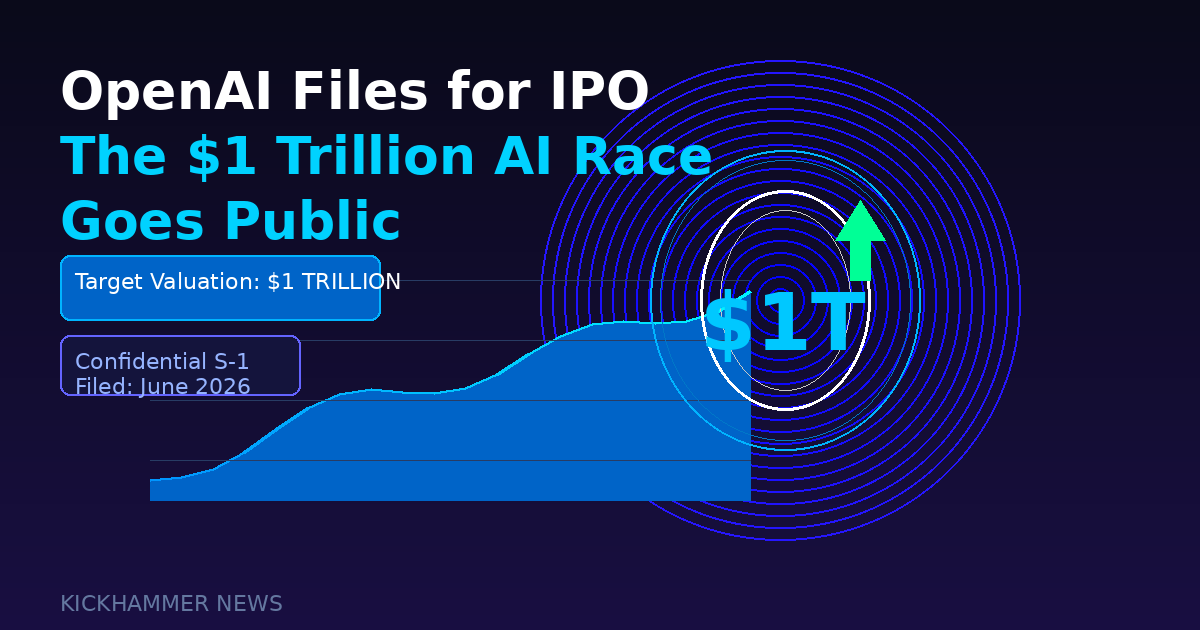
When OpenAI quietly submitted a confidential S-1 registration statement to the U.S. Securities and Exchange Commission last week, it didn’t just mark a corporate milestone — it signaled that the AI industry’s most consequential chapter is about to be written in public markets. For the first time in history, both of the world’s leading large language model companies are simultaneously in the IPO pipeline. The race to artificial general intelligence has gone Wall Street.
A Filing That Was Always Going to Leak
OpenAI announced its confidential S-1 submission with characteristic bluntness: “We recently submitted a confidential S-1. We expect it to leak so we’re just announcing it.” The filing, confirmed on June 8-9, 2026, sets the stage for what could be the most closely watched public offering since Meta’s 2012 debut — though this time the stakes, and the losses, are several orders of magnitude larger.
The company is targeting a valuation of roughly $1 trillion. That number would have seemed fantastical even eighteen months ago. Today, it feels almost modest given the pace at which AI revenue is scaling.
Goldman Sachs and Morgan Stanley have been tapped to manage the offering, which management has flagged could arrive as early as September 2026, with flexibility stretching into Q4 depending on market conditions. OpenAI was careful to note that “it may be a while” given there are strategic advantages to remaining private — but filing the S-1 preserves the option to move quickly if circumstances call for it.
The Numbers Behind the Narrative
The financial picture OpenAI will have to present to public investors is genuinely extraordinary on both ends of the ledger.
Revenue growth has been nothing short of historic. OpenAI went from approximately $2 billion in annualized revenue at the end of 2023 to roughly $25 billion by February 2026 — a 12.5x increase in barely over two years. ChatGPT crossed 1 billion monthly active users in early 2026, and enterprise adoption has accelerated as companies embed GPT-series models into core workflows. The API business, which seemed like a side project at the company’s founding, is now one of the most significant developer platforms ever built.
And yet the losses are eye-watering. Internal projections suggest management expects a $14 billion loss in 2026. Profitability, by current forecasts, isn’t expected until 2029. The compute bills required to train and serve frontier models at global scale are simply enormous, and OpenAI is not alone in this predicament. The entire frontier AI industry is burning cash at a rate that makes SaaS-era burn rates look quaint.
What will matter to public market investors, then, is not current profitability but the trajectory — and by that measure, OpenAI can tell a compelling story. Revenue is growing faster than infrastructure costs. The moat around GPT-branded AI, particularly among consumers, is real. And the enterprise pipeline continues to expand.
Racing Anthropic to the Bell
The timing of OpenAI’s filing is no accident. In late May 2026, Anthropic raised $65 billion in a Series H round at a $965 billion post-money valuation, briefly surpassing OpenAI in startup-land valuations and filing its own confidential S-1 in early June. The prospect of Anthropic listing first — and potentially claiming the narrative of being the “responsible AI company” that debuted on public markets — created pressure for OpenAI to accelerate its own timeline.
For decades, tech IPO rivalries were measured in months or years. This one has collapsed into weeks. Both companies filed confidential S-1s within roughly the same fortnight, making this the first time two leading AI labs have entered the public offering pipeline simultaneously.
The competitive dynamic matters for investors too. Anthropic has been growing its run-rate revenue to approximately $47 billion as of June 2026 — actually exceeding OpenAI’s figure — partly by winning enterprise deals that emphasize safety, auditability, and the constitutional AI approach that has become a differentiator among regulated industries like healthcare, finance, and government. OpenAI, meanwhile, has the consumer mindshare advantage: ChatGPT remains the dominant brand in public consciousness, and the pipeline of products built on OpenAI’s API includes virtually every corner of the tech industry.
Neither company has a clean path to dominance. Both will be scrutinized by public investors who will want answers to hard questions about compute dependency (read: NVIDIA), regulatory exposure across multiple jurisdictions, and whether the extraordinary revenue growth rates can be sustained as the market matures.
What the IPO Would Mean for the Industry
If OpenAI achieves its target valuation, it would immediately rank among the most valuable publicly traded companies in history. For context, a $1 trillion market cap would place it ahead of Meta, TSMC, and Berkshire Hathaway at current prices. Only Apple, NVIDIA, Microsoft, Google, and Amazon have crossed that threshold — companies that took decades to get there.
The implications for the broader AI ecosystem would be profound. Public markets would create a pricing mechanism for AI company valuations that private rounds cannot fully provide. Startup founders, venture investors, and acquirers would gain clearer benchmarks. And the liquidity event would unlock billions of dollars in paper wealth for employees at both OpenAI and Anthropic, some of which will undoubtedly flow back into new AI ventures — accelerating the next wave of the industry.
There is also the question of what a public market listing does to a company’s strategic options. Going public introduces quarterly earnings pressure, activist investor risk, and scrutiny that private companies rarely face. OpenAI has acknowledged as much in noting that some things it wants to do may be “easier as a private company.” The tension between long-horizon research goals and short-term shareholder expectations will be one to watch.
The AI Decade Enters Its Public Phase
The first half of this decade was defined by private capital pouring into AI companies at increasingly staggering valuations. The second half appears poised to be defined by the reckoning that comes when those companies must justify their worth to ordinary investors, pension funds, and the public markets.
OpenAI’s S-1 is the opening act. When the prospectus goes fully public — with audited financials, risk factor disclosures, and the full weight of securities law behind it — the AI industry will face the kind of scrutiny it has largely avoided while operating in the private sphere.
Whether that scrutiny reveals these companies as the generational infrastructure plays their backers believe them to be, or as a massively overcapitalized bet on technology that has yet to prove sustainable unit economics, will be one of the defining business stories of the decade. The filing has been submitted. The clock is ticking.
Sources: OpenAI, SEC filing confirmation, CNBC, Fortune, Bloomberg, TechCrunch


