For five years, the AI industry has been obsessed with a single question: how capable can these models get? Now, OpenAI has signaled that the next great frontier isn’t building more powerful AI — it’s getting the AI we already have off the whiteboard and into the actual machinery of global business.
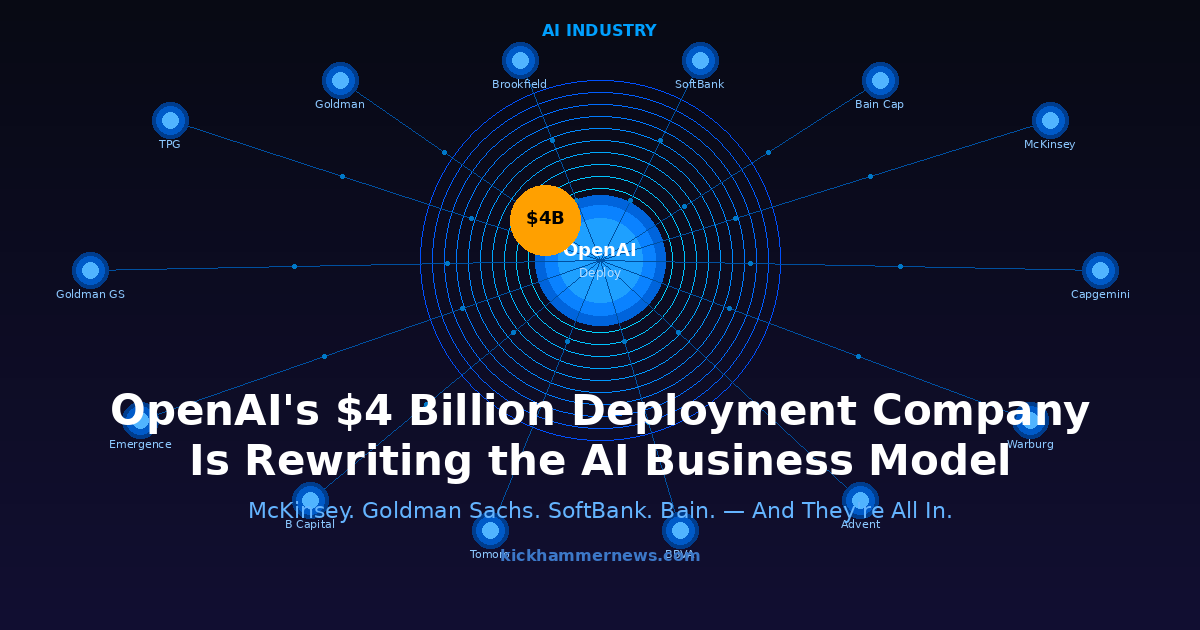
On May 12, 2026, OpenAI announced the launch of the OpenAI Deployment Company, a majority-owned subsidiary backed by more than $4 billion in initial investment from 19 of the world’s most powerful financial institutions, private equity giants, and management consultancies. The investors include TPG, Advent, Bain Capital, Brookfield, Goldman Sachs, SoftBank, Warburg Pincus, McKinsey & Company, Bain & Company, and Capgemini, among others. To anchor day-one operations, OpenAI simultaneously announced the acquisition of Tomoro, an applied AI consulting and engineering firm that will contribute approximately 150 forward-deployed engineers and AI deployment specialists from the outset.
The message is unmistakable: OpenAI is no longer content to be a model and API provider waiting for customers to figure out how to use it. It is moving directly into the business of transformation itself.
What the Deployment Company Actually Does
The OpenAI Deployment Company — already being nicknamed “DeployCo” by industry observers — is built around a core premise that has quietly become one of the most significant problems in enterprise technology: the gap between buying access to AI and actually deriving value from it.
According to Stanford’s 2026 AI Index Report, organizational AI adoption has reached 88 percent. Nearly every large company has AI pilots running somewhere. And yet the share of companies reporting transformative, bottom-line impact remains stubbornly low. The tools are there. The implementation capacity isn’t.
The Deployment Company is structured to close that gap. Working alongside enterprise clients, it will help organizations identify where AI can make the biggest measurable impact in their specific operations, redesign the workflows and organizational infrastructure to support AI at scale, and convert early-phase gains into durable systems that don’t evaporate when a pilot team moves on to the next project.
This is not ChatGPT with a consulting fee. The Forward Deployed Engineers brought over from the Tomoro acquisition are specialists in embedding AI into complex operational contexts — supply chains, financial workflows, clinical pipelines, legal systems — where a poorly designed AI integration doesn’t just underperform, it fails expensively.
Why This Changes Everything About the AI Business Model
For most of its existence, the AI industry has operated on a software-as-a-service logic: build the model, offer API access, and let customers build the rest. This model has been remarkably profitable for companies like OpenAI, Anthropic, and Google, but it has also created a ceiling. Enterprise customers willing to pay for AI access are a much smaller group than enterprise customers willing to pay for AI results.
The Deployment Company is OpenAI’s bet that the next wave of AI revenue will be services revenue, not subscription revenue — closer to what Accenture or McKinsey charges to run a transformation program than what AWS charges per API call.
The investor lineup reflects this logic clearly. Bain Capital and Bain & Company are separate entities, but both are involved, which means the firm’s private equity and management consulting arms are both betting that AI-as-deployment-service is where the margin lives. Goldman Sachs’ participation signals that Wall Street views enterprise AI implementation as a major capital opportunity, not just a sector to watch from the sidelines. McKinsey’s involvement is particularly notable: the firm has spent decades selling business transformation services, and is now betting that the future of that industry runs through being an OpenAI deployment partner rather than an independent advisor.
BBVA, the Spanish banking giant and one of the most tech-forward financial institutions in Europe, joined as a founding enterprise partner — in a dual role as both investor and early deployment customer. That kind of client-investor structure is a strong signal of confidence. Companies don’t put capital into ventures they expect to fail, and they don’t announce it publicly unless they want peers to take note.
The Tomoro Acquisition: Deployment Engineering as a Competitive Moat
The acquisition of Tomoro is easy to overlook in the shadow of the $4 billion headline, but it may be the most strategically important piece of the announcement.
Applied AI consulting is a scarce discipline. It requires engineers who understand AI model behavior deeply enough to anticipate failure modes in production, plus operational expertise to navigate the change management challenges that arise when AI disrupts existing workflows. These are not skills that scale by hiring more data scientists. They accumulate slowly through project experience, and firms that have built those teams are genuinely difficult to replicate.
Tomoro’s 150-person team represents years of accumulated deployment expertise — institutional knowledge about what actually goes wrong when enterprises try to build AI-native workflows, and how to fix it. By acquiring that team and folding it into the Deployment Company from day one, OpenAI is buying a head start that rivals would need years and dozens of failed client engagements to replicate.
It also sets up an interesting competitive dynamic with the established management consulting industry. McKinsey and Bain are partners in the Deployment Company — but OpenAI is simultaneously building an in-house engineering workforce that, at scale, could reduce what enterprises need to buy from traditional consultants. The relationship between OpenAI and its consulting partners may be collaborative today and competitive tomorrow.
The Broader Shift: From AI Development to AI Deployment
The launch of the Deployment Company is a data point in a much larger transition that has been building throughout 2026. The year began with AI models capable of scoring near-perfect marks on coding benchmarks that were considered impossibly hard just two years ago. That technical progress has not slowed. But the conversation in boardrooms and investment firms has quietly pivoted from “how good will AI get?” to “how do we actually make money from it?”
Several signals point in the same direction. Amazon has restructured its corporate workforce around agentic AI workflows, eliminating 16,000 positions while redirecting that capital into infrastructure investment. Novo Nordisk partnered with OpenAI in April not to explore AI but to integrate it end-to-end across drug discovery, manufacturing, and commercial operations — with full deployment targeted by the end of 2026. Airbnb disclosed that AI now writes 60 percent of its new code. These aren’t pilot programs. These are structural changes.
What OpenAI is doing with the Deployment Company is institutionalizing this transition — creating the professional services infrastructure to accelerate it across industries that haven’t moved as fast as tech and pharma.
The timing is notable too. Google I/O 2026 begins on May 19, where Google is widely expected to announce a major new version of Gemini alongside expanded agentic AI capabilities. The week of May 19 could become the moment that the entire AI industry collectively shifts its public positioning from “here are our models” to “here is how your business runs on them.”
OpenAI got there first with a $4 billion institution-building move.
What This Means for Businesses — and for the AI Industry
For enterprise leaders, the Deployment Company creates a new option that didn’t exist before: direct engagement with the model creator itself, backed by the deep-pocket investors and operational expertise needed to manage a real transformation program. Companies that have struggled to extract value from off-the-shelf AI tools now have a purpose-built partner with a financial stake in getting the implementation right.
For the broader AI industry, the move raises a competitive question. If OpenAI is now a deployment services company, does Anthropic need to build one too? Does Google? The model-plus-API approach may remain sufficient for developer-facing markets, but in enterprise, the services layer is increasingly where the commercial relationship deepens and the switching costs accumulate.
The AI race has entered a new phase. It is no longer purely about who builds the most capable model. It is about who builds the most capable organization for deploying that model at scale — inside the messy, legacy-entangled, politically complex reality of large enterprises.
OpenAI just announced it intends to win that race too.
Sources: OpenAI official announcement | PYMNTS.com | The Next Web | BBVA | Stanford AI Index 2026


