August 12, 2026
The countdown has begun. OpenAI — the creator of ChatGPT and the company that ignited the modern AI revolution — is weeks away from filing its public S-1 prospectus with the SEC, setting the stage for what could become the most anticipated and consequential technology IPO in history. With a targeted September 2026 listing and a valuation that could surpass $1 trillion, OpenAI’s debut on public markets represents a defining moment for the AI industry and for anyone who has watched the company reshape the technology landscape since ChatGPT launched in late 2022.
From Nonprofit to Public Company: A Remarkable Transformation
OpenAI’s journey to an IPO is unlike any in Silicon Valley history. The company was founded in 2015 as a nonprofit research lab, backed by a group of technologists — including Elon Musk and Sam Altman — committed to developing artificial intelligence safely for the benefit of humanity. For years it operated without commercial intent, publishing landmark research and releasing models freely.
That model changed dramatically. In October 2025, OpenAI completed a sweeping restructuring, converting from a nonprofit into OpenAI Group PBC — a public benefit corporation. The transformation unlocked the ability to raise conventional equity capital and, ultimately, to go public. But the nonprofit’s DNA wasn’t erased. The OpenAI Foundation, the reconstituted nonprofit parent, retained a 26% stake in the new company along with a warrant and — critically — the sole power to appoint and remove the entire board of OpenAI Group PBC at any time.
This structure will be one of the most closely scrutinized sections of the upcoming public S-1. Investors who buy shares in OpenAI will be stepping into an arrangement with no precedent in public markets: a company where the mission can, by charter, legally override shareholder value.
The Numbers: Stunning Growth, Staggering Losses
OpenAI’s financials, reported through confidential filings and pre-IPO disclosures, tell a story of extraordinary scale paired with formidable financial challenges.
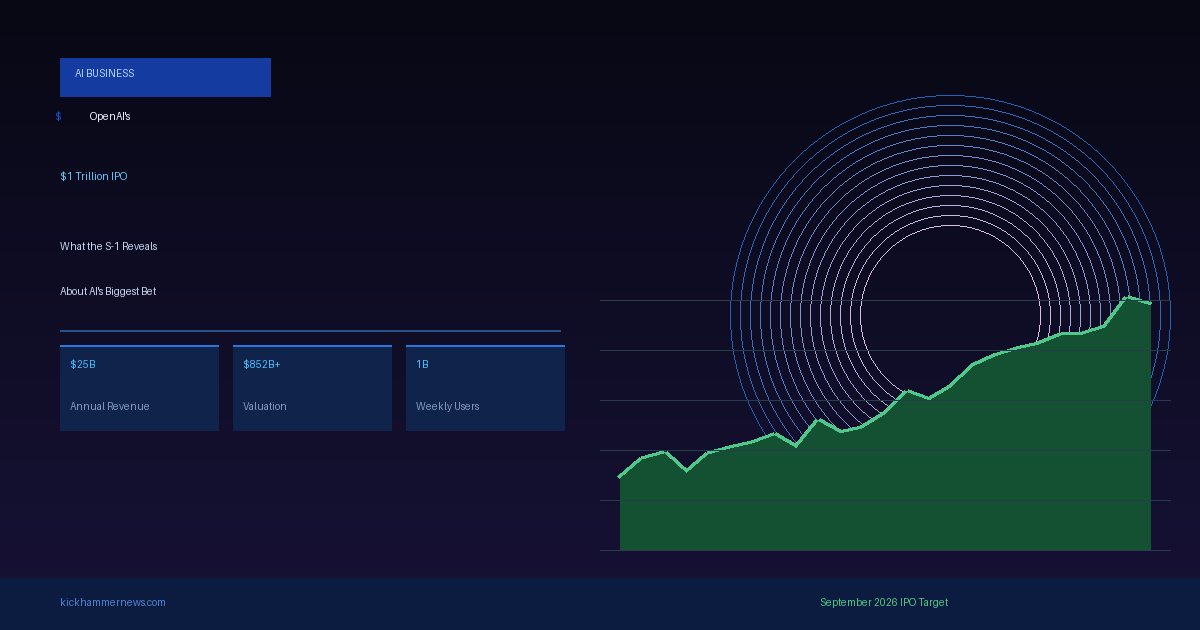
On the revenue side, the company is generating approximately $2 billion per month, putting it on a $25 billion annualized run rate as of early 2026. Those numbers have climbed sharply: OpenAI ended 2025 at roughly $20 billion in annualized revenue, meaning it has added billions in annual recurring revenue in just the first months of this year. The company counts 50 million consumer subscribers and 9 million business users, while ChatGPT now serves approximately 1 billion weekly active users worldwide.
But OpenAI is burning through cash at a rate that will test investor patience. The company loses an estimated $1.22 for every dollar it earns, with internal projections pointing to a $14 billion loss in 2026 alone. Cumulative losses are expected to reach $44 billion before the company reaches profitability — a milestone not projected to arrive until 2029. The math reflects the enormous cost of training frontier AI models, running inference at scale, and the relentless capital expenditure required to stay ahead in one of the most competitive technology races in history.
Despite this, market appetite appears robust. OpenAI’s most recent private-market valuation stood at approximately $852 billion, and underwriters Goldman Sachs and Morgan Stanley are reportedly targeting a public offering valuation that could exceed $1 trillion.
What Makes This Different From Every Other Tech IPO
Several features of OpenAI’s offering set it apart from even the largest technology listings of the past decade.
The governance structure is the most unusual. Through Class N Common Stock, the OpenAI Foundation retains the right to appoint and remove OpenAI Group PBC’s entire board at any time. The Foundation also holds prior written approval rights over mission amendments, charter changes, major asset sales, and the issuance of new voting stock. On matters of safety and security, the board is legally required to prioritize the company’s mission over shareholder returns — a provision that is enforceable and has no equivalent in American corporate law.
For institutional investors accustomed to standard governance rights, this is a significant concession to demand. But proponents of the structure argue it’s precisely what keeps OpenAI honest — that a company developing artificial general intelligence needs a check on pure profit motivation that no ordinary corporate board could provide.
Then there is the competitive environment. OpenAI operates in a landscape where Google, Meta, Anthropic, xAI, Mistral, and a growing fleet of open-source models are all competing for the same customers. Model pricing has dropped precipitously: OpenAI’s own GPT-5.6 Luna cut prices by 80% in recent months, to $0.20 per million input tokens. Lower prices expand the market but compress margins, and the race to maintain frontier model leadership requires constant reinvestment.
Why the Timing Matters
The OpenAI IPO arrives at a moment when the AI industry is simultaneously at its peak of public excitement and navigating its first serious wave of regulatory and financial scrutiny. The EU AI Act’s transparency rules came into force in early August 2026. The United States is rolling out its own framework for AI governance. And Wall Street is beginning to ask harder questions about AI monetization: not just whether companies can generate revenue from AI, but whether they can do so profitably.
OpenAI’s public filing will offer the first comprehensive look at the unit economics of the AI industry’s dominant commercial player. What does it actually cost to serve a ChatGPT subscriber? What is the gross margin on API calls? How much of the $2 billion in monthly revenue flows from consumer subscriptions versus enterprise contracts versus API access? These questions, unanswerable from the outside until now, will have answers in the S-1.
The timing also comes as OpenAI faces governance and reputational questions. The nonprofit-to-PBC conversion was contentious, drawing criticism from co-founder Elon Musk and raising concerns among AI safety researchers about whether commercial pressures would distort the company’s priorities. The IPO will intensify that scrutiny, transforming board decisions into fiduciary events subject to SEC oversight.
What Happens Next
The public S-1 is expected to hit SEC EDGAR within weeks — potentially before the end of August — giving analysts, investors, and competitors their first detailed look at the full financial picture. If the SEC review proceeds on schedule, a listing in mid-to-late September 2026 remains possible, though some internal signals suggest the window could slip into early 2027.
For the broader AI industry, the OpenAI IPO is a referendum on whether the promises made during the AI boom can translate into durable public-market businesses. It is also, almost certainly, the beginning of a wave: a successful OpenAI offering would likely accelerate IPO plans at Anthropic, Mistral, and others.
In the meantime, all eyes are on the S-1. When it drops, it will be one of the most-read corporate documents in the history of technology.
Sources: SEC filings, Goldman Sachs / Morgan Stanley deal reports, OpenAI pre-IPO financial disclosures, Techjournal.org, Buildfastwithai.com, Startuphub.ai, Evermx.com, Buildmvpfast.com, Decodethefuture.org, Useluminix.com, Techtimes.com, OpenTools.ai, Yahoo Finance


