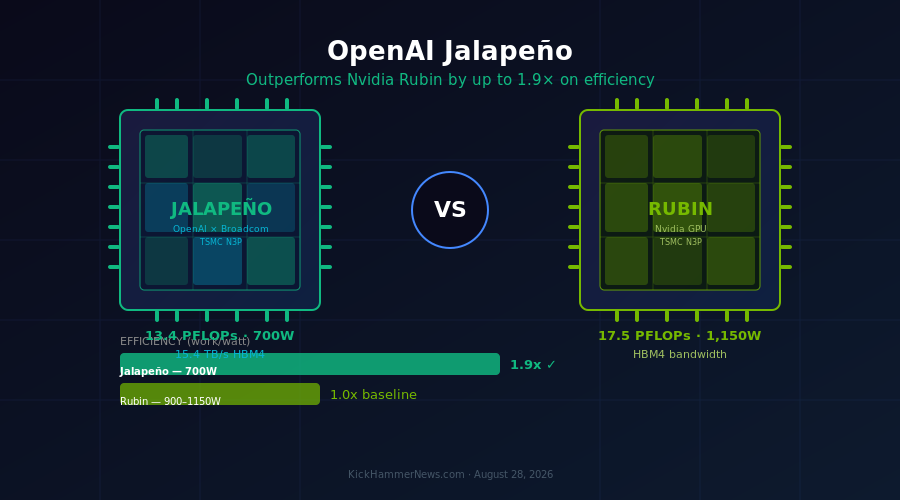
OpenAI just became a chip company. The AI lab unveiled detailed benchmarks this week for Jalapeño, its first custom-designed inference accelerator — and the numbers are eye-opening: 1.5x to 1.9x more work per watt than Nvidia’s flagship Rubin GPUs, built in just 16 months from scratch with Broadcom on TSMC’s latest 3-nanometer process.
For an industry that has spent years dependent on Nvidia’s silicon, the arrival of a credible in-house alternative from the world’s most prominent AI lab marks a turning point.
The Chip That Could Shake the Industry
Jalapeño — the name is an internal OpenAI codename — is an Application-Specific Integrated Circuit (ASIC) designed from the ground up for large language model inference, the computationally intensive process of generating responses to user queries. Unlike training chips, which must handle everything from gradient calculations to matrix decompositions, inference chips can be laser-focused on the specific math that makes LLMs tick. That specialization is precisely where Jalapeño excels.
SemiAnalysis, the semiconductor research firm that published the first comprehensive technical breakdown, describes Jalapeño as “a general-purpose inference ASIC” — not narrowly optimized for OpenAI’s own models, but competitive across a wide range of workloads. In the benchmarks released alongside the analysis, Jalapeño outperformed Nvidia, AMD, and Google accelerators on several inference metrics simultaneously.
Inside the Hardware
The chip’s B0 stepping — the production-ready revision — delivers 13.4 petaflops of MXFP4 compute at a thermal design power of 700 watts. By comparison, Nvidia’s Rubin compute die hits 17.5 petaflops in the same precision format, but draws between 900 and 1,150 watts to get there.
That gap in power consumption is where Jalapeño wins the efficiency argument. Raw peak compute favors Rubin on paper, but data centers care about performance-per-watt and performance-per-dollar. Cooling infrastructure, power delivery, and energy costs all scale with wattage — which means a chip that does more with less heat is worth far more to an operator than its teraflops alone suggest.
Jalapeño pairs its compute tile — manufactured on TSMC’s N3P node — with an N3E I/O chiplet and six stacks of HBM4 memory totaling 216 gibibytes at 15.4 terabytes per second of bandwidth. Memory bandwidth is often the binding constraint for LLM inference, since the models must stream billions of parameters from memory during every generation step. At 15.4 TB/s, Jalapeño is competitive with the highest-bandwidth memory configurations available today.
On real workloads, the results are compelling: the chip posts 700+ tokens per second per user on DeepSeek R1 and approximately 1,400 tokens per second per user on GPT-OSS, OpenAI’s open-weights model. Both figures represent meaningful performance for a first-generation chip.
From Idea to Silicon in 16 Months
Perhaps as impressive as the chip’s performance is how quickly it came to exist. OpenAI began hiring the team in mid-2024 and reached manufacturing tape-out — the point at which chip designs are sent to the fab for production — in roughly 16 months. That’s an extraordinary timeline for a first-generation custom ASIC, a category of project that typically takes three to five years for established companies with mature chip design organizations.
The partnership with Broadcom was central to the speed. Broadcom is one of the world’s leading chip designers and a major player in custom silicon for hyperscalers — Google’s TPUs, for instance, are manufactured through a similar arrangement. OpenAI tapped Broadcom’s existing infrastructure, toolchains, and relationships with TSMC to accelerate a project that would have taken far longer had the lab built an in-house chip design organization from scratch.
What This Means for Nvidia
Nvidia has built one of the most durable competitive moats in technology: the CUDA software ecosystem. For more than a decade, AI researchers and engineers have written code that runs on CUDA, making Nvidia GPUs the default substrate for nearly all AI workloads. Even when competing chips offer better raw performance or efficiency, switching costs — rewriting and revalidating software stacks — have kept customers on Nvidia hardware.
Jalapeño is unlikely to dissolve that moat overnight. But it represents something important: a proof of concept that a well-resourced AI lab can design inference silicon that outpaces Nvidia on efficiency metrics in roughly the time it takes to complete a standard graduate program.
More significantly, OpenAI is not alone in this direction. Google has been running TPU inference at scale for years. Amazon has Inferentia and Trainium. Microsoft has Azure Maia. Meta has MTIA. The hyperscale companies that are also Nvidia’s biggest customers have been methodically building alternatives, and with Jalapeño, OpenAI joins that cohort — with the added distinction of publishing detailed comparative benchmarks that make the efficiency story concrete.
Nvidia’s response, for now, is financial. Jensen Huang announced a $96 billion quarter as the Jalapeño benchmarks circulated, a reminder that Nvidia’s business remains healthy even as competitors encroach. But the company also announced price hikes of more than 15% on Rubin and Blackwell server systems starting in early 2027, driven partly by soaring DRAM costs — a dynamic that may accelerate the economics of custom silicon for customers who can afford the investment.
The Broader Shift: From Buying Compute to Building It
The arc of the AI hardware story is bending toward vertical integration. The companies spending the most on compute — OpenAI, Google, Meta, Amazon, Microsoft — are increasingly the same companies designing the chips that run it. Each has different motivations: some want cost control, some want performance advantages on proprietary architectures, some want supply chain independence from Nvidia.
Jalapeño is OpenAI’s entry into that club. And unlike some custom chip programs that exist primarily as negotiating leverage with Nvidia, OpenAI is publishing the benchmarks and inviting scrutiny. The numbers, at least in the initial SemiAnalysis deep dive, hold up.
For the AI industry, the implications are layered. Researchers and developers may see faster, cheaper inference as OpenAI deploys Jalapeño at scale across its data centers. Enterprises building on OpenAI’s API could benefit from improved latency and throughput. And the broader signal — that frontier AI labs can build competitive silicon on compressed timelines — will pressure every chip company in the inference market to sharpen its own efficiency story.
The jalapeño pepper, for what it’s worth, is known for delivering intense heat in a compact package. OpenAI’s chip, it seems, was named appropriately.
Sources: SemiAnalysis, AI Weekly, WCCFTech, TechCrunch, OpenAI Newsroom


