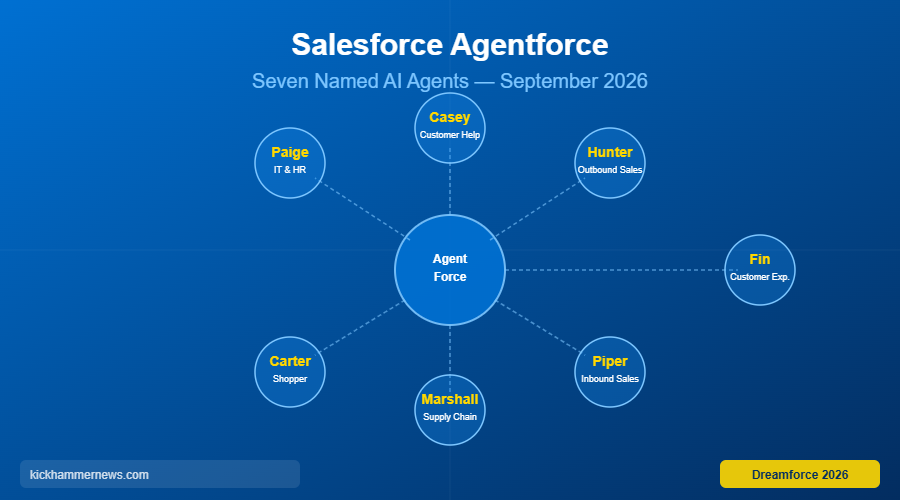
Salesforce has made its most ambitious move yet in the enterprise AI agent market, releasing seven named Agentforce agents just days before Dreamforce 2026. Each agent carries a distinct name and persona, handles a specific business domain, and operates autonomously within a company’s existing data, permissions, and security setup. The launch represents a significant shift in how enterprise software is being designed — away from feature-packed platforms and toward a roster of purposeful AI workers.
From Platforms to Personas: The Agentforce Strategy
The traditional CRM playbook involved configuring dashboards, hiring specialists to interpret data, and managing workflows that required constant human intervention. Salesforce is betting that named, role-specific AI agents can replace much of that overhead. Rather than asking businesses to learn a new interface, Agentforce puts AI to work within the tools and processes companies already rely on — Slack, email, web chat, service portals, and more.
The seven agents each have a defined job title:
Casey is the customer help agent. She resolves service issues across voice, SMS, WhatsApp, and web chat using pre-built support for FAQs, returns, account management, and human escalation. Casey is built for the frontline: handling the volume of inbound queries that would otherwise overwhelm human teams.
Paige handles IT and HR employee requests. She resolves issues across Slack and internal portals, giving employees a single point of contact for the kinds of requests — password resets, expense approvals, benefits questions — that typically consume large portions of support team bandwidth.
Carter is the shopping agent. Embedded in retail and e-commerce contexts, Carter helps shoppers discover and compare products, answers questions in real-time, and enables in-chat checkout without requiring the customer to leave the conversation.
Hunter is the outbound sales agent. Described by Salesforce as its most sophisticated release, Hunter works a sales pipeline from initial research through outreach, collaborating with human sellers over weeks or months rather than handling a single transaction. Hunter is still in pilot and is the first agent to use Salesforce’s new long-horizon runtime — a system that can pursue business goals across extended timeframes rather than a single session.
Piper handles inbound pipeline generation, turning web visits and inbound inquiries into qualified sales opportunities without waiting for a human to pick up the lead.
Marshall manages supply chain operations, coordinating procurement, inventory alerts, and supplier communications.
Fin covers customer experience, handling complex support cases that require pulling from product knowledge, customer history, and policy documentation simultaneously.
The Long-Horizon Runtime: A New Kind of Agent Infrastructure
Perhaps the most technically significant announcement alongside the named agents is the long-horizon runtime powering Hunter. Most AI agents today are reactive: they respond to a query, complete a task, and conclude. Long-horizon agents are persistent — they hold state, revisit goals, adjust strategies, and continue working in the background while human employees do other things.
Salesforce’s long-horizon runtime allows Hunter to track a prospect over a sales cycle spanning weeks, monitor signals like email opens, website revisits, and job changes, and adapt its outreach accordingly. This is qualitatively different from a chatbot or a workflow automation tool. It more closely resembles a digital employee that needs to be managed, monitored, and occasionally redirected.
The runtime also raises questions around governance. When an AI agent is working autonomously over weeks, organizations need clear controls around what actions it can take, what data it can access, and when it must escalate to a human. Salesforce says the agents operate within existing Customer 360 permissions and business rules, meaning an agent cannot take an action a human employee in the same role wouldn’t be authorized to take.
Why Named Agents Matter
The naming strategy is deliberate. Salesforce is not just building AI tools — it’s building a brand of AI colleagues. By giving agents names, personas, and defined scopes, the company makes them easier for non-technical staff to understand, request, and trust.
There is also a practical governance benefit. A named agent with a defined scope is easier to audit than a general-purpose AI assistant. If Casey makes a mistake in a customer interaction, it is clearer where to investigate. If Hunter pushes a deal at an inappropriate time, the long-horizon log provides a trail. Named agents are bounded agents.
This mirrors a broader industry trend. Enterprise buyers are increasingly wary of open-ended AI tools that do too much and explain too little. Purpose-built, scoped agents — even if less capable in raw terms — are often a more practical fit for regulated industries and risk-averse organizations.
Competitive Positioning
The launch comes as the enterprise AI agent market has become intensely competitive. Microsoft’s Copilot ecosystem now spans Teams, Outlook, SharePoint, and Dynamics 365. ServiceNow has deployed agents across IT service management. Workday and SAP have introduced AI workers for HR and finance respectively.
What distinguishes Salesforce’s approach is depth of CRM integration. Agentforce agents are not standalone tools layered on top of Customer 360 — they are built from the inside, inheriting the full context of a company’s customer relationships, sales history, and service records. For organizations already deeply embedded in the Salesforce ecosystem, the barrier to deployment is significantly lower than adopting a competing agent platform.
The timing relative to Dreamforce 2026 also signals intent. Dreamforce draws hundreds of thousands of Salesforce customers and partners annually. Releasing the seven named agents beforehand ensures that partners can begin exploring integrations and customers arrive at the conference with real questions to ask — shifting the conversation from demonstration to deployment.
What Comes Next
Six of the seven agents are generally available now. Hunter remains in pilot, with Salesforce targeting broader access later in Q4 2026 once the long-horizon runtime has been validated at scale. The company has also indicated that the Agentforce platform will support custom agents built by enterprises and partners using the same infrastructure — meaning the seven named agents are the beginning of a catalog, not its entirety.
For enterprise buyers evaluating AI agent platforms, the Salesforce announcement underscores a key principle: the value of an AI agent is not just in what it can do, but in how clearly it is scoped, how well it integrates with existing data, and how reliably its actions can be explained. With Casey, Paige, Carter, Hunter, Marshall, Piper, and Fin, Salesforce is making a clear argument that named, purposeful agents are the next evolution of enterprise software.


