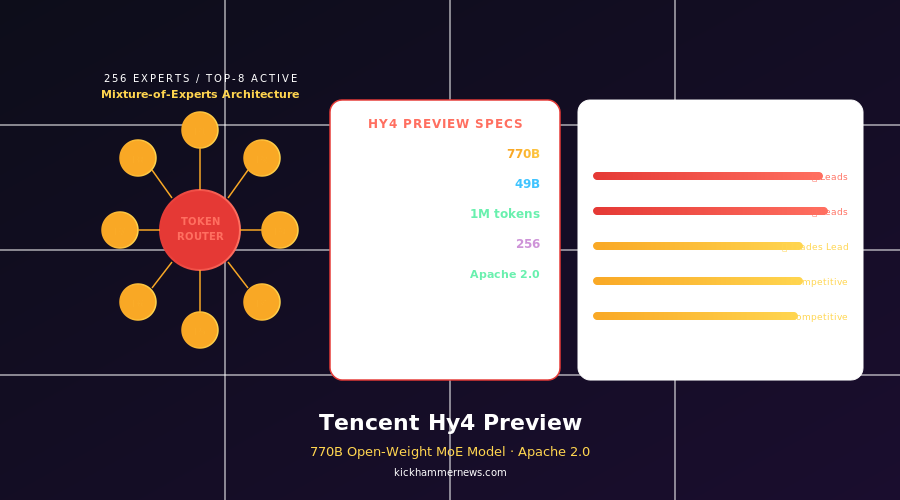
The frontier AI model race has a new serious entrant, and it’s coming from Tencent. The company this week released Hy4 Preview, a 770-billion-parameter Mixture-of-Experts language model available under the Apache 2.0 license — meaning anyone can download it, deploy it commercially, and fine-tune it without paying Tencent a cent. The release represents the most significant open-weight model challenge to the dominance of Western AI labs since DeepSeek shook the industry earlier this decade.
The Numbers
Hy4 Preview’s architecture is built around a principle that has become standard practice for large-scale efficient models: total parameter count and active parameter count are very different things. The model has 770 billion total parameters, but on any given token, it activates only 49 billion — a sparse Mixture-of-Experts design where a routing mechanism selects 8 of 256 experts for each inference pass.
The practical result is a model with the quality headroom of something approaching 770B scale, but the inference cost profile of a 49B dense model. For teams with GPU budgets shaped by reality, that’s a meaningful difference.
The context window is 1 million tokens — enough to fit a substantial codebase, a full legal document set, or hours of meeting transcripts in a single prompt. A native speculative decoding layer (what Tencent calls MTP) accelerates generation. An FP8-quantized variant ships alongside the full model, reducing memory requirements while preserving most of the quality gains.
How It Performs
Internal benchmarks from Tencent, and independent evaluations published by MindStudio, place Hy4 Preview in a three-way contest with GLM 5.3 (Zhipu AI) and Kimi K3 (Moonshot AI) for leadership among open-weight Chinese models. In long-context tasks and code refactoring specifically, Hy4 Preview leads the field. On agentic benchmarks — tasks requiring multi-step planning and tool use — it trades the top position across categories with its two main competitors.
Against the closed frontier, Hy4 Preview runs behind Claude Opus 5 and GPT 5.6 Sol on the hardest reasoning tasks. But that’s a bar that no open-weight model has cleared yet, and “close enough to be competitive on production workloads while fully self-hostable” is a useful position to occupy.
For developers who’ve followed the Chinese open-weight model ecosystem, the results confirm a pattern: Tencent’s Hunyuan team has been quietly building serious infrastructure, and Hy4 Preview is the most capable result of that work to date.
Why Apache 2.0 Changes the Conversation
The licensing choice matters as much as the model itself. Apache 2.0 is as permissive as open-source licenses get: commercial use, modification, and redistribution are all allowed. There are no usage restrictions attached, no research-only clauses, no requirements to share modifications back with Tencent.
This puts Hy4 Preview in a different category from models released under custom licenses that prohibit certain commercial applications or cap allowable revenue. For a startup building a product on top of a foundation model, or an enterprise that needs to fine-tune on proprietary data and deploy in an air-gapped environment, Apache 2.0 is the only license that works without a lawyer.
Weights and FP8 variants are available on Hugging Face, ModelScope, GitCode, and CNB. Fine-tuning recipes and deployment guides ship with the release.
The Deployment Question
Hy4 Preview is large. Running the full 770B model at FP16 requires approximately 1.5 terabytes of GPU memory — that’s a multi-node setup. The FP8 variant reduces that to roughly 770GB, still requiring serious hardware. For most individual developers and small teams, Hy4 Preview isn’t self-hosted in any practical sense.
But that’s not necessarily the target user. API access is available through Tencent Cloud and OpenRouter at $0.834 per million input tokens and $2.501 per million output tokens — pricing that positions it competitively against commercial alternatives from OpenAI and Anthropic, with the added option to eventually run it yourself if your organization has the infrastructure.
For enterprises with GPU clusters — the kind of organization that was already running LLaMA 3.1 405B on internal hardware — the FP8 variant is a credible upgrade path. The tooling for deployment, including detailed guides for multi-node vLLM configurations, is included in the release.
The Geopolitical Subtext
Every major open-weight model release from a Chinese lab now carries context that pure technical evaluation can’t capture. The global AI market is fragmenting along regulatory and supply-chain lines. Chinese enterprises face increasing restrictions on accessing the latest Nvidia H-series hardware for new purchases. Western enterprises operating in certain regulated sectors face mounting pressure to avoid models from Chinese companies, regardless of their technical merits.
Hy4 Preview is caught in that current. For organizations in markets where Chinese-origin models are acceptable — much of Southeast Asia, parts of Europe, and obviously mainland China itself — it’s a serious option. For organizations subject to stricter data governance requirements or operating in sensitive industries, the vendor’s national origin will be a factor in adoption decisions that no benchmark score can override.
Tencent is clearly aware of this. The Apache 2.0 license, the multi-platform weight distribution, and the inclusion of deployment tooling all read as moves to maximize accessibility and lower the political friction of adoption. Whether that’s enough depends on decisions being made far from the model training run.
What It Means for the Ecosystem
Hy4 Preview’s release continues a trend that has reshaped the AI landscape since late 2024: capable open-weight models are arriving faster than the industry expected, and each release narrows the gap between open and closed systems.
For enterprises evaluating their AI strategy, the practical question is increasingly not “open-source or proprietary?” but “which open-weight model fits our infrastructure and compliance requirements?” Hy4 Preview adds a serious option to that evaluation, particularly for organizations prioritizing long-context performance and code tasks.
For the commercial frontier labs, another 770B Apache-licensed model means more competitive pressure on pricing and a continued erosion of the quality moat they once held. OpenAI and Anthropic both charge for API access in part because they offer capabilities that open alternatives couldn’t match. That argument gets harder to make with every well-executed open-weight release.
The Bottom Line
Tencent’s Hy4 Preview is the most capable open-weight Chinese model released to date, available under the most permissive possible license, with competitive pricing for API access and deployment tooling for self-hosted use. It doesn’t beat the closed frontier on the hardest reasoning tasks, but it leads the open field on the workloads most development teams actually care about: long-context processing, code understanding, and multi-step agentic tasks.
For the right organization in the right regulatory context, it’s the most interesting model release this month.
*Sources: MindStudio Hy4 Preview analysis, TechNode Global, Developers Digest, FelloAI, AI Tools Review*


