October 13, 2026
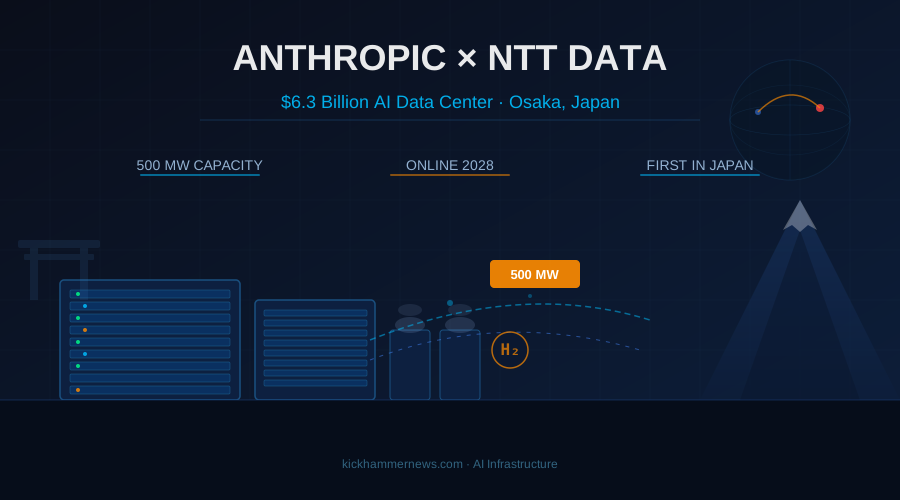
Anthropic is about to plant its most significant flag outside the United States. According to a Nikkei Asia report citing multiple unnamed sources — confirmed by Reuters — NTT Data Group is in the final stages of negotiations to build Anthropic’s first dedicated data center in Japan, located in Osaka Prefecture. The facility would cost up to $6.3 billion in construction alone, span 500 megawatts of capacity, and begin partial operations as early as 2028. If the deal closes — the companies aim to finalize it by the end of Japan’s fiscal year, March 2027 — it would be one of the largest AI infrastructure investments in Asian history.
Neither Anthropic nor NTT Data has commented publicly. But the scale of the project, the identity of the parties involved, and the timing relative to Japan’s own AI ambitions make this far more than a routine real estate deal. It is a signal of where the global AI race is heading next.
Why Japan, and Why Now
The answer to why Japan is partly economic, partly geopolitical, and partly a matter of raw necessity.
Japan’s government has committed to ¥32.7 trillion — roughly $210 billion — in public and private investment in data centers, cloud computing, and battery storage by 2035. That policy ambition has created a favorable regulatory climate and a queue of infrastructure partners eager to attract hyperscale AI tenants. Other large facilities are already planned in Akita and Kagoshima. NTT Data, which ranks third globally by data center market share and operates over 1,600 MW of capacity across multiple countries, is a natural anchor.
For Anthropic, Japan is already a growth market. In May 2026, Hitachi agreed to roll out Claude to approximately 290,000 employees — one of the largest single enterprise deployments of any AI assistant. An Osaka data center would reduce latency for Japanese customers, comply more easily with data residency requirements, and support the kind of always-on, low-latency inference that enterprise and government contracts increasingly demand.
There is also a broader pattern at work. Anthropic has reportedly committed to at least 14.8 gigawatts of compute capacity since October 2025. Most of those projects are in the United States. The Osaka facility would represent Anthropic’s first major move to diversify that infrastructure geographically — toward Asia, and toward a market where the company is already winning significant business.
The Power Problem
Five hundred megawatts is not a number the Japanese grid hands over easily.
For context, 500 MW is roughly half the output of a mid-sized natural gas power plant, and large enough to power a city of several hundred thousand homes. Drawing that from an existing urban grid connection would take years of permitting, transmission upgrades, and utility negotiation. The Nikkei report notes that both companies are exploring on-site power generation and fuel cells as a first step — approaches that are slower to build than a grid tie-in but faster to permit.
This power challenge is not unique to Japan. Nearly every hyperscale AI data center announced in 2025 and 2026 has faced some version of it. The computational demands of training and running frontier AI models have outpaced the world’s grid expansion capacity in every major market simultaneously. Anthropic’s Osaka project will require the same kind of creative power engineering — and the same close relationship with local utilities — that its US projects have required.
The fuel cell approach is particularly interesting. Japan has a more developed hydrogen and fuel cell industry than almost any other country, driven partly by Toyota’s long-term investment in hydrogen vehicles and partly by government energy diversification policy. A 500 MW facility powered partly by on-site fuel cells would be unprecedented in scale, but Japan is the country best positioned to attempt it.
What This Means for Anthropic’s Compute Strategy
Anthropic has made no secret of the fact that compute access is existential. The company’s competitive position against OpenAI, Google DeepMind, and Meta depends on its ability to train larger models faster, run inference at lower cost, and serve enterprise customers with the reliability those customers expect.
For most of 2025, that compute has come from Amazon Web Services — Anthropic’s largest investor and primary cloud partner. AWS has committed multi-billion dollar amounts to Anthropic’s cloud usage, and Anthropic’s models run predominantly on Amazon’s infrastructure. But as the AI compute race intensifies, dependence on a single cloud provider creates risk: scheduling conflicts, pricing pressure, and limited ability to run the kinds of infrastructure experiments that a dedicated facility allows.
The Osaka project would give Anthropic something it currently lacks: a large, owned-and-operated data center asset where it controls the hardware stack, the cooling design, the power sourcing, and the physical security. For training frontier models — the most demanding and least interruptible workload in AI — that kind of control is increasingly seen as a strategic necessity, not a luxury.
It also positions Anthropic favorably for Japan’s government AI procurement. Tokyo has made building domestic AI capacity a national priority, and the government has a history of preferring vendors with local infrastructure commitments. Anthropic, with an Osaka data center, becomes a credible partner for defense-adjacent, healthcare, and public service AI contracts that require Japanese-soil data sovereignty.
NTT Data’s Play
For NTT Data, the deal is a chance to leapfrog domestic competitors in the hyperscale AI tenant market.
Japan’s data center market is crowded: NTT competes with SoftBank, KDDI, and Equinix, as well as the domestic arms of AWS, Microsoft Azure, and Google Cloud. Signing Anthropic as a customer for a new 500 MW Osaka facility would be the largest AI-dedicated contract in the company’s history and would anchor NTT’s position as the preferred infrastructure partner for Western AI labs looking to enter the Japanese market.
NTT Data’s existing Osaka facilities — OSK11 and OSK12 — give the company operational experience in the region and relationships with local utilities and municipal authorities that would otherwise take years to build. The Anthropic deal would likely be housed in new purpose-built space adjacent to or near those existing campuses, drawing on the same grid connections and cooling infrastructure already in place.
The Asia AI Infrastructure Race
The Osaka announcement — if it becomes one — arrives in the middle of what is shaping up to be a multi-hundred-billion-dollar infrastructure race across Asia.
Microsoft has committed to $3.3 billion in Singapore and $2.9 billion in Japan. Google has announced $2 billion in Malaysia and a $1 billion Osaka investment of its own. AWS is building in Thailand. Oracle is constructing a 200 MW campus in South Korea. Every major Western AI company is racing to secure compute presence in Asian markets before regulatory, data sovereignty, or competitive pressures make entry harder.
For Anthropic, which has been slower to internationalize its infrastructure than its cloud-native rivals, the Osaka facility is a catch-up move — and a significant one. A 500 MW facility puts it in the same league as Google’s or Microsoft’s Asian buildouts, and positions Claude as a serious contender for the enterprise and government contracts that will define the Asian AI market through the end of the decade.
The deal isn’t signed yet. Neither company has spoken. Power hurdles remain. But if the Nikkei sources are right, the world’s most prominent safety-focused AI company is about to become one of Asia’s largest AI infrastructure investors. For a company that was, barely three years ago, a 150-person research organization arguing that AI needed to slow down, that is quite a turn.
Sources: Nikkei Asia, DataCenter Dynamics, The Next Web, AIWeekly, Reuters


