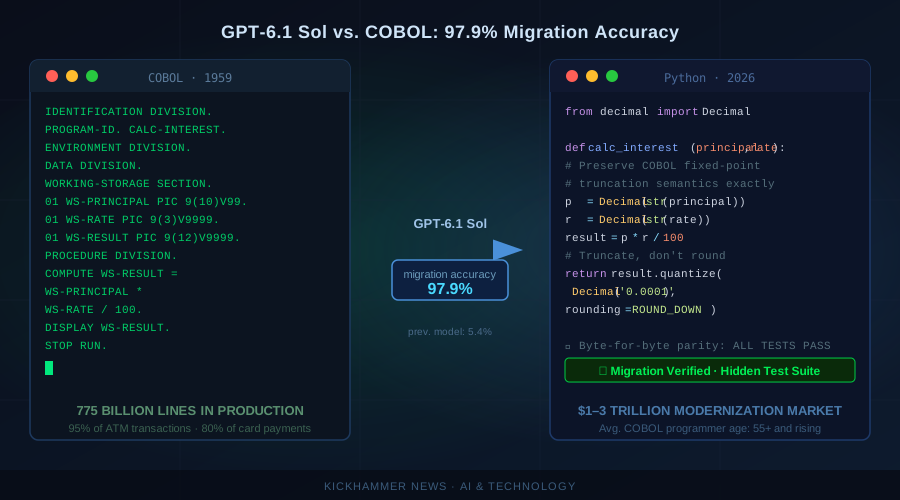
OpenAI’s GPT-6.1 Sol just scored 97.9% on a COBOL migration benchmark — up from 5.4% for its predecessor. The implications for banking, government, and everyone who depends on them are enormous.
Somewhere deep inside the infrastructure of the global financial system, billions of lines of code are quietly doing their job. They process your ATM withdrawal, route your credit card payment, calculate your paycheck tax withholding, and settle trades at exchanges you’ve never heard of. This code is written in COBOL — a programming language invented in 1959, championed by a US Navy admiral named Grace Hopper, and still, improbably, more load-bearing than almost anything built in the decades since.
On October 20, 2026, OpenAI published a research paper and benchmark called Advancing Coding in Low-Resource Programming Languages. The headline result: GPT-6.1 Sol, running at higher reasoning effort, scored 97.9% on OpenAI’s COBOL migration evaluation — a test that asks the model to translate working COBOL programs into modern languages while preserving every detail of their behavior down to the byte. Its predecessor, GPT-5.6 Sol, scored 5.4% on the same test.
That is not an incremental improvement. That is a different category of capability.
Why COBOL Is Still Here — And Why That’s a Problem
To understand why this matters, you have to understand why COBOL never went away. According to IBM, COBOL code handles more than 40% of online banking transactions, 80% of in-person credit card transactions, and 95% of all ATM transactions globally. Estimates put the total amount of COBOL still running in production at somewhere north of 775 billion lines of code — more than the entire volume of Python, JavaScript, and Java code ever written, by some reckonings.
It didn’t survive because it was beloved. It survived because replacing it was always more dangerous than leaving it alone. COBOL is not merely old — it is precisely specified in ways that matter enormously to financial computing. Its fixed-point decimal arithmetic, for instance, truncates rather than rounds when a calculated value doesn’t fit in a fixed number of decimal places. This sounds like a triviality until you’re at a bank where a rewritten system consistently rounds in the opposite direction, and the difference accumulates across hundreds of millions of transactions per day.
A migration that “works” — passes smoke tests, handles edge cases, processes a few thousand records correctly — can still fail in production in ways that take months to detect. That’s why enterprise COBOL modernization projects have a legendary history of blowing past budgets and timelines, or quietly getting cancelled when the CTO who championed them moves on.
The workforce problem compounds it. The average COBOL programmer today is over 55. The community college courses that once taught it have nearly all shut down. Every year, the pool of people who genuinely understand the language’s edge cases gets smaller. By the mid-2030s, estimates suggest the remaining COBOL expertise will be concentrated in a few hundred consultants billing rates that would make a senior ML engineer’s eyes water.
What GPT-6.1 Sol Actually Did
OpenAI’s COBOL benchmark is deliberately unforgiving. Models are given existing COBOL programs and asked to rewrite them in one of five languages: C++, Java, Kotlin, Python, or Rust. The migrated code is then run against a hidden test suite. A migration only counts as successful if every single test passes and the observable outputs match the original COBOL program byte for byte.
This means the model can’t just get the logic roughly right. It has to understand exactly how COBOL handles data types, how its fixed-point arithmetic differs from floating-point, how its record layouts map onto modern data structures, and how its I/O patterns translate into language-appropriate equivalents. Getting 97.9% on this benchmark means GPT-6.1 Sol is handling nearly every one of these gotchas correctly, including the ones that trip up experienced human programmers.
At lower reasoning effort, GPT-6.1 Sol scored 86.6% — still a 16x improvement over GPT-5.6 Sol, and at 39% lower API cost. The model also performed well on a companion benchmark called MultiLangBench, which tests the ability to build a SQLite-compatible database engine across 20 programming languages. COBOL specifically jumped from 10.9% to 72.1% under GPT-6 Astra. GPT-6.1 Sol’s higher COBOL score came from the dedicated migration evaluation rather than this broader test.
OpenAI has published the evaluation methodology and test suite on GitHub. The company is careful to note that production use “still requires expert review and testing against the system’s business rules and dependencies.” In other words: don’t let an AI migrate your bank’s payment processing code this afternoon without a COBOL engineer in the room. But don’t dismiss the headline number either.
The Opportunity Is Staggering
Modernizing COBOL has been estimated to cost financial institutions collectively somewhere between $1 trillion and $3 trillion over the coming decades — primarily in consulting fees, integration work, and the long tail of testing required to verify behavior parity. Much of that cost has been the skilled human labor needed to understand what the COBOL code is actually doing before writing a line of its replacement.
If a model can now generate that replacement code with 97.9% accuracy on behavior-preservation tests, and do it for fractions of a cent per line of code, the economics of this problem change significantly. The bottleneck shifts from code generation to validation: you still need experts who can review the migration, sign off on edge cases, and run the business-rule tests that only domain experts know to write. But the volume of work at the generation layer — which is currently the most expensive part — collapses.
For the financial sector, the implications run deeper than cost. Legacy COBOL systems are an ongoing security liability. Many run on mainframe hardware that vendors are quietly winding down support for. Some have been patched and layered so many times that no living person has a coherent picture of what they actually do. Modernizing them isn’t just a cost-optimization exercise — it’s a risk-management imperative with a ticking clock.
A Caveat Worth Taking Seriously
OpenAI designed and ran both evaluations internally. No third party has independently verified the 97.9% figure. OpenAI has a clear commercial interest in COBOL modernization services — its Rosalind platform, announced earlier this year, already has enterprise partnerships with Novo Nordisk and Moderna for life-science applications. A COBOL modernization push for financial institutions would be a natural adjacent market.
That doesn’t mean the result is wrong. It means it hasn’t been stress-tested yet by people who didn’t build it. The history of AI benchmarks is filled with impressive-sounding numbers that degrade when the problem space expands slightly or when someone tests edge cases the benchmark didn’t cover. The fixed-point arithmetic issue alone has more than enough corner cases to humble a system that looks nearly perfect on a curated test suite.
What it does mean: the benchmark result is an invitation to test this claim seriously, not a reason to halt COBOL modernization hiring immediately.
COBOL has outlasted every prediction of its death for six decades. It will likely outlast many of the AI tools that now claim to finally be capable of replacing it. But 97.9% is a number that deserves a serious experiment. The banking systems that rely on it certainly deserve one.


