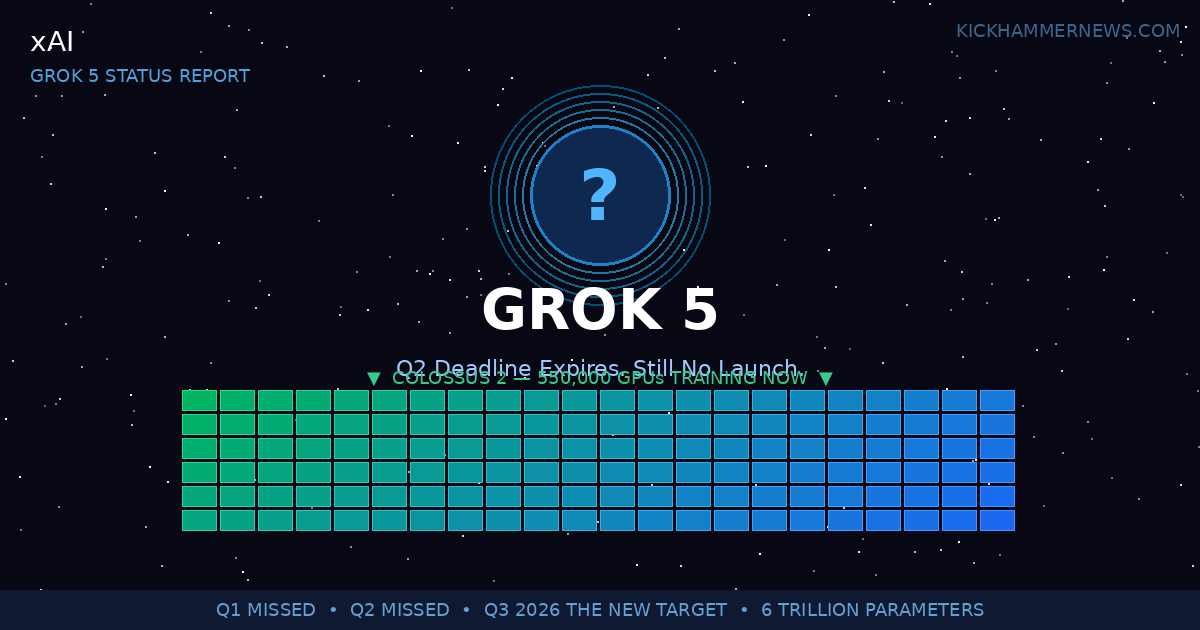
As the final days of Q2 2026 tick down, one of the most hyped AI model releases in recent memory remains stubbornly absent. Grok 5, xAI’s next-generation flagship model, has now missed two consecutive self-imposed deadlines, leaving developers, researchers, and AI enthusiasts watching the calendar with growing skepticism. With June 30 just ten days away, prediction market Polymarket puts the odds of a Q2 release at roughly one in three — and the smart money is increasingly betting on Q3.
So what exactly is going on inside Elon Musk’s AI company, and what does the Grok 5 delay tell us about the state of frontier AI development in 2026?
A Timeline of Missed Promises
The story of Grok 5’s delay is, at its core, a story about the brutal difficulty of training models at scales that have never been attempted before.
Elon Musk originally targeted Q1 2026 for Grok 5’s launch, a window that came and went without a release. xAI then pointed to Q2 — May through June — as the revised target. That window is now nearly closed. The official xAI News page, the authoritative source for confirmed releases, has stayed silent on Grok 5 itself, even as the company shipped a flurry of adjacent products in the same period.
This pattern of hype followed by quiet delay is not unique to xAI. The frontier AI race is littered with ambitious timelines that reality has gently — or not so gently — corrected. But the stakes around Grok 5 are particularly high given the company’s recent trajectory.
The Colossus 2 Factor
To understand why Grok 5 is taking so long, you need to understand the infrastructure behind it. xAI’s Colossus 2 supercluster in Memphis, Tennessee, is arguably the most powerful AI training facility ever built. The cluster runs approximately 550,000 Nvidia GB200 and GB300 GPUs, drawing close to a gigawatt of power. For context, that is enough electricity to power roughly 750,000 American homes.
Colossus 2 is simultaneously training seven AI models, including variants at 1 trillion, 1.5 trillion, 6 trillion, and a staggering 10 trillion parameters. The 6 trillion parameter model is the leading candidate for what the public will eventually know as Grok 5.
This scale of ambition comes with enormous engineering complexity. Training a 6-trillion-parameter Mixture-of-Experts model is not like scaling up a smaller one — it introduces qualitatively new challenges in stability, convergence, and hardware coordination. A single training run at this scale can take months, and any instability can set the entire process back significantly.
In February 2026, SpaceX — Musk’s rocket company — formally acquired xAI in a deal that valued the combined entity at approximately $1.25 trillion. A month earlier, xAI had closed a $20 billion Series E funding round at a $230 billion valuation, with backers including NVIDIA, Cisco, Fidelity, and the Qatar Investment Authority. The pressure to justify that capital with a landmark product release is immense.
What xAI Has Been Shipping Instead
While Grok 5 stays in the oven, xAI has kept busy delivering smaller but genuinely impressive releases that collectively paint a picture of where the company is heading.
Grok Voice launched on June 4, 2026, bringing conversational spoken interaction to the Grok mobile app. Users can now speak to Grok and receive spoken replies, positioning xAI to compete directly with the voice interfaces offered by OpenAI and Google.
Grok Imagine Video 1.5 arrived as a preview on May 30, with API access opening on June 3. The model generates 720p video clips up to 15 seconds long, with native audio that includes background music, sound effects, and lip-synced dialogue generated in a single pass alongside the video. It currently sits at number one on the Image-to-Video Arena leaderboard, a +52 Elo jump over its predecessor.
Grok V9-Medium, a 1.5 trillion parameter model explicitly trained on Cursor data for software development tasks, finished training in late May. Elon Musk confirmed the model’s completion on X, with a public release expected in mid-June 2026. This model is frequently — and incorrectly — described in tech headlines as Grok 5. It is not. It is a specialized coding model with a very different purpose and parameter count.
Grok 4.3, the current consumer flagship, launched on April 30 with a 1-million-token context window, native video input, and aggressive API pricing at $1.25 per million input tokens and $2.50 per million output tokens — roughly 40% cheaper than its predecessor.
What Grok 5 Is Supposed to Be
When Grok 5 does arrive, xAI is promising something substantially more capable than anything the company has shipped to date.
The model’s Mixture-of-Experts architecture means that despite having 6 trillion total parameters, only a subset activate for any given query. This design allows xAI to build a model of massive capacity while keeping inference costs manageable — a critical consideration when you’re trying to offer competitive subscription pricing.
Grok 4.20 Beta, released in February 2026, introduced a four-agent multi-agent architecture where specialized sub-agents named Grok, Harper, Benjamin, and Lucas work in parallel to cross-verify outputs. The system achieved an 83% non-hallucination rate. Grok 5 is expected to scale this multi-agent approach significantly, potentially running 16 or more specialized agents simultaneously, enabling far more complex and reliable reasoning chains.
Elon Musk himself has made bold claims about Grok 5’s potential. In a characteristically Musk-scale statement, he put the probability of Grok 5 achieving artificial general intelligence at “10% and rising.” That figure should be interpreted with appropriate skepticism — Musk’s track record on timelines and capability predictions has been mixed — but it illustrates the internal ambitions driving the project.
The Competitive Landscape Grok 5 Faces
Grok 5’s delays are not occurring in a vacuum. The rest of the frontier AI field has been moving fast, and the model will be entering a market that looks very different from when it was first announced.
Claude Opus 4.8, Anthropic’s current flagship released on May 28, 2026, holds the top position on the Artificial Analysis Intelligence Index with a score of 61.4. OpenAI’s GPT-5.5 scores 60.2 and remains dominant for general enterprise work. Google’s Gemini 3.5 Pro is expected to launch in late June, adding another high-capability competitor to the mix.
The race has also shifted significantly toward agentic capabilities — AI systems that can plan and execute multi-step tasks autonomously rather than simply responding to single prompts. Every major lab has made agents a centerpiece of its 2026 strategy, and the model that ships a genuinely capable agentic system will have a structural advantage in enterprise sales.
What Comes Next
For developers and organizations considering xAI for their AI infrastructure, the practical question is whether to wait for Grok 5 or commit to the current Grok 4.x lineup. Grok 4.3 is a legitimate competitor at its price point, and Grok 4.20 Beta’s multi-agent architecture offers capabilities unavailable elsewhere at comparable cost.
For those willing to wait, the consensus emerging from analysts who follow xAI closely points to Q3 2026 as the most realistic window for Grok 5’s public launch, with full API availability potentially following the tiered rollout model xAI used for Grok 4.3. SuperGrok Heavy subscribers at $300 per month would likely get access first, followed by standard SuperGrok at $30 per month and X Premium+ at $40 per month.
The irony of the situation is not lost on observers. xAI, a company that positioned itself as the fast-moving antidote to more cautious AI labs, is now the one asking the market to be patient. The frontier of AI development, it turns out, does not care much for press timelines.
Whether Grok 5 launches this month, next month, or later in the summer, the model’s eventual release will be one of the most significant AI events of the year. A 6-trillion-parameter MoE model trained on the world’s largest GPU cluster, with advanced multi-agent reasoning and the full firehose of X’s real-time data behind it, could genuinely reshape how the frontier is ranked.
For now, though, the most powerful model Musk has ever promised remains the most anticipated product in AI that no one has actually seen.


