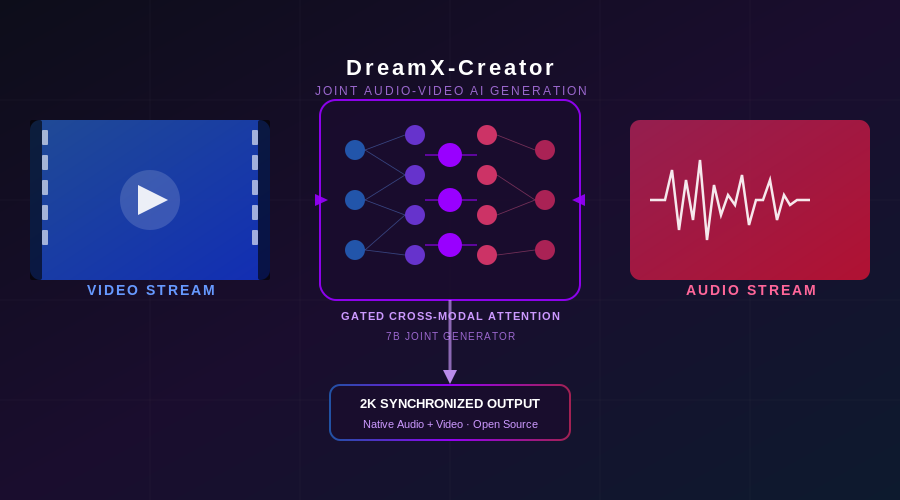
September 7, 2026 — A new open-source AI model published last week on arXiv is drawing significant attention from researchers and developers for a capability that sounds deceptively simple: generating video and audio together, simultaneously, from a single text prompt and a reference frame — and doing it at 2K resolution.
The model is called DreamX-Creator 1.0. It comes from a team at AMAP-ML, and while it is compact by the standards of today’s frontier systems — built around a 7 billion parameter generator — it achieves something that much larger closed-source models have struggled to do: treating video and audio as a unified perceptual event rather than two separate problems stitched together in post-production.
The Problem It Solves
Most AI video generators today have a dirty secret: they are deaf. They produce visual content and then, in a separate pipeline, add audio that was synthesized independently. This sequential approach has a fundamental limitation — the audio cannot react to what is happening in the video in real time because it was never trained to see the video as it was being generated. The result is that synthesized audio often feels slightly off: footsteps that don’t quite sync with feet, ambient sound that doesn’t respond to scene transitions, dialogue that drifts from lip movements.
The underlying problem is architectural. Separate-stage systems process the two modalities in sequence, which means the model generating audio has no gradient signal from the visual generation process. Each modality is essentially blind to the other during training.
DreamX-Creator’s approach is different. It jointly denoises audio and video streams within a single 7B generator. The two streams are processed independently in the first half of the network — allowing each modality to develop its own representations — and then coupled in the latter half through a mechanism the authors call Gated Cross-Modal Attention. This architecture lets the model learn not just what video looks like and what audio sounds like in isolation, but what audio sounds like given what is happening visually, and vice versa. The gates in the attention mechanism are token- and head-wise, meaning the coupling happens at a granular level that can capture subtle temporal relationships between visual and acoustic events.
The Architecture in Plain Language
Think of it this way: when a door slams in the real world, your ears and eyes receive the event simultaneously and your brain integrates the two streams into a single perceptual moment. Separate-stage AI systems are more like watching a film where the audio was recorded separately in a studio — technically plausible, but lacking the physical causality that makes a slammed door feel real.
DreamX-Creator is trained to learn that causality. Given a starting frame — a bedroom at night, a concert hall, a city street — and a text description of what should happen, the model jointly generates the visual sequence and the accompanying soundscape as a unified prediction problem. The acoustic events emerge from the same underlying probabilistic model as the visual ones, which means they share the same temporal structure.
To achieve 2K resolution output, the team built a separate component they call the Autoregressive 1-Step 2K Refinement pipeline. This component takes the output of the 7B generator, which operates at a lower resolution, and upscales it using a technique that adapts a bidirectional multi-step teacher model into an autoregressive refiner — essentially a model that has learned to predict high-resolution detail one temporal chunk at a time. The key innovation is distilling this refiner into a student model that requires only one denoising evaluation per chunk, which dramatically reduces the computational cost of high-resolution output.
The Training Pipeline
Getting the model to learn audio-video co-generation at this quality required building a custom data infrastructure from scratch. The team developed what they call the Audio-Video Data System, which constructs and filters temporally coherent clips from large-scale video collections, produces structured multimodal annotations, and organizes clips into capability-oriented data pools — essentially curriculum buckets that progressively expose the model to more complex audio-video relationships during training.
Training itself proceeded in stages: two audio-video pre-training phases, followed by a High-Quality Finetuning pass. After this supervised training, the model was further improved using Audio-Video Reinforcement Learning, a post-training technique that routes video-specific, audio-specific, and cross-modal feedback to the corresponding parts of the network. This allows the model to improve its synchronization on the basis of rewards that explicitly measure how well audio and video co-vary — not just how good each looks and sounds in isolation.
Why Openness Matters Here
The most significant aspect of DreamX-Creator is not purely technical. The paper’s title contains the word “democratizing” deliberately. The authors are releasing the full 7B generator and the 2K Refiner under open weights, making it possible for researchers, independent developers, and small studios to run native audio-video generation locally without paying per-query API fees to a frontier lab.
At current hardware capability, a consumer-grade GPU cluster can run the 7B generator with reasonable throughput. The 2K upscaling requires more memory but remains within reach of prosumer setups — the kind that are already used for image and video generation workflows by independent artists and filmmakers.
This matters because the alternative — closed API access to generation models — creates a structural dependency on a handful of large companies. Creative workflows that use closed models can be disrupted by pricing changes, API rate limits, or policy decisions made by providers. Open weights remove that dependency and allow the model to be fine-tuned, adapted, and integrated into custom pipelines without any of those constraints.
The Competitive Context
DreamX-Creator arrives in a generative media landscape that has been moving extremely fast. Text-to-video systems have improved dramatically over the past two years, and several companies now offer compelling commercial APIs. What has lagged is native joint audio-video generation at consumer-accessible quality levels. Most commercial offerings either focus purely on video or treat audio as a post-processing step handled by a separate model.
The paper positions DreamX-Creator as competitive with state-of-the-art open-source systems on standard benchmarks — a meaningful claim given how rapidly those benchmarks have been rising. For a 7B parameter model to achieve results competitive with much larger systems is a reflection of the quality of the training data pipeline and the efficiency of the joint-modeling architecture.
Implications for Creators and Developers
The near-term applications are easy to imagine. Film and video production pipelines that currently require separate teams for sound design and visual effects could potentially be streamlined significantly. Game developers building procedurally generated environments could use native audio-video generation to create coherent ambient scenes. Advertising agencies producing social video content at scale could automate aspects of production that currently require human editors.
Longer-term, models like DreamX-Creator point toward a world in which generating a short video clip — complete with realistic synchronized sound — is as accessible as generating a still image is today. The barriers that still exist — compute cost, generation time, fine-tuning complexity — are the same barriers that existed for image generation two years before it became a tool that ordinary users adopted without thinking about the underlying technology.
The open release accelerates that timeline by putting the model and its architecture in the hands of the global developer community, which has a track record of finding efficiency improvements and practical applications that the original research teams never anticipated.
What to Watch
DreamX-Creator 1.0 is a first version. The paper is explicit about what it does not yet address — longer generation windows, precise lip-sync for speech, and fine-grained control over individual audio elements like isolating a single instrument in a complex soundscape. These limitations define the roadmap for future work.
What it does achieve is a clear architectural demonstration that native joint modeling is not just theoretically sound but practically achievable at a scale that can be deployed outside a frontier lab. For a field that has spent years treating audio and video as separate problems, that is a meaningful step forward.
Sources: arXiv:2608.31106, GitHub (AMAP-ML/DreamX-Creator), Hugging Face (GD-ML/DreamX-Creator)


