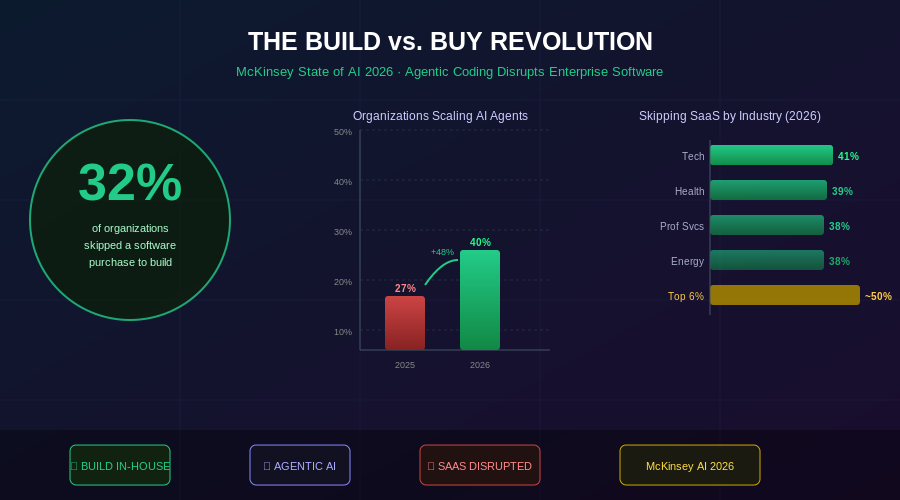
The software industry is facing a structural disruption unlike anything it has seen since the rise of cloud computing. According to McKinsey’s landmark State of AI 2026 global survey — released this week and drawing on responses from thousands of executives across dozens of industries — roughly one in three organizations has made a deliberate decision to skip buying off-the-shelf software in favor of building their own solutions using agentic coding tools. The implications for the $700 billion global enterprise software market are profound, and they are only beginning to register on Wall Street.
The headline figure — 32% of organizations have foregone at least one software purchase because they could build the functionality internally with AI — is striking on its own. But the McKinsey data reveals something more nuanced and arguably more alarming for traditional software vendors: this is not the behavior of fringe early adopters. It is happening at scale, across industries, and it is accelerating.
From Vibe Coding to Enterprise Strategy
The story of how agentic coding tools crossed from developer toy to boardroom strategy is one of the fastest technology adoption curves in recent memory. Just two years ago, AI coding assistants were productivity boosters for individual developers — tools that autocompleted functions, suggested variable names, and caught syntax errors. Today, they are something categorically different: autonomous software factories capable of designing, building, testing, and deploying complete applications from high-level natural language specifications, with minimal human intervention.
The shift was driven by the rapid maturation of what the industry now calls “agentic coding” — systems in which AI models operate iteratively over extended tasks, using tools, running code, reading error messages, and self-correcting. Platforms built on this paradigm, including GitHub Copilot Agent, Cursor, and Anthropic’s own agent infrastructure, can now take a product requirements document and produce a working, tested application in hours rather than the weeks or months a traditional software development cycle would require.
For enterprise executives watching their software spend balloon while vendor pricing becomes increasingly opaque — GitHub Copilot’s controversial shift to token-based billing in early 2026 was a flashpoint — the ability to build rather than buy has started to look less like a technical option and more like a financial imperative.
What the Numbers Actually Say
McKinsey’s data illuminates the shape of this shift in granular detail. Among the 6% of survey respondents that McKinsey classifies as “high performers” — companies attributing at least 5% of their EBIT to AI initiatives — nearly half have already skipped at least one software purchase due to internal build capability. That figure is 50% higher than the already-elevated 32% average, suggesting that the organizations that are best at AI are also the ones most aggressively disrupting conventional software procurement.
The industry breakdown is equally revealing. Technology companies lead adoption at 41%, unsurprisingly, since they have the technical talent to act on the opportunity most quickly. But healthcare payers and providers follow closely at 39%, and professional services and energy at 38% — sectors that would have been considered laggards in technology adoption just a few years ago. The build-vs-buy disruption, in other words, is not confined to Silicon Valley. It is spreading through the economy with a velocity that traditional software vendors should find genuinely alarming.
Large enterprises are scaling agents aggressively. The share of organizations with over $1 billion in revenue that report scaling AI agents in at least one business function rose from 27% to 40% year-over-year — the single largest jump McKinsey has recorded for any technology adoption metric in the survey’s decade-long history. These are not pilots. These are production deployments.
The SaaS Industry’s Existential Moment
For traditional software-as-a-service vendors, the McKinsey findings describe an environment that has shifted from challenging to existential. The SaaS business model has always rested on a fundamental value proposition: the cost and complexity of building enterprise software makes buying it from a specialized vendor economically rational, even at premium prices. That proposition is now under direct assault.
Consider what agentic coding tools make possible for a mid-size enterprise. Rather than paying six-figure annual licenses for a project management platform, a company can now deploy an agent to build a custom tool tailored precisely to its workflows in a matter of days. The resulting software costs almost nothing to maintain relative to vendor pricing, integrates natively with internal systems, and can be modified instantly as requirements change. The only real cost is compute — and compute continues to get cheaper.
This dynamic has already registered in the public markets, where SaaS valuations have faced sustained pressure since early 2026. Several prominent SaaS companies have reported slowing net revenue retention figures — the canary-in-the-coalmine metric for subscription software health — in their most recent earnings calls, with executives variously attributing the trend to macroeconomic caution or competitive pressure while notably avoiding direct reference to AI-enabled insourcing.
The deeper problem for SaaS vendors is structural rather than cyclical. A company that cancels a software subscription because it built the functionality in-house does not come back when economic conditions improve. The switching cost dynamics that made SaaS so defensible are now working in reverse: every company that successfully builds its own solution becomes more capable of building more solutions, and less willing to pay for external ones.
The Hidden Costs That Complicate the Picture
McKinsey is careful to note that the build-vs-buy shift is not without risks and hidden costs that organizations are only beginning to grapple with. Building custom software requires ongoing maintenance, security patching, and technical stewardship — responsibilities that enterprise IT teams may be ill-equipped to handle at scale. The agentic coding tools that make initial development rapid can also produce code that is difficult to audit, maintain, or debug, particularly if the humans overseeing it lack deep software engineering backgrounds.
There is also the question of what analysts have started calling “run cost reckoning.” The compute costs associated with operating AI-assisted software development and, increasingly, AI-embedded applications, represent a new and often underestimated line item on the enterprise P&L. Organizations that triumphantly avoided a SaaS subscription are sometimes discovering that the AI compute consumed by their internally-built replacement costs comparably or more at scale. McKinsey flags this as an emerging execution gap: 75% of organizations claim to be adopting agentic AI, but only 17% have actually deployed agents in production, according to Gartner, and only 11% have production-ready agentic systems per Deloitte. The gap between aspiration and execution remains substantial.
What Comes Next
The McKinsey report’s implications point toward a significant consolidation in the software industry, with vendors that offer genuine differentiation — deep vertical expertise, proprietary data, regulatory certifications, or network effects that custom builds cannot replicate — likely to prove durable, while commodity horizontal SaaS products face the sharpest headwinds.
For technology leaders, the strategic calculus has shifted permanently. The question is no longer whether to consider building with AI, but which capabilities are worth building and which still make sense to buy. The organizations navigating that question most effectively are already separating from the pack. The McKinsey data suggests they will continue to do so — with or without the traditional software vendors that have long counted on the complexity of enterprise IT to protect their margins.
Sources: McKinsey & Company, “The State of AI: Global Survey 2026”; Yahoo Finance reporting on enterprise build-vs-buy trends; Gartner CIO Survey 2026; Deloitte 2026 Tech Trends.


