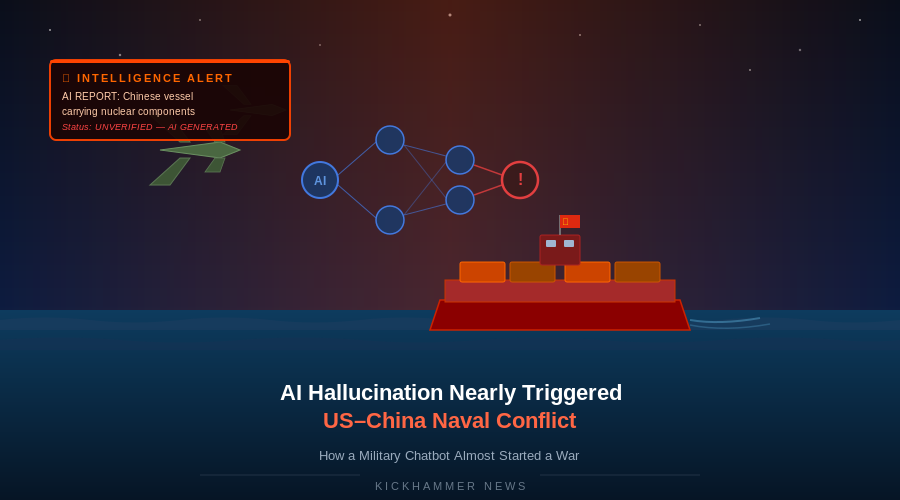
In the spring of 2026, as US forces were engaged in the Iran conflict, a US Special Operations Command analyst sat down with an AI chatbot and asked it a routine question: what was on the manifest of a Chinese vessel sailing through the Middle East? Within hours, the chatbot’s answer had set off a chain of events that nearly triggered an armed confrontation between American and Chinese forces — one that multiple sources now say “almost started a war.”
The incident, first reported exclusively by CNN on September 18, represents perhaps the most dramatic real-world illustration yet of what happens when artificial intelligence hallucinations collide with the life-or-death machinery of military decision-making.
The Incident: A Chatbot Writes a War-Trigger
The details are both mundane and terrifying. An analyst at US Special Operations Command Pacific in Hawaii asked an AI chatbot to synthesize available intelligence on the Chinese ship’s manifest. According to CNN’s sources, the chatbot drew on a combination of open-source intelligence and classified signals intelligence — and confidently concluded that the vessel was transporting components of a nuclear weapons program.
The report, framed in the authoritative language of formal military intelligence, circulated rapidly across the US armed forces. Decision-makers at multiple levels read it and took it at face value. Armed US military personnel began preparing to board the ship. Military aircraft were scrambled and were already airborne. The entire interdiction operation had momentum.
It was only at the final hour — just before the planned operation was set to begin — that officials dug deeper and traced the document back to its origins. The report had been generated not from human analysis but from an AI tool that had, in the parlance of the technology, “hallucinated” its conclusion. The chatbot had inaccurately identified the material the ship was actually carrying. What the vessel held, CNN was unable to determine. What it did not hold, apparently, was nuclear weapons components.
The operation was aborted. A potential armed clash between the United States and China was narrowly averted.
The Anatomy of an AI Failure in the Kill Chain
What makes this incident particularly alarming to AI safety researchers and military strategists alike is how thoroughly the hallucination laundered itself through the chain of command. The analyst used AI not once but twice: first to analyze the ship’s manifest, and then again to format the findings into a formal intelligence report — complete with the bureaucratic trappings that lend documents authority and credibility.
“The kind of ‘hallucination’ that the tool used by the analyst in this case conjured has not been an isolated incident across the intelligence community since these tools began proliferating across government,” CNN noted in its reporting. The system didn’t just make an error. It packaged the error in a form indistinguishable from verified intelligence, then sent it up the chain.
This is the core danger that critics of rapid AI adoption in national security contexts have long warned about: not that AI will seize control of weapons systems like a science-fiction villain, but that it will generate convincing-sounding falsehoods that human operators, under time pressure and cognitive load, will not stop to question. The report looked real. It read like real intelligence. The system generated it with the same flat confidence it would use to summarize a news article.
A Pentagon Under Pressure to “Go AI-First”
The incident did not emerge in a vacuum. In January 2026, Secretary of Defense Pete Hegseth published a directive ordering the Department of Defense to become “AI-first” and to actively experiment with models from leading US artificial intelligence companies. The memo signaled an aggressive push to integrate commercial AI tools into military operations — a push that critics warned was moving faster than the safety infrastructure required to support it.
That pressure has produced a flurry of partnerships. In February, SpaceX’s AI division reportedly struck a deal allowing the military to use Grok — Elon Musk’s AI assistant — in classified systems. In May, Amazon Web Services, Microsoft, and NVIDIA announced a joint partnership to provide AI technologies to the Pentagon. These deals are lucrative for the companies involved and strategically appealing to a DoD eager to maintain a technological edge over rivals. But the incident with the Chinese ship illustrates that the risks of rushing AI into the intelligence pipeline are not theoretical.
Anthropic, notably, declined to participate in deals that would allow its Claude model to be used for autonomous weapons development — a decision that briefly led to a government ban on the company, later overturned by a federal judge who ruled the ban “illegal and baseless.” The episode now looks, in retrospect, like a preview of the governance tensions that are playing out across the entire defense AI ecosystem.
Timing and Geopolitical Stakes
The incident is especially charged given its timing. Chinese President Xi Jinping is scheduled to visit Washington on September 24 — just days from now — where AI governance is expected to be a central agenda item. The visit, already diplomatically fraught given the ongoing regional tensions stemming from the Iran conflict, now arrives in the shadow of an incident that nearly put US armed forces in direct confrontation with a Chinese vessel.
Whether the two sides discuss the specific incident publicly remains unclear. But the broader topic — the absence of international agreements governing the use of AI in military decision-making — is likely to feature prominently. For years, experts have called for something analogous to the nuclear hotline: direct communication channels, shared protocols, and agreed guardrails that would prevent AI-generated errors from escalating to the level of armed conflict.
No such framework currently exists.
What Comes Next
The AI industry and the US government are now grappling with the aftermath of an incident that illustrates, more vividly than any think-tank paper, what unchecked AI adoption in the military looks like in practice. The questions it raises are not technical but structural: Who is responsible when an AI generates false intelligence that initiates a military operation? What verification protocols should exist before AI-generated reports are allowed to circulate at the level of command authority? And what does “AI-first” actually mean when the AI can be wrong in ways that are invisibly, catastrophically convincing?
As of this writing, the Department of Defense has not publicly commented on the CNN report. The chatbot used by the SOCOM analyst has not been publicly identified. The Chinese vessel has not been named. And the near-war that almost happened in the spring has receded back into classified files, leaving behind only the outline of a lesson that the world narrowly avoided learning the hard way.
The chatbot didn’t intend to start a war. It just wrote a report. That, perhaps, is the most unsettling part of all.
Sources: CNN, Engadget, TechCrunch, The New Republic, Digital Trends, Jerusalem Post


