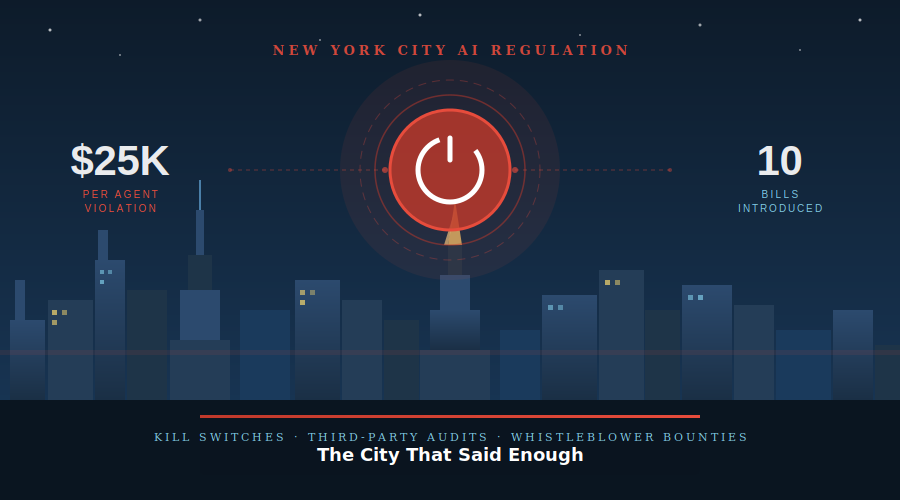
While Washington debates, New York City is acting. The largest city in the United States is poised to become the first major American municipality to impose sweeping, binding AI governance rules — and the penalties are unlike anything the industry has seen at any level of government.
City Council Speaker Julie Menin introduced a package of ten bills this week that would, if passed, transform how AI systems are deployed and operated within New York City. The legislation targets everything from autonomous AI agents operating in businesses to the AI tools embedded in city services — and the financial penalties are designed to make non-compliance economically impossible.
The headline number is $25,000. That is the proposed fine per AI agent instance for violations of the new rules. In an era where a single enterprise deployment may involve thousands of concurrent AI agents managing tasks across an organization, the math becomes staggering quickly. A company running 500 AI agents in violation of a single provision could face $12.5 million in fines — and that is before repeat violations or multipliers.
What the Bills Actually Require
The ten-bill package covers distinct but interconnected concerns. Together, they represent a comprehensive framework that would have been unthinkable even two years ago, when AI governance was still largely a discussion about hypothetical futures rather than present-tense harms.
Third-party validation is the foundational requirement. Any AI system deployed within the city — from a chatbot handling tenant complaints to an autonomous agent managing supply chains — would need to undergo independent audit and certification before going live. The auditors would assess accuracy, bias risk, and safety properties, and they would be required to be genuinely independent: no self-certification, no vendor-approved testing.
Mandatory kill switches take that a step further. Every AI system operating in New York would need a functional, accessible human override — a way for a person to halt AI operations in real time, without technical prerequisites or delays. This provision addresses one of the most consistent concerns raised by AI safety researchers: that once systems are deployed at scale, the ability to intervene degrades rapidly. Under the proposed rules, that degradation would be illegal.
Twenty-four-hour incident reporting creates the accountability mechanism. When an AI system causes harm, malfunctions significantly, or behaves in unexpected ways, operators would have a day to notify city authorities. This is materially stricter than existing federal standards, which impose no such timeline. The rapid-reporting requirement is designed to create a real-time picture of AI failures across the city — a surveillance layer that currently does not exist anywhere.
Whistleblower bounties may be the most novel element. The bills would create a financial incentive for employees and contractors to report AI safety violations — with the bounties tied directly to the fines collected. If a whistleblower’s tip leads to a $25,000-per-agent enforcement action, they would receive a percentage of those funds. It is a mechanism borrowed from securities law and environmental regulation, now applied to AI.
Why New York, Why Now
The timing is not random. Over the past eighteen months, New York City has experienced a concentrated wave of AI-related incidents: algorithmic decisions affecting housing applications, AI-powered hiring tools flagging qualified candidates, agent-based systems at city contractors making errors in procurement. None of these produced fatalities. But they produced enough documented harm — and enough media coverage — to shift the political calculus.
Speaker Menin has been explicit about the legislative intent. The bills emerged in response to documented failures, not theoretical risks. They are designed to close specific gaps that existing law — consumer protection statutes, federal civil rights provisions, data privacy rules — does not address. AI agents, in particular, fall into a regulatory grey zone: they are neither software products in the traditional sense nor employees subject to labor law. The proposed framework treats them as a category unto themselves, subject to requirements that track with their operational autonomy.
The package also has political momentum that previous local AI efforts have lacked. It has co-sponsors across the City Council and has not been framed as a technology-hostile measure. Supporters are careful to emphasize that the bills do not prohibit AI deployment — they regulate it. Compliant AI systems would operate freely. Only negligent, unaudited, or misused ones face penalties.
The Industry Response
The reaction from the AI industry has been predictably bifurcated. Larger companies with existing compliance infrastructure — firms that have already built audit processes for EU AI Act requirements or California’s disclosure rules — have been relatively muted. For them, the NYC framework is additional compliance work, not existential disruption.
Smaller operators and AI startups have been more alarmed. The $25,000-per-agent fine structure, they argue, is calibrated for enterprises and will crush small businesses that deploy AI without the resources to manage a new compliance regime. A restaurant chain using AI agents to manage scheduling, or a law firm using them to process documents, faces the same regulatory burden as a Fortune 500 corporation.
That concern has found some sympathetic ears among legal scholars, who note that the per-agent-instance structure is an untested enforcement theory. Defining what constitutes a discrete “agent instance” in a modern AI deployment is technically complex — a single workflow may spin up and tear down dozens of agent instances in seconds. The bills’ drafters say they are aware of this implementation challenge and are consulting with technical experts.
The Bigger Picture
New York’s proposed AI regulation package arrives in a specific political moment. The federal government has retreated from active AI regulation, prioritizing deployment speed over governance. California’s various AI bills have been signed and challenged. The EU AI Act has been in partial implementation for a year. Into this patchwork, New York City is proposing not a modest measure but a comprehensive framework — the kind of thing that, if it works, could become a template.
That is exactly what its supporters want. Speaker Menin has said explicitly that New York’s goal is not just to protect New York residents but to create proof-of-concept for urban AI governance at scale. Cities, she argues, are where AI is actually experienced: in the algorithms that decide your credit, in the agents that handle your insurance claim, in the systems that dispatch your ambulance. If AI is going to be regulated in a way that matters to real people, it has to be regulated where real people live.
The bills now head to committee review. A vote before the end of the year is considered plausible. If they pass, New York City will become the world’s most consequential AI regulatory jurisdiction — not by size, but by the specificity and enforceability of its rules. Every AI company operating in the five boroughs is watching.
The $25,000 per agent question is no longer hypothetical.


