When Jeff Dean quietly sent a message on X announcing Discovery Loop last week, the AI world stopped to read it twice. Not because the concept — using AI to automate the scientific method — was entirely new. But because of who was saying it, and who was standing beside him.
Dean, Google’s chief scientist and the man whose name is attached to some of the most consequential infrastructure ever built (MapReduce, Bigtable, TensorFlow, Google Brain), announced that he was leaving Google after 27 years. With him: Sanjay Ghemawat, the Google Senior Fellow who has been his coding partner for three decades; Quoc Le, one of the co-founders of Google Brain and a pioneer of large-scale neural networks; and Oriol Vinyals, a former VP at Google DeepMind who co-created AlphaStar and made fundamental contributions to sequence-to-sequence learning.
This is not a startup. This is a who’s-who of modern AI research deciding, collectively, that the most important work they can do is no longer at Google.
What Is Discovery Loop?
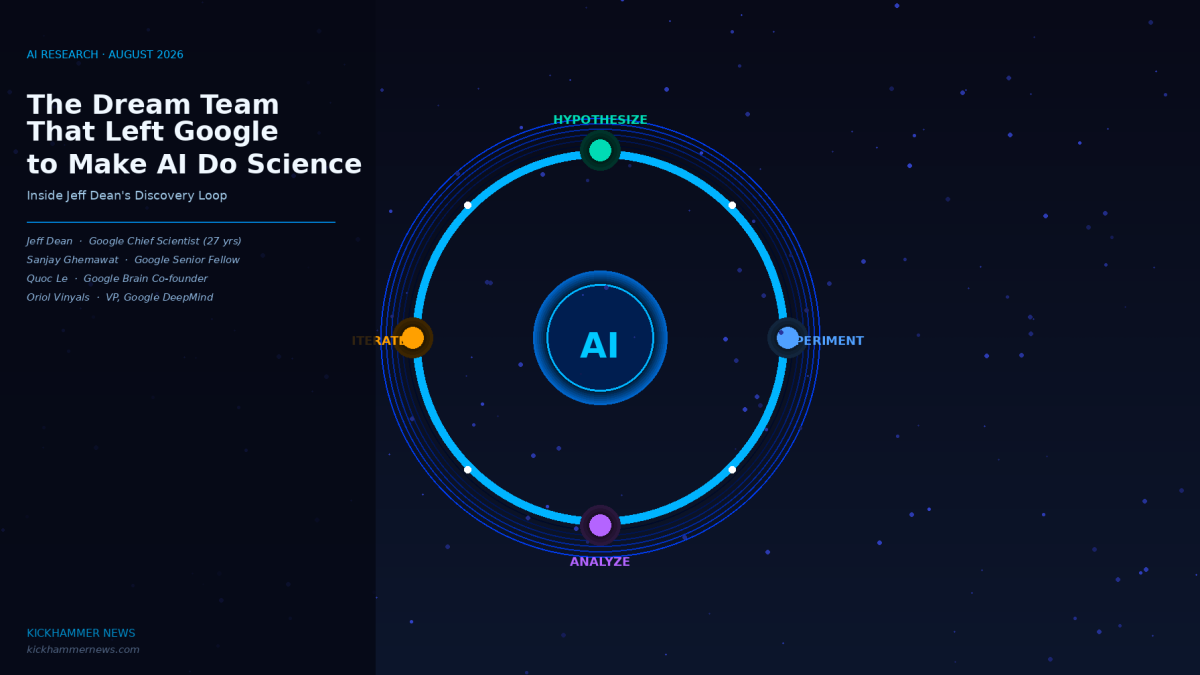
Discovery Loop is a public benefit corporation whose stated mission is to automate the experimental loop — the core cycle that drives all scientific progress: form a hypothesis, design an experiment, run it, analyze the results, and iterate. Discovery Loop wants AI to run that cycle not once or twice, but thousands of times in parallel, at speeds no human lab could match.
The name is almost literal. Science is a loop. You observe something unexpected, you form a theory, you test it, you revise. Einstein did it. Curie did it. Every great discovery came from someone willing to run that loop long enough. Discovery Loop is betting that AI can run it faster, wider, and without getting tired.
“We believe that by automating this loop at scale, we can compress decades of scientific progress into years,” Dean wrote in the announcement. “And we believe it’s important enough that we had to go build it ourselves.”
Starting With AI, Then Turning It on Everything Else
The company’s initial focus is deliberately recursive: automating machine learning research. In other words, they will use AI to accelerate AI research — a bet that success here will give them a dramatically improved technology stack to apply everywhere else.
The logic is sound. ML research is among the most structured forms of scientific inquiry. You propose an architecture, you train, you evaluate metrics, you adjust hyperparameters. It’s already half-automated in many labs. Discovery Loop wants to close that loop entirely, running thousands of such cycles simultaneously, discovering improvements that humans would take years to stumble across.
Once they’ve sharpened that tool, the plan is to turn it outward: chip design, drug discovery, materials science, and clean energy research. Each of these fields runs on the same basic loop. Hypothesis, experiment, result, revision. The infrastructure Discovery Loop builds for ML research would, in theory, apply just as well to discovering a new battery chemistry or a novel cancer therapeutic.
The Funding and Google’s Unusual Role
The seed round is being co-led by Radical Ventures and Khosla Ventures, with Lightspeed and Kleiner Perkins also participating. The total amount has not been disclosed, though sources familiar with the round describe it as substantial — consistent with a founding team of this caliber commanding significant pre-product valuation.
Perhaps the most striking detail: Google is participating as a founding investor. The company that Dean spent 27 years building is now backing him to go compete — or perhaps more accurately, to go build something that Google, as a product-driven company, was structurally unable to build on its own.
Google is also supplying compute. In a world where access to GPUs can define a startup’s ceiling, having Google Cloud as your compute partner for the first year of operations is a significant advantage. It also suggests that Google sees Discovery Loop as aligned with, rather than threatening to, its own interests — at least for now.
Why Now? Why Them?
The timing is no accident. The AI field has spent the last three years building progressively more capable models. What has lagged behind is the pace at which those models can be directed at fundamental research problems — not summarizing papers, but generating genuinely new experimental insights.
The infrastructure for AI-driven discovery now exists at a scale it didn’t in 2023. Compute costs have fallen dramatically. Foundation models are good enough to reason about scientific domains with real nuance. Agent frameworks exist that can coordinate complex multi-step tasks. The moment, in other words, is actually here.
As for why this particular team: the co-founders are perhaps uniquely qualified to build the thing they’re describing. Ghemawat helped build the distributed systems that would underpin any large-scale parallel experimentation infrastructure. Le and Vinyals developed some of the core modeling techniques that would power the hypothesis-generation components. And Dean has spent decades thinking about how to make computation scale.
There’s also a cultural argument. At Google’s scale, it is genuinely hard to prioritize a long-horizon moonshot that may not have clear commercial returns for a decade. A public benefit corporation structure — the same organizational form chosen by Anthropic and, initially, OpenAI — gives Discovery Loop the flexibility to pursue that horizon without quarterly earnings pressure forcing it toward safer, faster-payoff work.
The Bigger Picture
Discovery Loop sits at an interesting inflection point in the broader AI narrative. For the past few years, the dominant story has been AI as a tool — something humans use to write faster, code better, analyze data more efficiently. Discovery Loop represents a different framing: AI as a scientific agent, capable of advancing human knowledge rather than merely summarizing it.
If the company succeeds even partially at its ambitions, the implications are hard to overstate. A machine that can run ten thousand drug-discovery experiments in parallel, learn from each one, and continuously refine its hypotheses would not merely accelerate medicine — it would transform it. The same applies to climate science, materials research, and the design of AI systems themselves.
Whether Discovery Loop will actually get there is unknowable today. Building the thing they’re describing is extraordinarily hard, even for this team. But it’s worth taking seriously when four of the most accomplished researchers in AI history decide, collectively, that this is the most important problem left to solve.
The loop has started. We’ll find out how fast it runs.


