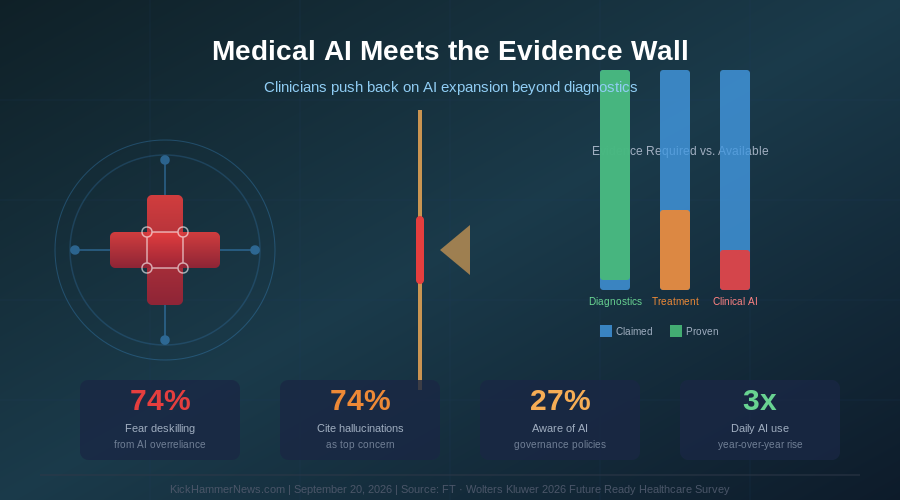
The promise of artificial intelligence in medicine has never sounded more ambitious. Vendors tout AI systems capable of catching rare diseases, predicting patient deterioration, optimizing drug dosages, and streamlining clinical workflows from intake to discharge. Yet on the front lines of care, a quiet but significant backlash is forming — not against AI in medicine broadly, but against its rapid expansion into domains where the evidence simply hasn’t kept pace with the hype.
Reporting in the Financial Times on September 20, journalist Sarah Neville documents a growing unease among clinicians who are pushing back on medical AI’s march beyond diagnostics and imaging — the two areas where the technology has arguably earned its credibility. The objection isn’t ideological. It’s evidentiary.
Where AI Has Worked — and Where It Hasn’t
In radiology and dermatology, AI has compiled an impressive track record. Diagnostic models have demonstrated AUC values — a measure of a model’s ability to distinguish between conditions — ranging from 0.85 to 0.96, with sensitivity reaching as high as 97% in some imaging applications. In these narrow, well-defined tasks, AI performance is genuinely competitive with, and sometimes superior to, trained specialists.
But those domains have something that many newer applications lack: massive labeled datasets, standardized inputs, and decades of clinical validation infrastructure. When AI companies began moving into clinical decision support, treatment planning, discharge summaries, and patient triage, they entered territory where none of those conditions reliably hold. The data is messier. The tasks are fuzzier. And the consequences of error are often more severe.
According to the FT’s reporting, clinicians are increasingly vocal that technology advances have not yet translated into significant real-life improvements in patient care — and they want to see the evidence before their hospitals commit further.
A Survey Puts Numbers to the Skepticism
The frustration isn’t just anecdotal. Wolters Kluwer’s 2026 Future Ready Healthcare survey, conducted with Ipsos among 355 US doctors and nurses in March, put specific numbers to clinician concerns. Among the top risks flagged:
Deskilling: 74% of respondents cited worry that growing reliance on AI tools will erode their ability to independently identify errors or make sound judgments. Hallucinations: 74% listed AI hallucinations — plausible but factually wrong outputs — as a top concern, a particularly alarming failure mode in a clinical setting. Advertiser-driven bias: 72% expressed concern that commercial incentives might distort AI recommendations. Governance awareness: Only 27% of clinicians reported awareness of formal AI governance policies at their organizations — up just six percentage points from 21% in 2025.
That last figure is especially striking. Physicians’ repeated daily AI use tripled year over year, according to Healthcare Dive’s analysis of the same dataset. Clinicians are using these tools constantly, but the institutional frameworks meant to ensure that use is safe and accountable are barely keeping pace.
The Deskilling Concern Is Real
Of the concerns surfaced by the Wolters Kluwer report, deskilling deserves particular attention because it operates subtly and over time. The report describes it as “an increasing overreliance on AI tools that reduce clinicians’ skills and ability to independently identify inaccuracies or poor recommendations.”
This isn’t a hypothetical risk. Research in other high-stakes domains — aviation, for instance — has documented how automation can lead to skill atrophy that only becomes visible when the automated system fails. In medicine, where AI systems are still imperfect and the stakes are literally life and death, the ability of a human clinician to catch and correct an AI error isn’t optional redundancy. It’s a core safety mechanism.
The irony is sharp: as AI use climbs, the very skill set needed to audit that AI is quietly eroding.
Governance Is the Missing Infrastructure
One of the most consistent findings across 2026’s medical AI research is that the technology has outrun the governance structures meant to oversee it. A formal AI governance policy — defining which systems can be used, for what, with what human oversight, and with what audit trails — ought to be table stakes for any healthcare institution deploying AI in clinical settings. Yet with only 27% of clinicians aware of such policies at their institutions, it’s clear that most hospitals haven’t built that infrastructure.
Clinicians seem to understand this. Seventy-seven percent reported that they double-check AI answers against original sources or trusted databases such as PubMed or UpToDate. Fifty-three percent said they want AI to be required to show the reasoning behind its responses — a standard known in the field as explainability. Both behaviors reflect a rational response to deploying AI without guardrails: compensate at the point of use.
But individual workarounds are an unstable substitute for institutional policy. A physician who manually verifies every AI recommendation is absorbing friction that the AI was supposed to eliminate. Worse, in a busy clinical environment, the verification step gets skipped. The AI answer gets used as-is. And without governance, there’s no audit mechanism to even know when that happens.
What Vendors Need to Show
The FT’s framing is careful: this is not a rejection of AI in medicine. Clinicians are not calling for AI to be removed from hospitals. They are calling for the evidence burden to be met before expansion continues.
That means prospective clinical trials, not retrospective analyses of existing data. It means real-world validation in the specific patient populations and care settings where a tool will be deployed. It means head-to-head comparisons against current standard of care, not against historical baselines. And it means transparent publication of results — including failures.
AI vendors that clear those bars will find a healthcare system genuinely ready to adopt their technology at scale. Those that don’t are running into a clinician wall that won’t move for polished demos and cherry-picked performance statistics.
The Broader Signal
The medical AI pushback is, in a sense, a microcosm of a broader inflection point in AI deployment across high-stakes domains. The years of hype and pilot programs are colliding with practical reality. Professionals who live with the consequences of AI errors — doctors, lawyers, engineers — are increasingly demanding the same rigor from AI systems that they’d demand from any other tool in their field.
In medicine, that demand is appropriate. Healthcare institutions that treat it as an obstacle are likely to find it becomes a liability — in patient outcomes, in regulatory exposure, and eventually, in litigation. Those that treat it as a legitimate engineering and governance challenge to be solved will be the ones standing when the current cycle of inflated expectations gives way to something more durable: AI that actually improves care.
The evidence gap is real. Closing it is the work of the next several years. The clinicians pushing back aren’t opponents of progress. They’re insisting that progress be demonstrated, not assumed.
Sources: Financial Times (September 20, 2026); Wolters Kluwer 2026 Future Ready Healthcare Survey (Ipsos, March 2026); Healthcare Dive; AI Weekly


