September 23, 2026 | By KickHammer Tech
There is a peculiar irony at the heart of America’s most consequential technology debate. The legislators writing the rules that will govern artificial intelligence for a generation — shaping everything from autonomous weapons to AI-generated medical advice — are largely barred from using the most powerful AI tools available today. As Congress races to regulate a technology reshaping civilization, the people crafting those rules have never actually used the systems they’re seeking to control.
That is the central finding of a new NPR report published today, revealing that Senate staff operate under strict AI access restrictions that block them from the agentic, autonomous AI platforms now standard in enterprise America. The revelation underscores a fundamental challenge facing AI policymakers worldwide: how do you regulate something you’ve never experienced firsthand?
What Senators Can — and Cannot — Use
Senate staffers currently have access to three approved AI chat tools: Microsoft Copilot Chat, Google Gemini for Workspace Enterprise Plus, and OpenAI’s ChatGPT Enterprise. While these are capable systems, they operate under a critical constraint: they cannot access internal Senate drives, shared folders, email systems, Microsoft Teams chats, or any other internal Senate resources.
That limitation matters enormously. Modern legislative work involves synthesizing hundreds of documents, cross-referencing committee reports, tracking amendments across sprawling bills, and coordinating across offices. The AI tools that are transforming private sector productivity — tools that can autonomously browse files, draft and compare documents, schedule meetings, and manage complex workflows — are precisely what Senate staff cannot access.
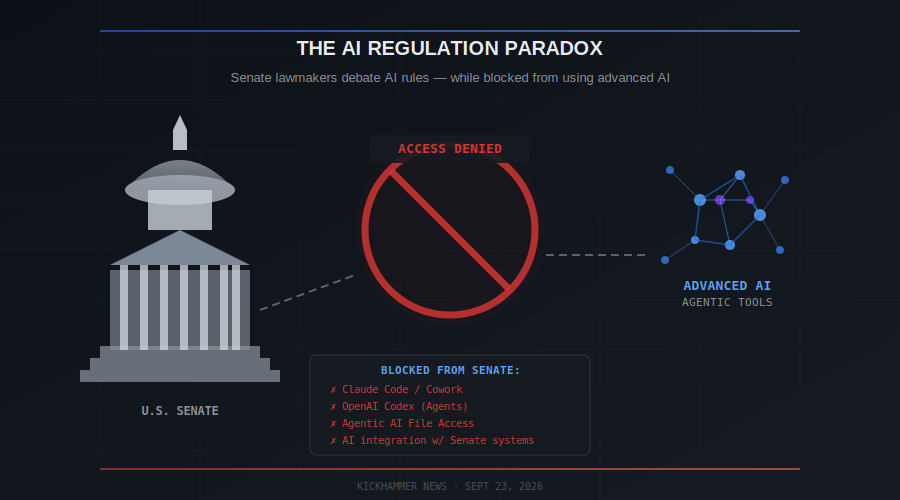
More significantly, the Senate has placed a blanket ban on advanced AI “agent” tools — the autonomous systems capable of completing multi-step tasks and accessing computer file permissions on their own. These include OpenAI’s Codex, Anthropic’s Claude Code and Cowork, and similar platforms. These are the frontier AI systems that have triggered most of the regulatory concern on Capitol Hill, yet the people writing regulations for them cannot use them.
“The Senate prohibits us from integrating outside systems into the Senate’s,” said Sen. Bernie Moreno (R-Ohio), whose office uses an AI research tool called Albert but cannot connect it to Senate infrastructure.
No timeline has been provided for when these advanced tools might be vetted and approved.
The Regulatory Paradox
The timing creates an almost paradoxical situation. A majority of Americans now support some form of AI regulation, according to recent polling, and Congress is fielding dozens of competing proposals — from kill-switch mandates to liability frameworks to compute caps on frontier models. Yet the people writing these laws are doing so without direct experience with the capabilities they’re legislating.
Adam Kovacevich, CEO of the Chamber of Progress, put it plainly: “Congress, unfortunately, has always lagged behind. Right now you’ve got lawmakers writing rules for technology they, in many cases, never even used.”
This isn’t simply a matter of technological literacy. Frontier AI tools are genuinely transformative in ways that are difficult to grasp without hands-on experience. The gap between reading descriptions of agentic AI capabilities and actually watching an AI autonomously research, plan, and execute a multi-step task is enormous. Regulatory decisions about where to draw capability lines, what safeguards to mandate, and which use cases to restrict require judgment that is difficult to exercise in the abstract.
Daniel Schuman of the American Governance Institute offered a more cynical read: “Security is often a pretext for slower adoption by government agencies and businesses.” On this view, the restrictions are less about genuine risk management and more about institutional inertia — and the cost is a legislature writing AI policy in the dark.
A Tale of Two Chambers
The divide between the Senate and the House underscores how arbitrary these restrictions can be. House rules differ significantly: lawmakers and staff there have been approved to use tools from Microsoft, OpenAI, Google, and Anthropic for a wider range of specific use cases. The same AI systems that are forbidden in Senate offices are authorized — with appropriate oversight — across the hallway.
The Senate’s cybersecurity posture is managed by the sergeant at arms, and the bar for approving new tools is high. Critics argue this creates a two-tier Congress where House members develop hands-on intuition about AI capabilities while their Senate counterparts are effectively regulated back to a pre-2025 baseline.
Some senators have reportedly begun using AI tools on personal devices or ad hoc accounts, working around the restrictions. That workaround carries its own risks — data governance, security protocols, and confidentiality requirements may be violated when staffers use unapproved systems on personal accounts.
The Cost of Not Knowing
The stakes of this knowledge gap are high. Among the AI regulation proposals currently circulating in Congress are measures that would require frontier AI labs to implement “kill switches” enabling government shutdown of powerful models, mandatory safety evaluations before deployment, liability frameworks for AI-caused harms, and restrictions on autonomous AI agents operating in critical infrastructure.
These are not abstract policy choices — they will shape the competitive landscape of the global AI industry, affecting where companies build, who they hire, and what they deploy. Getting the details right requires understanding not just the theoretical capabilities of modern AI systems but the practical reality of how they’re used, what their failure modes look like, and where genuine risks lie versus where fears are overblown.
The irony is especially acute given that AI regulation has been justified in part by fears of what advanced agentic AI systems might do if left ungoverned. Yet the people tasked with governing them have, by institutional policy, never encountered an advanced agentic AI system directly.
What Comes Next
There are signs the Senate’s posture may be loosening. Congressional staff from both chambers have participated in AI “Insight Forums” — industry-organized briefings designed to give lawmakers and their staff exposure to AI capabilities. But passive observation during a structured demo is a far cry from the hours of exploration and failure that produce genuine AI fluency.
Schuman and other government technology advocates have been pushing for expanded AI access programs that would give legislative staff hands-on time with frontier systems under appropriate security controls. The model already exists in other domains: classified intelligence briefings give lawmakers access to sensitive information they cannot otherwise access; a parallel framework for advanced AI tool access is technically feasible.
The question is whether the will is there — or whether America’s AI regulations will continue to be written by people who, in many cases, have never personally experienced what they’re regulating.
In an era where AI systems are making decisions that affect millions of lives daily, that gap between regulator and regulated may be the most significant blind spot in American technology policy.
KickHammer News covers technology, AI, and the business of innovation.


