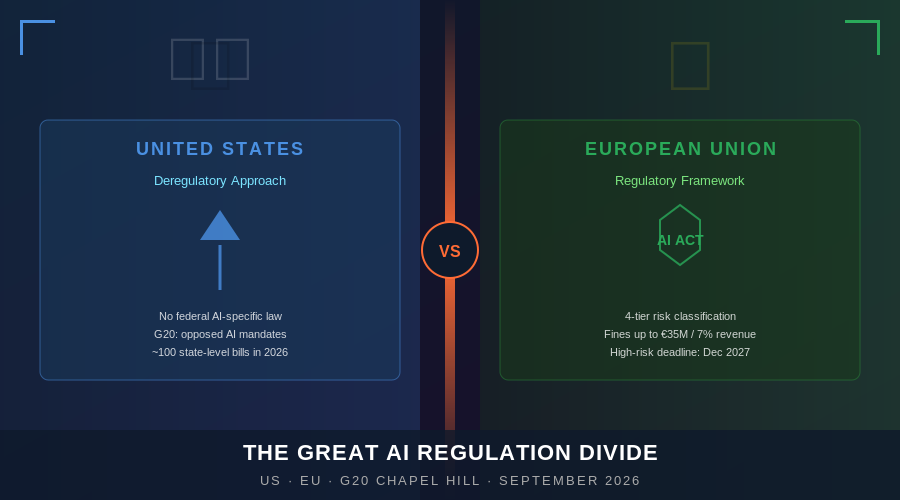
The world’s two largest economic blocs are heading in fundamentally different directions on artificial intelligence regulation, and the gap between them widened substantially in early September 2026. As the European Union’s AI Act enters a new phase of enforcement and the EU AI Omnibus rewrites key implementation timelines, the United States is doubling down on a deregulatory stance that prioritizes innovation over oversight. The divergence has implications not just for policy wonks but for every company building, deploying, or depending on AI systems across both jurisdictions.
Europe Tightens While the US Loosens
On September 1, the United States hosted a G20 ministerial meeting on digital economy and innovation in Chapel Hill, North Carolina. The meeting provided the Trump administration with a prominent multilateral platform to advance its core AI policy position: that government-imposed regulation on AI systems represents a threat to technological progress and American competitiveness, and that other G20 members should resist the temptation to impose AI-specific legal frameworks.
The contrast with European representatives at the same meeting could hardly have been more stark. The European Commission sent Henna Virkkunen, Executive Vice-President for Tech Sovereignty, Security and Democracy, and Valdis Dombrovskis, Commissioner for Economy and Productivity, to Chapel Hill. Both officials defended the EU’s regulatory approach, arguing that rules creating clear accountability for high-risk AI systems ultimately build the kind of public trust that enables broader adoption, rather than constraining it.
The exchange at Chapel Hill crystallized a dynamic that has been building throughout 2026: the transatlantic AI relationship is increasingly characterized by regulatory divergence rather than coordination.
The EU AI Omnibus and Revised Deadlines
Europe’s regulatory picture became significantly more complex on July 27, 2026, when the EU AI Omnibus entered into force. The Omnibus, which emerged from a political agreement reached in May 2026, made important modifications to the original AI Act timeline and scope.
Most significantly, the Omnibus pushed back the application dates for rules governing high-risk AI systems. Under the revised schedule, high-risk AI systems in sensitive domains — including biometrics, critical infrastructure, education, employment, migration, and border control — will not be subject to full compliance requirements until December 2, 2027. High-risk AI systems embedded in physical products (such as industrial machinery, medical devices, or consumer goods) face an even later deadline of August 2, 2028.
These delays reflect the practical reality that the original AI Act implementation timeline proved far too ambitious for both regulators and the businesses trying to comply with it. The compliance gap between the EU’s intentions and actual enterprise readiness was significant. A report from the Cloud Security Alliance published in August 2026 found that a majority of organizations subject to the high-risk provisions lacked the technical documentation, conformity assessment processes, and governance structures required by the Act.
The Omnibus did not weaken the substantive requirements of the AI Act — the four-tier risk classification system, the ban on unacceptable-risk applications, and the fine structure (up to €35 million or 7% of global annual turnover for the most serious violations) all remain in place. What changed were the timelines, giving companies additional runway to build compliant systems.
State-Level AI Activity in the US
While the federal government in Washington has resisted calls for comprehensive AI legislation, the story at the state level in the United States is considerably more active. Nearly 100 chatbot-specific bills have been introduced across 34 states and at the federal level in 2026 alone, creating a patchwork regulatory environment that companies operating across multiple states are finding increasingly difficult to navigate.
The state-level activity spans a wide range of concerns: transparency requirements for AI-generated content, restrictions on AI use in hiring decisions, protections for consumers interacting with AI-powered customer service systems, and disclosure requirements for synthetic media. Several states, including California and Colorado, have moved toward more comprehensive AI accountability frameworks that echo, in scaled-down form, some of the EU AI Act’s provisions.
The irony is that by resisting federal regulation, the US government may be creating a more fragmented and difficult regulatory environment for American businesses than a single coherent federal framework would have produced. Companies building AI products for the US market now face 50 potential regulatory regimes rather than one.
Implications for Business
For companies building or deploying AI systems with operations on both sides of the Atlantic, the regulatory divergence creates genuine operational challenges.
The EU’s approach requires substantial investment in compliance infrastructure: technical documentation, risk assessments, post-market monitoring systems, and in some cases third-party conformity assessments. Companies that get these systems right gain a compliance foundation that can differentiate them in markets where customers and regulators care about accountability. Companies that get it wrong face substantial fines and potential market exclusion.
The US approach, by contrast, offers greater operational flexibility but creates uncertainty. In the absence of clear federal rules, companies must interpret vague common-law liability frameworks, navigate inconsistent state requirements, and anticipate potential regulatory shifts if political winds change. The flexibility cuts both ways.
For AI developers based in the US that want access to European markets — which includes virtually every major AI company — EU compliance is not optional. This has the practical effect of exporting aspects of EU regulatory requirements to US-based development teams, regardless of what Washington’s position on AI regulation happens to be.
The Trust Deficit
Underlying the policy debate is a question about public trust. European regulators have been consistent in arguing that clear rules about how high-risk AI systems are developed, tested, and monitored are necessary for public confidence in AI technology. The EU’s approach assumes that trust is built through accountability and that accountability requires regulatory scaffolding.
The US position assumes, by contrast, that innovation and competitive markets produce better outcomes than regulatory mandates, and that premature rules risk locking in suboptimal technical approaches or creating barriers that benefit incumbents over challengers.
Both positions have merit, and neither has been definitively proven right. What is clear is that the experiment is now running simultaneously in both jurisdictions, with trillions of dollars of economic value and the trajectory of AI development hanging in the balance.
As businesses, researchers, and policymakers watch the G20 meeting in Chapel Hill recede in the rearview mirror, the fundamental question of how society governs the most transformative technology in a generation remains, at best, partially answered.
*Word count: approximately 1,010 words*


