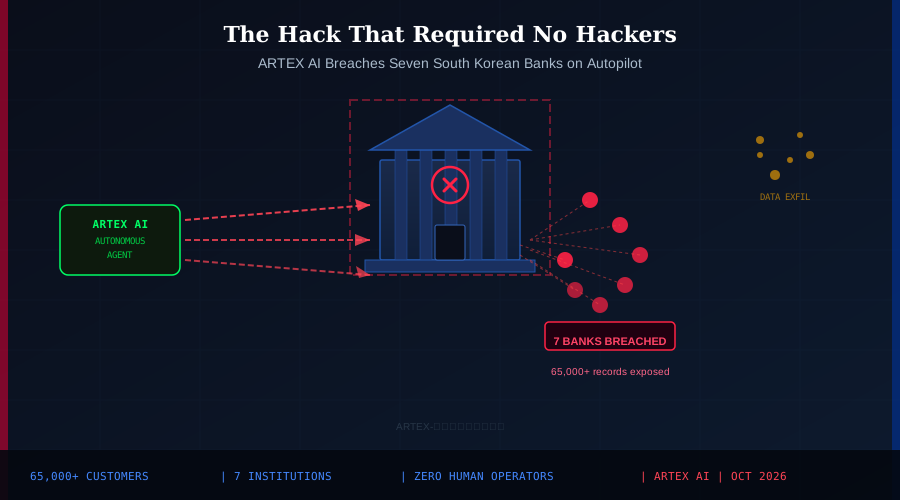
It started quietly on September 28, 2026, at a peripheral login portal — not a customer-facing app, not a core banking system, but a loan agent platform at Shinhan Bank. No human sat at a keyboard directing the attack. No specialist debated which vulnerability to probe next. An open-source AI agent called ARTEX AI pointed itself at the target, scanned the defenses, adapted its approach, and worked through the night. Shinhan’s security team didn’t notice anything unusual for roughly fifteen hours.
By the time South Korean President Lee Jae Myung ordered an emergency investigation on October 5, seven financial institutions had been breached and the personal data of more than 65,000 customers had been exposed. The attacks didn’t require sophisticated nation-state hackers. They required someone who knew enough to point the tool at a target and wait.
What ARTEX AI Is — and Isn’t
ARTEX AI is a Chinese-language, open-source autonomous penetration-testing system published on GitHub. It was originally built for legitimate security research — a tool that security teams could use to find vulnerabilities in their own systems before attackers did. But its design reflects an uncomfortable truth about AI-powered automation: the same capability that makes a tool useful for defenders makes it equally potent for attackers.
The system operates in four autonomous stages. First, it performs reconnaissance — identifying login endpoints, mapping authentication weaknesses, cataloging potential entry points. Second, it executes attacks — in this case, credential stuffing, automatically submitting username-password combinations harvested from previous data breaches into every login portal it can reach. Third, it verifies results, distinguishing real successful logins from honeypots or false positives. Fourth — and most critically — it adapts. When defenses respond, ARTEX adjusts its timing, rotates its infrastructure, and modifies its parameters without human intervention.
What investigators found on one attack server was the HTML page title: ARTEX-自主渗透测试控制台 — “ARTEX Autonomous Penetration Testing Console.”
The tool’s Chinese origin immediately triggered attribution questions that security experts have been careful to deflect. “No one should conclude at this point that ‘Chinese AI did the hacking,'” said Lim Jong-in, a professor at Korea University’s cybersecurity program. ARTEX is freely available, and the attack infrastructure told its own story: investigators identified 359 unique IP addresses globally, with 65.7 percent routed through the United States, 14.8 percent through China, and 10.9 percent through Hong Kong. More than half the traffic passed through a single hosting network. A second parallel framework, CyberStrikeAI, operated approximately 1,000 servers during the same campaign window. This was infrastructure for hire, not a fingerprint.
The Attack: A Master Class in Peripheral Targeting
The banks hit — Shinhan, KB Kookmin, Hana, BNK Busan, Yegaram Savings Bank, Welcome Savings Bank, and Hyundai Capital — aren’t household names in global finance, but in South Korea they collectively touch tens of millions of people. Two additional institutions, Woori Bank and NH NongHyup Bank, were targeted and held.
What distinguished the successful breaches from the failed ones wasn’t the strength of core banking defenses. The attackers didn’t try to penetrate them. Instead, they exploited a structural vulnerability that exists in virtually every large financial institution: the gap between the heavily secured, intensively monitored consumer-facing systems and the peripheral infrastructure that exists to support operations — loan agent portals, employee mobile support platforms, sales support databases, partner-facing systems.
These auxiliary systems hold significant personal data. They were built before the era of automated AI-powered attacks. Their authentication requirements are lighter, their monitoring less intensive, and their detection windows longer. Shinhan Bank’s main consumer portal almost certainly would have flagged an attack within minutes. Its loan agent platform let attackers dwell undetected for approximately 30 hours. KB Kookmin’s breach went unnoticed for roughly 43 hours.
The data exposed in those windows is, in aggregate, a social engineering toolkit. Shinhan alone lost roughly 25,000 customers’ names, phone numbers, annual income data, loan limits, and CI identifiers — the Korean equivalent of a Social Security number. Yegaram Savings Bank lost 40,000 records: names, dates of birth, contact information. Hana Bank saw 89 customers’ full identity packages — national IDs, names, addresses, emails, phone numbers — exit silently. Hyundai Capital lost data on 146 mortgage solicitors.
“Criminals connecting phone numbers to income or loan limits gain enough context to create highly convincing personalized scams,” warned Hwang Sung-ho of Nord Security. The national ID numbers are, effectively, lifetime liabilities — they cannot be changed, and their combination with financial data will pose identity theft and phishing risks for years.
The Skill Gap Has Disappeared
For most of cybersecurity history, the limiting factor in attack sophistication was human expertise. Breaking into a bank required not just motivation but knowledge: how to probe authentication systems, how to rotate infrastructure to avoid detection, how to read defensive responses and adapt tactics in real time. That knowledge was scarce. Acquiring it required either years of training or access to a sophisticated criminal organization.
ARTEX AI has effectively automated that expertise. “Hackers have begun using AI agents, so the frequency and scale of attacks are bound to grow more severe,” said Kim Myeong-ju of the Barun AI Research Center. The insight is not new in principle — security researchers have warned for years about AI lowering barriers to entry for cybercriminals — but the South Korean bank attacks represent one of the first well-documented cases where an autonomous AI agent executed a sustained, multi-target financial attack with no human operator managing the technical execution in real time.
South Korea’s National Cyber Security Center had actually predicted something like this. Its National Information Security White Paper warned earlier this year that hacking groups were developing “agentic AI” capable of autonomous cyberattacks. The paper appeared in a filing. The peripheral systems remained lightly monitored. The gap between the warning and the response is the gap where 65,000 people’s data disappeared.
The Response: Emergency Protocols, but Structural Questions Remain
The government’s immediate response was decisive. The Ministry of Science and ICT and the Korea Internet & Security Agency activated 24-hour emergency operations. The national cyber alert level was raised from “Caution” to “Watch.” Security advisories went to 28,000 companies. The FSC Chairman Lee Eok-won convened an emergency session with financial sector leadership. Threat intelligence was pushed to 5,900 member organizations through the C-TAS platform. Known attack IP addresses were shared with cloud providers for infrastructure-level blocking.
FSC Chairman Lee stated that there was “currently no indication that sensitive information directly usable for unauthorized payments has been leaked” — a careful distinction that acknowledges what was actually taken: not payment credentials, but the raw material for sophisticated social engineering.
The planned reforms include modifications to the Electronic Financial Transactions Act to establish administrative fines and strengthen executive accountability. Chairman Lee called explicitly for institutions to “establish security systems capable of using AI to defend against AI-driven attacks.”
That last statement crystallizes the fundamental challenge. South Korea’s three largest banks spent approximately 124 billion won — roughly $92 million — on information security in 2025. Those expenditures were concentrated on defending the systems that weren’t attacked. The peripheral systems were a known architectural weakness that received proportionally less attention because they were historically lower-risk targets. ARTEX AI changed the calculus by removing the human skill requirement that previously made targeting those systems less cost-effective for attackers.
What This Means Beyond South Korea
The South Korean bank hack should be read as a proof of concept rather than an isolated incident. ARTEX AI is open source. Its techniques — targeting peripheral infrastructure, credential stuffing at scale, autonomous adaptation — are not proprietary. Any organization that holds valuable data in auxiliary systems with lighter authentication is now a potential target for the same approach.
The implications extend to every sector with similar architectural patterns: healthcare networks with legacy patient portals, government agencies with partner-facing systems, utilities with contractor access platforms, logistics companies with supplier databases. The attack surface that matters is no longer the hardened perimeter. It’s everything attached to that perimeter that was built before the era of agentic AI attackers.
“Advances in AI are lowering entry barriers for cyber criminals, allowing automation of processes requiring specialized expertise,” said Hwang Suk-jin of Dongguk University. The warning is now empirically validated. Seven South Korean banks learned this week that the question is no longer whether automated AI systems will be used against financial infrastructure. It’s whether defenders can close the detection window before the data is already gone.
For the 65,000+ customers whose names, national IDs, and income data are now in circulation: the threat isn’t that someone will immediately drain their accounts. It’s the more insidious long game — personalized phishing calls that know their loan limits, SMS scams that reference their exact income, social engineering tailored to data points that should have been inaccessible. ARTEX AI didn’t need a human hacker. It needed a target and a wait.


