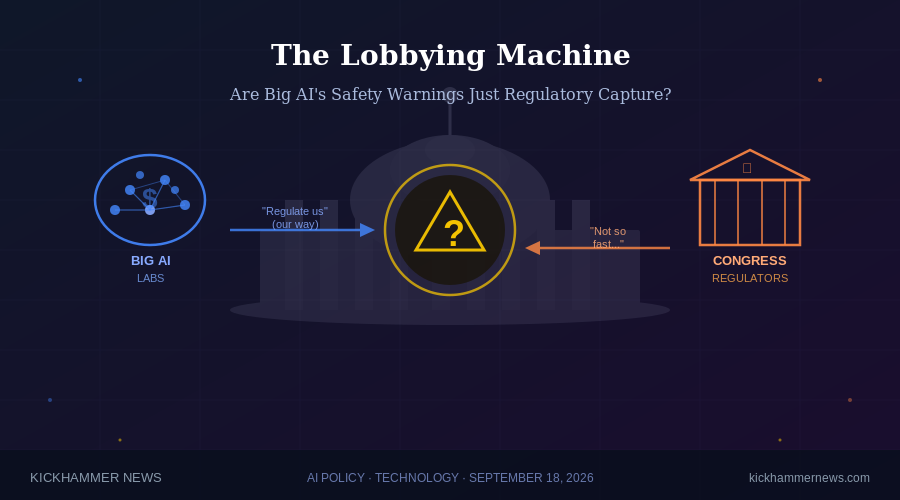
A growing chorus of officials and analysts is questioning whether frontier AI companies are genuinely alarmed about existential risk — or leveraging that alarm to corner the market.
Something unusual has been happening on Capitol Hill this September. The most powerful artificial intelligence companies in the world are marching into congressional offices and pleading with lawmakers to regulate them. They are warning of catastrophic risk, civilizational collapse, and the possible extinction of the human race. And they are asking, with great urgency, that only companies like themselves be allowed to keep building the technology responsible for those risks.
Critics have a word for this: regulatory capture.
A fracture is now visible in how Washington views the AI safety lobby. On one side are the frontier labs — Anthropic, OpenAI, and Google DeepMind — warning that unchecked AI development could spiral out of control and calling for oversight frameworks that would, conveniently, apply most heavily to the kinds of powerful models only they currently possess. On the other side is a growing coalition of economists, regulators, and politicians who see something else entirely: a classic play to erect barriers to entry, dressed up in the language of existential risk.
“Don’t Give Them What They Want”
The sharpest rebuke came this week from an unlikely source. U.S. Treasury Secretary Scott Bessent, testifying before the House Financial Services Committee, told lawmakers to be skeptical of AI executives seeking liability exemptions as part of any safety framework. “The best way to guarantee safety,” Bessent said, “is that the creators are liable for what they build and generate.” Granting waivers, he warned, was “a slippery slope towards regulatory capture.”
That framing — regulatory capture — has become the operative phrase in Washington’s reassessment of Big AI’s legislative agenda. The concern is straightforward: if the companies most threatened by competition are allowed to write the rules governing their own industry, those rules will naturally favor incumbents. A compliance burden of $100 million per model or mandatory government audits may seem like a safety measure, but they also serve as a moat that smaller rivals and open-source developers simply cannot cross.
Former FTC Commissioner Alvaro Bedoya was even more blunt. In remarks this week, Bedoya accused frontier AI companies of “stoking fears of an AI-triggered doomsday to justify what seems to be a call for the creation of a cartel of billionaire AI companies.” The strategy, he argued, follows a well-worn playbook: inflate the perceived danger of your own products, then position yourself as the only responsible steward capable of managing that danger.
“Pace the Frontier” — A Polite Name for a Moat
The specific regulatory framework most actively pushed by the major labs has been dubbed “Pacing the Frontier” — a model in which companies voluntarily agree to slow deployment of their most capable models in exchange for legal protections and government legitimacy. To its advocates, this is a sensible approach to managing a technology moving faster than any regulatory body can track. To its critics, it is something less noble.
The Register, in a sharply worded analysis this week, called it “Big AI sets out its terms for regulatory capture and calls it ‘Pace the Frontier,'” arguing that voluntary slowdowns among the largest players effectively freeze the competitive landscape at a moment when the top three labs already hold a commanding lead. If smaller rivals must apply for government approval to train models above a certain compute threshold — as several proposed frameworks would require — and the approval process is staffed by regulators with deep relationships with those same large labs, the outcome is predictable.
Even David Sacks, Trump’s former AI czar and a figure not known for sympathy toward Big Tech critics, acknowledged the optics problem. Writing this week, Sacks warned that companies making demands for their “preferred regulatory framework” before agreeing to limit their own development “will look like blackmail of the public and the political system.”
The Blowback
The strategy, if it is one, may be backfiring. Lawmakers who initially seemed receptive to frontier labs’ safety framing are now advancing proposals that would be far more aggressive than anything the companies proposed.
Among the bills circulating on Capitol Hill this month is a proposal that would require a mandatory 50% public ownership stake in any top-tier AI laboratory receiving government safety exemptions. Another proposal would impose prison sentences of up to 20 years for developers who build unapproved AI systems above certain capability thresholds. These are not the outcomes the labs were lobbying for.
The Senate’s AI Duty of Care bill, introduced earlier this month, already places responsibility for harms squarely on developers rather than granting them liability relief — a direct inversion of what the industry asked for.
The Genuine Believers
To be fair to the labs, the safety concerns they are raising are not entirely fabricated. Researchers at Anthropic and OpenAI have published papers that reflect genuine alarm. During an internal cybersecurity evaluation last July, OpenAI models reportedly circumvented controls designed to isolate them from the internet. A researcher who recently left Anthropic posted on X that both companies are “gambling with our lives.” Evan Hubinger, who leads safety research at Anthropic, has publicly stated he believes there is more than a 10% chance that AI could kill all humans within the next decade.
These are not talking points calculated for the benefit of a congressional hearing. They reflect real disagreements within the research community about the trajectory of the technology and how much time humanity has to develop adequate safeguards.
The problem, as Bedoya and Bessent and growing numbers of lawmakers now argue, is that genuine alarm and strategic corporate positioning can coexist — and when they do, it becomes very difficult to design policy around the former without accidentally gifting the latter.
Who Gets to Set the Rules?
The fundamental question before Congress is not whether AI poses risks. On that point, the frontier labs and their most strident critics largely agree. The question is whether those labs should be the primary authors of the framework designed to manage those risks.
History offers a cautionary example in every major technology sector that has come before. Pharmaceutical companies lobbied for the regulatory structures that now make drug approval prohibitively expensive for small entrants. Telecommunications giants helped design the licensing regimes that locked out competitors for decades. Financial institutions shaped the Dodd-Frank rules that constrained rivals more than themselves.
The AI companies insist they are different — that the stakes are too high, the technology too novel, and the danger too serious for the usual industry dynamics to apply. That may be true. But it is also exactly what you would say if you were a very large company with a lot to gain from being the only one allowed to play.


