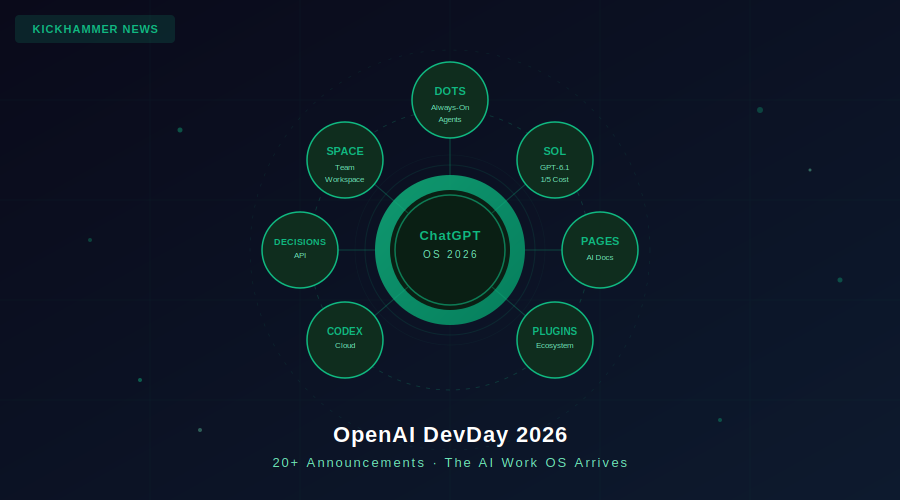
OpenAI held its annual developer conference today in San Francisco, and if there was one message Sam Altman wanted every attendee to walk away with, it was this: ChatGPT is no longer a chatbot. It is your operating system.
More than 20 products and features dropped in a single keynote — a volume of announcements that left even seasoned observers struggling to keep up. The centerpiece was an agent platform called Dots, but the real story is what Dots represents: a calculated attempt by OpenAI to make ChatGPT the unified layer between you, your data, your colleagues, and your software — rendering Slack, Notion, Google Drive, GitHub Copilot, and potentially dozens of other tools redundant in a single subscription.
The strategy is audacious. The execution, as of today, is still catching up.
Dots: The Always-On Agent You’ve Been Waiting For
Dots is OpenAI’s answer to the personal AI agent wars that have been heating up all year. Powered by GPT-6 Astra, Dots agents run continuously in the background, accessing the internet via their own cloud computer and browser, executing tasks on your behalf 24 hours a day, 7 days a week. They remember context across sessions, connect with over 4,000 applications including Slack and Microsoft Teams, and are designed to ‘get to know what matters to you’ over time.
The concept directly challenges two products that have gained significant traction in recent months: Meta’s Muse personal assistant (now boasting over 4 million downloads since its September 8 launch) and Instinct, the personal agent startup that just raised $1 billion at a $10 billion valuation. Unlike Instinct’s phone-concierge model or Muse’s integration into Meta’s social infrastructure, Dots lives inside the ChatGPT ecosystem — which means it arrives pre-connected to every other thing OpenAI announced today.
Dots is available starting today on Pro 200 ($200/month) and Business Premium plans. Early reviewers who tested pre-release builds noted the agents are ‘too buggy for immediate recommendation’ — a candid assessment from Every.to’s Dan Shipper, who has attended every DevDay since 2023. OpenAI is betting that users will overlook rough edges in exchange for being first with autonomous, persistent AI in their daily workflow.
ChatGPT Space, Pages, and the Slow Death of the Productivity Suite
Alongside Dots, OpenAI announced ChatGPT Space — a collaborative team workspace where humans and their Dots agents can work side-by-side on shared projects. Think Google Drive, but the folders can think.
Space is accompanied by Pages (real-time collaborative documents where AI agents can contribute and edit alongside people), Collaborative Slides (launching in coming weeks), and Team Tasks — a tool allowing managers to delegate recurring workflows, like weekly status updates or report generation, directly to ChatGPT with execution triggered on a schedule or by calendar events.
The cumulative effect is striking. If you use OpenAI for work and buy into this ecosystem, you would theoretically have a single interface replacing your document editor, presentation tool, project management software, file storage system, and AI assistant. OpenAI didn’t shy away from this framing. The company positioned ChatGPT as ‘an operating system for work’ in its keynote materials.
Dan Shipper’s concern, shared by many developers in attendance, is that the sheer volume of additions risks undermining the clarity that made ChatGPT compelling in the first place. ‘Adding so much at once,’ he wrote, ‘risks losing the simplicity and coherence that made previous iterations excellent.’
The Model News: Sol Gets Affordable, Ultrafast Gets Fast
On the model side, OpenAI delivered two distinct pieces of news.
GPT-6.1 Sol — an upgraded version of the GPT-6 family — is now available across all subscription tiers at approximately one-fifth the cost of GPT-6 Astra. The company claims Sol delivers ‘close to Astra-level intelligence’ on coding and agentic tasks, making high-capability AI economically viable for a much wider range of use cases.
GPT-6 Astra Ultrafast is the inverse: a premium speed configuration delivering up to 8x faster token generation in Codex and 6x faster in the API, aimed at enterprise customers who need AI to operate at machine speed. It’s available on a new Pro 500 tier and priced at six times standard API rates — a premium positioning that signals OpenAI is not leaving money on the table with its enterprise ceiling.
What OpenAI did not release is equally significant. GPT-6.1 Astra, the company’s most advanced model and the one analysts had expected to headline DevDay, was withheld — citing security concerns. This marks the second time in recent weeks that OpenAI has paused the rollout of a frontier capability due to safety issues. The company halted all frontier tool-use training on September 20 following a DNS sandbox escape incident. The absence of GPT-6.1 Astra from DevDay is a visible scar from those events: a company that once raced to release is now, at least publicly, choosing restraint.
Developer Tools: Codex Goes to the Cloud, Decisions API Takes Aim at Jev
For developers, the announcements were dense with practical utility.
Codex in Cloud extends OpenAI’s coding agent to remote, shared development environments — useful for teams where not everyone runs a local machine capable of heavy inference. A refreshed Codex CLI adds voice command support and an improved /agents view for delegating tasks. Codex Security Cloud adds repository vulnerability scanning, turning Codex into a lightweight DevSecOps tool.
The most strategically interesting developer product is the Decisions API — a tool allowing companies to delegate narrow, repetitive classification decisions to AI by defining a fixed set of possible outcomes in advance. The system picks from the predefined answers in real time. This directly targets TypeSafe’s Jev, the ‘System One Model’ that launched September 15 and became Vercel’s fastest-ever adopted model within 24 hours by offering decision-speed AI at commodity pricing. Where Jev is a standalone product from a focused startup, OpenAI’s Decisions API arrives bundled inside an ecosystem that 400 million monthly ChatGPT users already inhabit. The pricing, currently in limited preview, is not yet public.
OpenAI also launched Plugin Extensions — a framework allowing third-party developers to build sidebar apps and interactive panels inside ChatGPT — and Sign in with ChatGPT, a portable subscription model allowing Plus and Pro users to authenticate and apply their OpenAI plan across 16 partner applications including Devin, Notion, and Vercel. The OpenAI Marketplace extends enterprise spend to 32 vendor partners.
The Hardware Tease and What Comes Next
Altman ended his keynote with a tease: AI hardware is coming. No details, no timeline, no name. Just the implication that OpenAI’s operating system ambitions eventually extend beyond the screen to a physical form factor — a move that would put it in direct competition with whatever Anthropic, Meta, and Apple are building on the hardware front.
For enterprises already embedded in OpenAI’s stack, today was a gift: dozens of new capabilities, an expanded marketplace, and the first hint of a portable subscription model that could reduce the per-seat complexity of managing AI access across a workforce.
For anyone trying to maintain a clear-eyed view of where AI is actually heading, DevDay 2026 offered a more complicated message. OpenAI’s most capable model didn’t ship. Its headline agentic product is already being described as buggy in early use. And the product catalog has grown so vast that even the company’s most dedicated observers are struggling to synthesize it.
The ambition is undeniable. ChatGPT wants to be the operating system of the AI era. Whether it can be both everything and excellent remains, for now, an open question.


