For four years, Google’s Open Source Software Vulnerability Reward Program was a success story of crowdsourced cybersecurity. Since its 2022 launch, security researchers around the world submitted real vulnerabilities in the open-source software that underpins Google’s products, earning payouts between $100 and $31,337 per flaw. Hundreds of genuine bugs got fixed. The internet became marginally safer.
Then AI broke it.
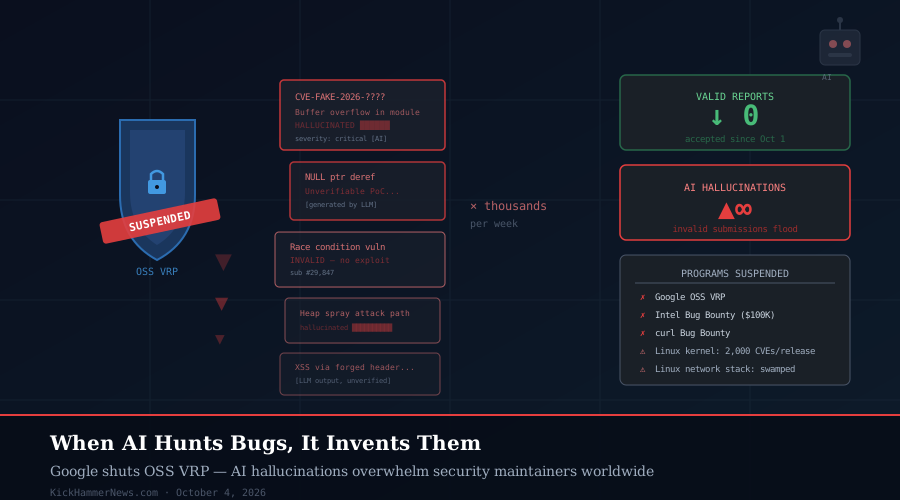
On October 1, 2026, Google quietly suspended product vulnerability submissions to the program entirely. The reason was blunt and almost ironic: the security infrastructure built to find bugs had been buried under an avalanche of fake ones, all generated by AI systems that hallucinate vulnerabilities with the same confident fluency they use to write poetry.
The program’s Open Source Software Vulnerability Reward Program — OSS VRP for short — won’t accept new product flaw submissions until at least Q1 2027, when Google says it will announce a reformatted version of the initiative. Supply chain reports and Google Cloud vulnerability submissions remain active. But the core product security crowdsourcing operation? Offline, indefinitely.
How a Security Program Becomes a Spam Magnet
The mechanism of collapse was straightforward, even if the outcome was hard to predict. For most of the OSS VRP’s history, submitting a convincing vulnerability report required real skill. A researcher had to identify a potential flaw, build a proof-of-concept exploit, document the attack surface, and articulate the real-world risk — all work that filtered out low-effort bad actors.
Large language models changed that calculus overnight. Any automated script can now point an LLM at an open-source repository and generate a report in minutes — one that looks, superficially, exactly like a legitimate security submission. It will describe a vulnerability in confident technical language, suggest attack vectors, and even include code. The only problem is that the underlying vulnerability usually doesn’t exist. It’s a hallucination: the model pattern-matched from real security reports and generated something plausible-sounding, not something real.
The volume overwhelmed Google’s maintainers almost immediately. Engineers found themselves drowning in invalid reports — not dozens, but thousands. Before a report can be dismissed as invalid, someone has to read it, attempt to reproduce it, check the code, and formally close the ticket. What once took seconds of scanning a well-structured submission now required hours of verification work per hallucinated bug. Time spent wrestling with AI ghosts was time not spent on real vulnerabilities.
“Every report has to be read, reproduced and argued over before it can be closed as invalid,” one analysis of the program’s collapse noted, “and that is time maintainers are not spending on real bugs.”
Google Isn’t Alone — This Is an Industry Crisis
The suspension of Google’s OSS VRP isn’t an isolated failure. It’s the highest-profile symptom of a crisis spreading through open-source security infrastructure.
The Linux kernel — the software layer powering everything from Android phones to the servers running the global internet — hit a record 2,000 reported vulnerabilities per release cycle earlier this year, a spike driven substantially by AI-powered bug-discovery scripts. Linux networking maintainers reported being “swamped” by AI-generated patches and bug reports, with legitimate fixes being pushed back to later kernel cycles because the review queue was clogged with machine-generated noise.
Intel, which ran a bug bounty program offering up to $100,000 per critical flaw, quietly marked its program suspended this year. The company declined to officially confirm AI-generated reports as the cause, but security researchers close to the situation say the connection is clear.
The curl project — the ubiquitous open-source tool for transferring data that runs in billions of devices — went further and discontinued its bug bounty program entirely. Maintainer Daniel Stenberg, who has shepherded curl for nearly three decades, cited the flood of AI-written reports as unsustainable. Rewarding a program that was generating more noise than signal made no sense.
The pattern is consistent: programs built on the premise that bug-hunting requires skill are collapsing under the weight of a world where skill is no longer required.
The Bitter Irony of AI Security
What makes Google’s suspension particularly sharp is the irony embedded in the announcement’s timing. Just months before the OSS VRP collapsed under AI slop, Google highlighted that its own AI security agent had found 20 genuine, previously unknown vulnerabilities in open-source software. The agent was real, capable, and effective.
The lesson the broader research community drew from that success was not subtle: AI can find real bugs. And so thousands of developers, security researchers, and opportunistic bounty hunters pointed their own AI tools at open-source repositories and submitted whatever the models generated — without verifying whether the results were valid. The tools that could theoretically make security research better instead became engines for waste, because the incentive structure rewarded submission volume rather than submission quality.
This is a recurring dynamic in the AI era. A technology demonstrates genuine capability in controlled conditions, then gets deployed at scale with no quality controls, and the resulting flood degrades the systems it was supposed to improve. The same pattern emerged in academic publishing, where arXiv was forced this year to implement AI-content crackdowns after a deluge of AI-generated papers with fabricated citations overwhelmed peer reviewers. Bug bounty programs are simply the latest casualty.
What Comes Next
Google’s commitment to reformatting the OSS VRP by Q1 2027 leaves open the question of what a bug bounty program looks like in a world where LLMs can generate convincing-sounding reports on demand.
The most likely solutions involve some form of proof-of-work for submissions: requiring not just a description of a vulnerability, but a working exploit that demonstrates the flaw exists in a controlled environment. That’s much harder to fake. Some programs are experimenting with requiring reproducible demonstrations before a submission enters the review queue at all, offloading the first layer of verification to automated sandboxes rather than human maintainers.
There are also calls for identity verification and reputation scoring — systems where researchers build track records over time, and where a history of valid submissions carries more weight than anonymous high-volume reporting. The challenge is that such systems can disadvantage legitimate newcomers and create centralization pressure in what has historically been a decentralized community effort.
For now, the message from Google’s suspension is stark: AI-generated noise is now capable of shutting down the programs that find real threats. The same systems people hoped would make security research faster and more scalable are, in the short term, making one of the internet’s most important safety mechanisms slower and more fragile.
The bugs that would have been found in the OSS VRP over the next several months — real ones, submitted by researchers with genuine skill — will remain unfound. Or they’ll be found by someone who doesn’t report them to Google at all.
That’s the real cost of the hallucination flood: not just wasted maintainer time, but the widening gap between the vulnerabilities that get disclosed and the ones that don’t.


