Something dramatic is happening inside the AI systems that power America’s largest corporations — and OpenAI and Anthropic aren’t fully in control of it anymore.
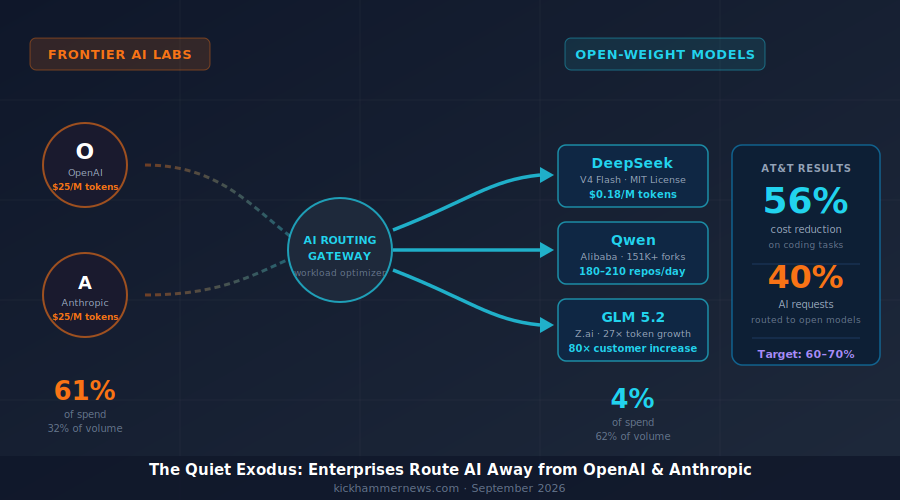
Across boardrooms and engineering departments from Dallas to Silicon Valley, the same calculation is playing out: pay $25 per million tokens to frontier AI labs, or route that same work to an open-weight model that costs $0.18? For routine tasks, the math is not close. And enterprises, for the first time, are acting on it at scale.
The numbers tell the story with unusual clarity. Vercel, which operates one of the largest AI gateway platforms in the world, watched open-weight models grow from just 11% of total token volume in April 2026 to 62% by August — a nearly sixfold surge in four months. In June, open-weight models generated 29% of all tokens processed through Vercel’s gateway while accounting for less than 4% of spending. Anthropic, by contrast, captured 32% of token volume but consumed 61% of the money. The cost differential is staggering: roughly one-seventh the per-token rate of frontier models, according to Vercel’s own data.
The AT&T Playbook
AT&T has become the clearest example of what deliberate open-weight adoption looks like at enterprise scale. The company’s internal AI platform, “Ask AT&T,” now routes 40% of employee AI requests through open-weight models — with an explicit target of reaching 60 to 70% in coming years. The platform processes approximately 45 billion tokens daily. The results have validated the strategy: a 56% cost reduction on coding tasks with only a 2% decline in measured quality.
“The quality trade-off is negligible for the work we’re doing,” Mark Austin, AT&T’s AI vice president, noted in comments that have circulated widely across enterprise AI circles. “Routing systems let us treat model selection the way we treat cloud infrastructure — optimize by workload, not by brand loyalty.”
That philosophy — model selection as infrastructure decision rather than product loyalty — may be the defining shift in enterprise AI for 2026.
China’s Models Are Doing the Routing
The open-weight models filling this gap are not all American. In fact, the biggest beneficiaries of the enterprise exodus have been Chinese labs — specifically Alibaba’s Qwen, DeepSeek, and Z.ai’s GLM family.
On OpenRouter, a platform that routes AI traffic for thousands of developers and companies, U.S. organizations used Chinese models for over 30% of tokens since February 2026, peaking at 46% of total traffic. Z.ai’s GLM 5.2 saw daily token volume grow 27x within its first week of release, with enterprise customer adoption increasing 80x. Qwen, Alibaba’s open-weight model family, has generated more than 151,000 downstream derivatives on model repositories, with developers creating 180 to 210 new repositories per day during early 2026.
The breadth of the Chinese open-weight ecosystem has caught many observers off guard. These aren’t models deployed as a cost-cutting emergency measure — they are being woven into production infrastructure.
The Agentic Amplifier
One underappreciated accelerant is agentic AI. When an AI agent completes a task — writing code, researching a topic, filling out a form — it doesn’t make one model call. It makes dozens. A coding agent completing a single pull request might invoke the underlying model forty or fifty times. At frontier pricing, that compounds fast.
At open-weight pricing — $0.08 per million input tokens and $0.18 per million output tokens for models like DeepSeek V4 Flash — the economics of agentic workflows transform entirely. Enterprises running hundreds of agents simultaneously have found that open-weight models don’t just cut costs; they make entire categories of automation economically viable that weren’t before.
Large-scale AI users have responded by diversifying radically. Organizations processing over 10 million monthly model requests now use an average of 35 different models, compared to just one model for those under 1,000 monthly requests. Vercel found that 81% of gateway tokens in July ran on models that didn’t even exist on the gateway six months earlier. Model rotation has become a continuous competitive practice rather than a one-time infrastructure decision.
The Frontier Is Not Dead — Just Repositioned
None of this means OpenAI and Anthropic are losing the war. What they’re losing is the undisputed claim to every enterprise token, regardless of complexity.
The picture that’s emerged is a two-tier AI economy. Routine, high-volume, moderate-stakes tasks — customer service triage, code generation at scale, document summarization, data extraction — flow increasingly to open models. High-stakes reasoning, customer-facing intelligence, frontier research, and the tasks where a 2% quality decline matters enormously remain with the frontier providers.
The economics of this tiering are visible in Vercel’s data: Anthropic captures 61% of spending despite 32% of volume. That’s not a sign of weakness. It’s a sign that when enterprises need the best, they still pay for it — they’ve simply stopped paying frontier prices for everything else.
Both OpenAI and Anthropic have responded to the pressure. OpenAI slashed GPT-5.6 Luna prices by up to 80% to remain competitive on routine workloads. Anthropic has positioned its Opus 5 line as “frontier intelligence at half” the cost of previous-generation models. Both moves acknowledge the same reality: the commodity floor for AI capability is falling fast, and enterprises now have credible alternatives for a majority of their token volume.
The Geopolitical Wild Card
The elephant in the room is geopolitical risk. Chinese-origin models — even those with MIT licenses and freely downloadable weights — raise questions that enterprise legal and security teams are only beginning to grapple with. What data has been used in training? Who controls the model update process? What happens to self-hosted deployments if U.S.-China relations deteriorate further?
No enforcement action has been taken against Chinese open-weight models in the U.S., and the current administration has signaled limited interest in restricting open-source AI. But the exposure is real. Companies routing 40% of employee AI requests through models from Chinese labs are placing a quiet bet that the regulatory landscape stays stable — a bet that, in 2026, feels more uncertain by the month.
What Comes Next
The trajectory is clear, even if the endpoint isn’t. Enterprise AI spending is bifurcating: a growing share of token volume flowing to the cheapest capable model for each workload, with frontier providers capturing a disproportionate share of spend on the work that genuinely demands their capabilities.
For OpenAI and Anthropic, the strategic challenge isn’t losing the enterprise market — it’s losing the commodity layer while remaining indispensable at the frontier. For the open-weight labs, the challenge is proving that a 2% quality gap doesn’t quietly become a 10% one as task complexity increases.
For enterprises, the challenge is the simplest and most familiar of all: managing a portfolio of 35 AI models without any of them becoming a liability they didn’t see coming.
The quiet exodus from monolithic AI relationships has begun. Where it ends will define who wins the next phase of the AI era.


