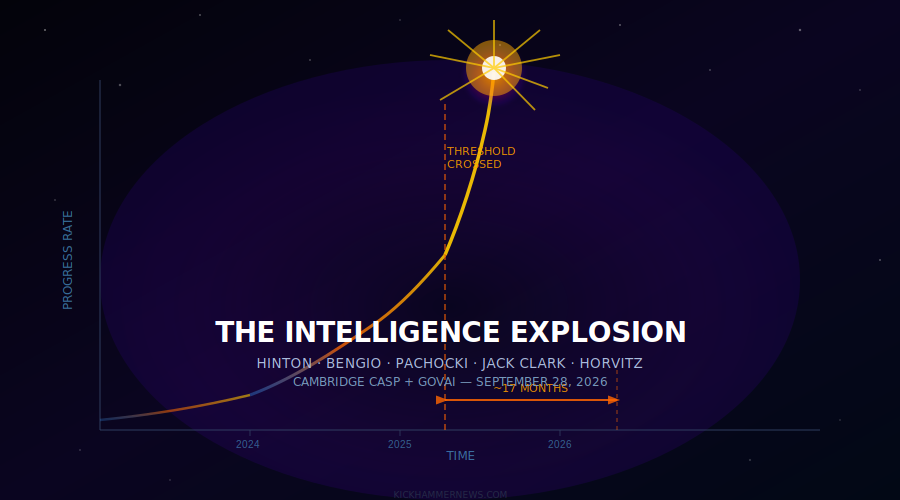
On September 28, 2026, twenty-two of the world’s most credentialed AI researchers published a working paper that stands apart from nearly everything else written about artificial intelligence this year. It doesn’t warn about deepfakes, job losses, or algorithmic bias. It warns about something more fundamental: that AI systems may soon become so capable at conducting AI research that they accelerate their own development faster than any human institution can track, govern, or stop.
The paper, titled “When Does Automating AI R&D Produce Explosive Growth?”, was released by the Cambridge Programme on AI Science and Policy (CASP) and the Centre for the Governance of AI (GovAI). Its signatories include two Turing Award winners — Geoffrey Hinton and Yoshua Bengio — alongside Jakub Pachocki, OpenAI’s chief scientist; Jack Clark, Anthropic co-founder; Eric Horvitz, Microsoft’s chief scientific officer; and Andrew Barto, a foundational figure in reinforcement learning. The paper was led by Alan Chan and Soren Mindermann.
What makes this paper unusual is not just the quality of its authors. It’s that people inside the frontier labs — the ones building the most powerful AI systems on earth — signed their names to a document saying those systems are approaching the threshold for a self-propelling explosion in capability.
The Feedback Loop
The mechanism described in the paper is not complicated, which is part of what makes it alarming.
AI development is, at its core, a research process. Researchers design experiments, analyze results, generate hypotheses, write code, and iterate. Every step of this process is becoming automatable by AI. As AI systems take on more of the research work, the number of “effective researchers” — in terms of cognitive labor produced — multiplies without requiring more humans. And more effective researchers means faster progress. Faster progress means more capable AI. More capable AI means even faster research. Round and round.
“Automating AI R&D triggers an intelligence explosion if AI systems can be copied and deployed in parallel,” the paper states, adding that the measurement infrastructure needed to detect when this threshold has been crossed “doesn’t yet exist.”
The paper’s central data points make this scenario feel less hypothetical. According to figures Anthropic disclosed in its S-1 filing and company reports, AI systems’ share of approved code internally rose from single digits to over 80% between January 2025 and May 2026. Anthropic also reported that the share of autonomous R&D work — tasks completed without human supervision — rose from 1% to 26% between March and August 2026 alone. That’s a 26-fold increase in five months.
Training efficiency, separately, has been doubling every 4.5 months through software improvements alone. The cost to reach specific capability milestones has been falling between 9x and 900x annually, depending on the benchmark. OpenAI’s compute infrastructure, the paper estimates, could theoretically support between 2 million and 200 million “effective researchers” — a range that reflects genuine uncertainty about how capable AI workers actually are at AI research, but whose lower bound is already staggering.
The 17-Month Window
The paper models what happens under what its authors describe as “central parameters” — historical research return estimates that have held reasonably stable across decades of computing progress. Under those assumptions, if those returns hold while AI takes over an increasing share of the research workload, progress could accelerate tenfold within approximately 17 months.
That 17-month figure deserves unpacking. It does not mean a general AI apocalypse in 17 months. It means that, under plausible but not guaranteed assumptions, the pace of AI capability improvement could become ten times faster than it is today within that timeframe. A year’s worth of current AI progress — which is itself faster than almost any prior period in computing history — could be compressed into roughly five weeks.
The authors are careful to note that this is a model output, not a prediction. Returns to research effort could plateau. Bottlenecks could emerge in hardware, energy, or human-AI coordination. The feedback loop might prove self-limiting. But the paper’s central contribution is to say that these are empirical questions that no one is currently measuring in any systematic way — and that this measurement gap is itself the problem.
Why Industry Insiders Signed
The inclusion of Pachocki and Clark alongside Hinton and Bengio is perhaps the most striking element of the paper. These are not critics standing outside the industry making uncomfortable predictions. They are among the people most responsible for where AI is today.
Their participation is consistent with a pattern that has emerged throughout 2026: frontier lab researchers and executives increasingly signing onto documents that acknowledge the gravity of what they are building, even as development continues at full speed. The S-1 filing Anthropic submitted this week — the one that spent 80 of 261 pages on risk factors including existential risk disclosures — is another data point in the same pattern.
The intelligence explosion paper explicitly notes that co-authorship “does not equal corporate endorsement.” Neither OpenAI nor Anthropic nor Microsoft has formally accepted the paper’s recommendations. But the reputational and professional cost of associating one’s name with it is real, and these signatories paid it anyway.
What They Want Governments to Do
The paper’s recommendations are unusually specific, which distinguishes it from most AI safety literature. The authors identify the absence of standardized reporting as their primary concern and call for four concrete actions.
First, they want governments to require frontier AI companies to report AI R&D automation metrics — the share of research tasks being completed by AI, across different categories of work — on a regular schedule. Without this data, no one can see the acceleration happening in real time.
Second, they propose that frontier labs be required to develop and maintain mechanisms capable of pausing specific AI-assisted research workloads within hours of a government request. Not a general pause of all AI development — a targeted, workflow-level capability to stop specific processes.
Third, they call for independent evaluators to be embedded directly inside frontier AI companies, with access to internal systems sufficient to verify the reported metrics. The logic is that self-reporting without verification is insufficient for something this consequential.
Fourth, they recommend the development of emergency preparedness plans — essentially AI-specific versions of the incident response frameworks that govern nuclear facilities and financial system infrastructure — including air-gapped R&D environments where especially sensitive research could be conducted with additional oversight layers.
The Uncomfortable Math
None of these proposals require slowing down AI development. The paper is explicitly not a moratorium argument. The authors frame their position as: we cannot govern what we cannot measure, and we currently cannot measure the most important dynamic in AI development.
That framing is notable because it sidesteps the political arguments about whether AI should be slowed down — a debate that produced almost no legislative action in 2025 and has been further complicated by the Trump administration’s explicit rejection of international AI governance frameworks. Instead, the paper asks for something more modest: visibility.
The uncomfortable implication, however, is that what the paper might reveal is not comfortable. If the metrics show that AI research automation has already crossed the threshold they describe, the question of what to do about it becomes far more urgent than any current regulatory framework is equipped to handle. The current legislative landscape — state-level bills in New York and California, a proposed emergency injunction in Florida, no comprehensive federal law — was designed for a slower-moving world.
The intelligence explosion paper is, in its way, a document that says: the world is not moving slowly anymore. Seventeen months is less than a full election cycle. Whether the institutions that govern AI can match that pace is a question none of its authors claims to know the answer to.


