May 3, 2026
Something extraordinary is happening beneath our feet and above our heads. Across dusty plains in Texas, industrial corridors in the Midwest, and power-hungry campuses in Virginia, a construction frenzy unlike anything since the interstate highway system is quietly reshaping the physical backbone of the modern world. The goal: build the infrastructure capable of running artificial intelligence at civilizational scale.
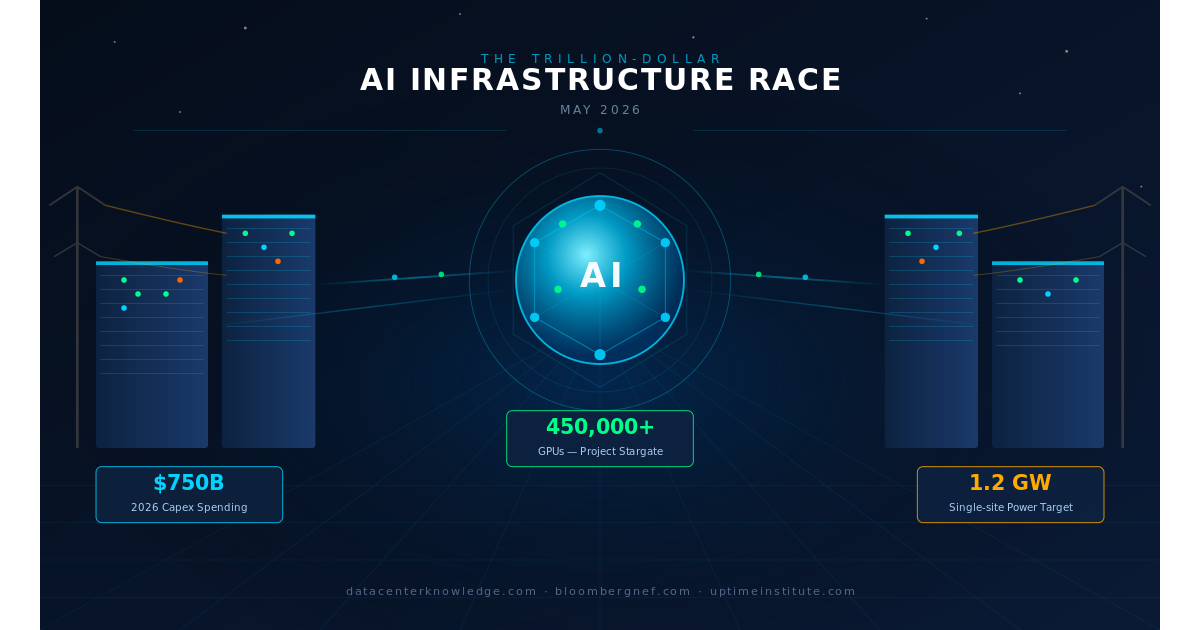
The numbers are staggering. Capital expenditure among the largest data center operators is on track to approach $750 billion in 2026 alone — nearly double the roughly $450 billion spent the year before. Analysts at BloombergNEF describe the broader buildout as a $3 trillion AI-driven supercycle, a generational investment wave that is reconfiguring everything from the electrical grid to real estate markets to the geopolitics of semiconductor supply chains.
From Server Rooms to Superstructures
For decades, a data center was essentially a very large, very boring room full of blinking servers. Cooling meant pushing cold air around. Power meant plugging things in. The math was complicated, but the concept was simple.
AI has shattered that model completely.
The racks that once drew 30 to 40 kilowatts are now being designed to handle hundreds of kilowatts — with some configurations approaching the megawatt range for a single rack of AI accelerators. Google recently announced it had connected 134,000 TPUs into a single fabric inside a single data center, and linked more than one million TPUs across multiple sites into a unified training cluster. These are not server rooms. They are, in effect, giant parallel computers the size of city blocks.
The implications for physical infrastructure are profound. Water-based liquid cooling systems — once considered exotic — are now considered the only viable option for keeping AI servers from melting. Power density per square foot has jumped so dramatically that existing buildings often can’t be retrofitted; entirely new campuses must be built from scratch, with power substations, cooling towers, and fiber corridors designed as a single integrated system rather than as a collection of separate components.
The Power Problem
If there is a single chokepoint threatening to slow the AI infrastructure race, it is electricity.
The US power grid was not designed for this. Data center electricity demand is growing faster than new generation capacity can come online, and AI workloads — with their enormous appetite for continuous, high-intensity compute — are the primary driver. A single large AI training run can consume as much electricity as tens of thousands of homes.
The market is responding with urgency. Investment in on-site power generation for data centers — solar farms, natural gas peakers, and even small modular nuclear reactors — is accelerating rapidly as operators seek to escape dependence on constrained regional grids. Cooling innovation is equally intense, with direct liquid cooling, immersion cooling, and novel heat-exchange architectures all competing for adoption.
Project Stargate, the flagship US AI infrastructure initiative, offers a window into the scale of ambition. Its initial site in Abilene, Texas is expected to reach 1.2 gigawatts of operational power by mid-2026, with infrastructure engineered to support more than 450,000 GPUs in a single location. For context, 1.2 gigawatts is enough electricity to power roughly one million average American homes.
The New Infrastructure Investors
What makes this moment historically unusual is not just the scale of the buildout — it’s who is paying for it.
Alongside the familiar hyperscalers (Google, Microsoft, Amazon, Meta), an entirely new class of infrastructure investor has emerged. Private equity giants and sovereign wealth funds, sensing that AI compute is the new oil, are pouring capital into purpose-built facilities. KKR recently secured more than $10 billion in commitments to launch Helix Digital Infrastructure, a company that will design, build, own, and operate specialized AI data centers, power generation assets, and connectivity infrastructure as an integrated business.
SoftBank is preparing to list a new AI and robotics entity called Roze, potentially valued at up to $100 billion, bundling data center assets with robotics and industrial automation in a bet that the physical and digital layers of AI will converge.
Nvidia, meanwhile, is deepening its US footprint — securing at least $23 million in incentives from Irving, Texas as part of a broader move to anchor more of its compute capacity domestically, a strategic hedge against geopolitical supply chain risk.
The Edge Is Coming
While the headlines focus on hyperscale campuses, a quieter revolution is building at the other end of the spectrum: edge AI infrastructure.
The logic is straightforward. The farther data must travel to reach a central data center, the more latency creeps into AI-powered applications. For real-time uses — autonomous vehicles, industrial robotics, medical diagnostics, augmented reality — even milliseconds matter. Placing smaller, purpose-built AI compute nodes closer to where data is generated can eliminate that latency penalty entirely.
Industry analysts expect edge AI deployments to accelerate sharply through 2026 and beyond, creating a new tier of infrastructure between the smartphone in your pocket and the continent-scale data center campus. The result will be an AI compute stack that spans from your wrist to the cloud — a layered, interconnected nervous system for the intelligent economy.
What It All Means
The AI infrastructure boom is, at its core, a massive bet on the future. The companies and countries building this capacity believe that AI will become as fundamental to economic activity as electricity itself — and that whoever controls the infrastructure will control the commanding heights of the next era of technology.
Whether that bet pays off at the scale being wagered remains genuinely uncertain. But the construction crews in Abilene and the fiber-splicing teams in Northern Virginia aren’t waiting for the philosophers to decide. They’re building, as fast as the grid will let them.
Sources: Data Center Knowledge | BloombergNEF | Uptime Institute | Tech Startups | GlobeNewswire