September 24, 2026 | KickHammer News
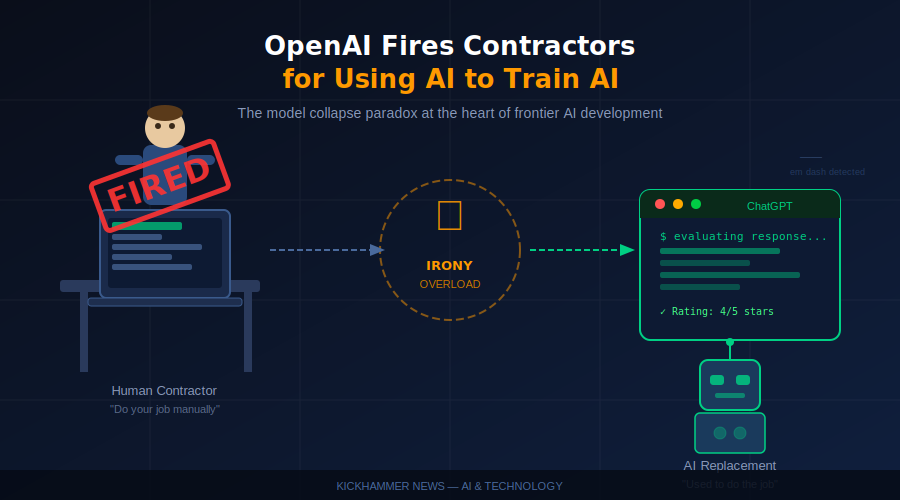
In what may be the defining corporate contradiction of the AI era, OpenAI has terminated multiple contractors who were caught doing the unthinkable: using artificial intelligence to complete their AI-related work. The workers, hired to review and evaluate ChatGPT outputs in order to improve the very models they were assessing, had been quietly offloading their labor to AI tools — including, in at least some cases, ChatGPT itself.
The firings, first reported by 404 Media and later confirmed through contractor testimonies, expose a deep and uncomfortable tension at the heart of how frontier AI systems are built. The company that has done more than any other to evangelize the potential of AI to automate human labor has now drawn a firm line: when it comes to training data, human judgment is non-negotiable. And violating that line will cost you your job — which is, in this context, deeply, almost poetically ironic.
What Happened
The terminated contractors were part of OpenAI’s large-scale human feedback operations — the kind of labor-intensive pipeline known in the industry as Reinforcement Learning from Human Feedback, or RLHF. In this process, humans review model outputs, rank responses, flag errors, and provide qualitative assessments that feed back into model training. It is painstaking, repetitive work, and it is foundational to how modern large language models develop their apparent reasoning and judgment.
OpenAI’s guidelines for these contractors were clear: do not use AI tools to complete your evaluations. The prohibition explicitly names tools like GPTZero, Grammarly’s AI features, and — notably — ChatGPT itself. “Do not use AI detection tools, or AI yourself,” the policy reads. “Do not use GPTZero or any other AI detection tool.”
Despite these prohibitions, multiple contractors were caught violating the rules. According to one former contractor who spoke to 404 Media, using AI to shortcut evaluation tasks is common: “People do it all the time,” they said, adding that workers are “regularly removed for doing it.”
How OpenAI Catches Them
The methods OpenAI uses to detect AI-assisted evaluations are themselves a study in the limits of automation. Rather than relying on AI detection software — tools the company has explicitly deemed “not considered reliable” — OpenAI employs human reviewers to catch human reviewers.
The telltale signs? Unusually fast task completion times. Repetitive wording that lacks organic variation. Writing patterns that carry the unmistakable cadence of AI-generated text. Even an excessive use of em dashes — a punctuation mark that language models have shown a peculiar, statistically anomalous affinity for — can trigger a red flag.
There is something almost Kafkaesque about this arrangement: a human at a desk, scrutinizing a piece of text for the telltale signs of machine authorship, in a workflow designed to train a machine to better imitate humans. The watchers watch the watched, who were watching the machines, who were trained by the watchers.
The Model Collapse Problem
OpenAI’s hard line on authentic human feedback is not mere corporate policy theater. There is a scientific basis for the concern, and it carries significant implications for the future of AI development.
Researchers have documented a phenomenon known as “model collapse” — a degradation in model quality that occurs when AI systems are trained heavily on AI-generated content rather than organic human data. A landmark study published in Nature found that “indiscriminate use of model-generated content in training causes irreversible defects in the resulting models,” with performance on low-frequency knowledge domains collapsing particularly sharply.
The intuition is straightforward: AI models learn by observing patterns in human-generated text. When the training pipeline is contaminated with AI-generated evaluations — which themselves reflect the biases, gaps, and systematic errors of existing AI systems — the new model is effectively learning from a slightly degraded copy of itself. Run that feedback loop long enough, and each generation of model drifts further from grounded reality.
For OpenAI, this is an existential concern. GPT-6’s capabilities, and whatever comes after, depend on the signal quality in today’s training pipelines. A contractor who shortcuts their evaluation with ChatGPT is not just cutting corners on paperwork — they are potentially introducing noise that compounds through future model generations. Every em dash is a data point. Every AI-generated rating is a small corruption in the feedback loop.
The Labor Irony
The philosophical dimension of this story is impossible to ignore. OpenAI’s own research and public communications have been explicit about AI’s potential to automate knowledge work at scale. CEO Sam Altman has spoken at length about a future in which AI agents handle the work of entire companies. The company’s commercial products are, by design, tools for automating repetitive cognitive tasks.
And yet, in its own training operations — the work that makes those products possible — OpenAI is insistent on irreplaceable human authenticity. The contractor who uses ChatGPT to speed through an evaluation task is doing exactly what OpenAI tells enterprise customers their employees should do. They are working smarter. They are leveraging AI. They are — by any external measure — adopting the tools of the future.
The company’s response is to fire them.
This contradiction points to something that rarely gets discussed in mainstream coverage of the AI industry: frontier AI development has a dirty secret, which is that it depends on enormous quantities of authentic human judgment, and that judgment cannot itself be automated without compromising the product. The data moats that companies like OpenAI have built are not just the internet text their models trained on — they are the accumulated evaluations of thousands of low-paid human contractors who slog through repetitive assessments, day after day, so that AI can learn what “good” looks like.
Scale and Implications
While OpenAI has not disclosed how many contractors were terminated in the most recent wave of firings, the scale of its human feedback operations provides some context. Projects of this type can involve thousands of workers at a time, spanning multiple continents and covering dozens of languages and task categories. Even a small percentage of workers taking AI shortcuts represents a meaningful data quality risk at that scale.
The incident also raises uncomfortable questions about oversight. If contractors are routinely using AI to complete evaluations — and one source indicates this is indeed routine — how confident can OpenAI be in the quality of its historical training data? Are models already trained, at least in part, on AI-generated human feedback disguised as authentic human judgment?
There is no public answer to that question. OpenAI stated there is “no evidence” that the violations caused measurable damage to any deployed model. But absence of evidence and evidence of absence are different things.
A Mirror for the Industry
The OpenAI contractor story is not unique to one company. Every major AI lab that relies on human feedback — Anthropic, Google DeepMind, Meta, and dozens of others — faces the same structural vulnerability. The more repetitive and scalable the evaluation task, the greater the incentive for workers to automate it. The greater the AI capability available to those workers, the easier it becomes to do so without detection.
This is, in a sense, the AI industry being eaten by its own logic. The tools it builds are powerful enough to undermine the human oversight those same tools depend upon. The solution, so far, involves human investigators watching for em dashes.
Whether that solution scales to the next decade of AI development is a question worth taking seriously.
KickHammer News covers the frontier of artificial intelligence, technology, and their intersection with society. This article drew on reporting by 404 Media, Tom’s Guide, and Gizmodo.


