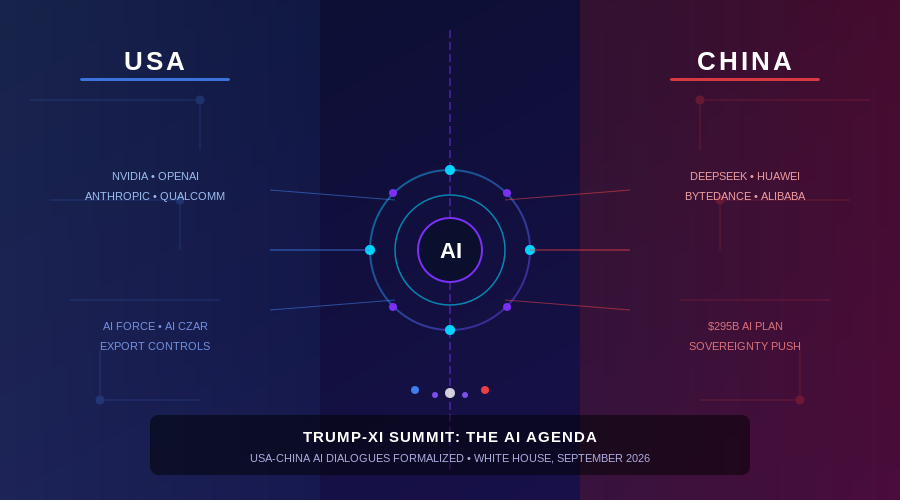
As world leaders gather in New York for the United Nations General Assembly, the most consequential bilateral meeting of the year is drawing near — and artificial intelligence has moved to the top of the agenda. President Donald Trump and Chinese President Xi Jinping are set to sit down at the White House later this week in a summit that will define, at least in part, the geopolitical rules of the AI age. The stakes could not be higher.
On Sunday, the groundwork was laid when U.S. Treasury Secretary Scott Bessent met with Chinese Vice Premier He Lifeng at JPMorgan Chase headquarters in New York City. After nearly eight hours of talks described by Bessent as “very successful,” the two sides emerged with something quietly historic: the formalization of the “USA-China AI Dialogues” — a structured, ongoing communications channel dedicated specifically to artificial intelligence risks and safety protocols.
A New Hotline for the AI Era
Bessent’s description of what was agreed upon sounds almost Cold War-era in its design — but fitted for the machine learning age. “We want to open a communications line, an incident line, so that we have constant communications, especially in the event of some kind of an incident,” Bessent told CNBC after Sunday’s talks. “And then we want to start discussing protocols for what our — so both sides can agree on — what the leading AI dangers are, whether it’s uncontrollable agents, whether it’s non-state actors, and cyber non-state actors in bioweapons.”
The two sides have agreed to reconvene in two months in China to continue the dialogues. This mirrors the kind of crisis-communication infrastructure that the U.S. and Soviet Union built during the Cold War — a hotline to prevent catastrophic miscalculation. In this case, the threat isn’t nuclear missiles; it’s runaway autonomous agents and AI-enabled biological weapons.
Trump’s Winning Frame
President Trump has made his own position unambiguous. In a social media post Monday, he doubled down on his view that AI’s existential risks are a “hoax,” writing: “We are leading now over China, and everyone else, and I’m going to keep it that way! I’m not going to stifle Growth, of something that will be bigger than the Industrial Revolution, or the Internet itself.”
For Trump, AI is a race — and slowing down to install safety guardrails means handing the lead to Beijing. “Whoever wins AI, wins,” he declared on September 13. His administration has signaled it would only support government safety involvement in AI if China agrees to equivalent measures — in essence, making AI safety a diplomatic bargaining chip.
This competitive framing has been woven into a flurry of executive action. Last week, Trump announced plans to appoint a new AI czar and establish an “AI Force,” modeled on the Space Force, to coordinate national AI strategy across government and military functions. Details on the scope and responsibilities of both remain vague, but the political signal is clear: AI is now a matter of national security, and the White House intends to treat it as such.
China’s Response and the IP Dispute
Beijing has not been passive in this rivalry. Chinese AI companies — most notably the team behind DeepSeek — have developed sophisticated models that critics in Washington allege were built in part by “distilling” leading U.S. AI systems, effectively reverse-engineering their capabilities. The Trump administration has threatened sanctions over these practices, accusing China of intellectual property theft at machine scale.
Beijing, for its part, has rejected these accusations and accused Washington of running “a Cold War playbook” designed to contain Chinese technological advancement rather than address genuine safety concerns. The IP standoff threatens to dominate summit discussions, even as both sides try to find common ground on managing AI catastrophic risk.
AI Royalty at the State Dinner
Perhaps the most telling signal of AI’s place at the center of geopolitics is the guest list for Trump’s state dinner for Xi. According to multiple reports, Nvidia CEO Jensen Huang, OpenAI CEO Sam Altman, and Qualcomm CEO Cristiano Amon are all expected to attend. The presence of the most powerful figures in the American AI industry at a diplomatic state dinner underscores how thoroughly AI has fused with foreign policy.
Jensen Huang, whose Nvidia chips remain the dominant hardware behind virtually all frontier AI training runs, is uniquely positioned at the intersection of U.S.-China AI tensions: Nvidia has been repeatedly caught in the middle of U.S. export controls designed to slow China’s AI development, including restrictions on high-end H100 and A100 chips. His attendance at a Trump-Xi dinner raises questions about what conversations might happen in the margins.
The Warning from the Past
Even as the current administration dismisses AI safety concerns as obstructionism, former voices from Washington are growing louder. Former President Barack Obama, speaking at Colgate University ahead of the summit, issued a pointed warning about the accelerating pace of AI development.
“We have reached this point of what’s called recursive learning, where essentially — and we had anticipated this, but now we’re seeing it — the machines are starting to be able to teach themselves. They don’t have to wait for humans to start figuring things out,” Obama said. A decade ago, his administration had issued a prescient report on preparing for AI’s future. Now, he warned, time is running out.
Obama’s central concern is not abstract superintelligence — it’s the near-term weaponization of AI by bad actors. “The more serious problem is, these models are getting powerful enough that if they get in the hands of bad humans, they can do bad things,” he said, citing bioweapons design and financial market manipulation as examples. He called for urgent, bipartisan regulatory action and warned voters to hold leaders accountable if they lack a serious AI policy plan.
What’s Really at Stake
The Trump-Xi summit on AI arrives at an inflection point. Frontier AI models are now capable of autonomous multi-step tasks, real-time reasoning, and self-improvement in constrained domains. The gap between what AI can do today and the regulatory frameworks governing it is growing by the quarter. Meanwhile, the two countries responsible for the majority of the world’s AI development are locked in a rivalry that mixes genuine security concern with economic competition and strategic posturing.
The “USA-China AI Dialogues” announced Sunday may be a modest but meaningful step. A formal channel for discussing AI incidents — analogous to nuclear hotlines — could prevent miscommunication during a future AI-enabled cyberattack or autonomous agent misbehavior from escalating into something worse. Whether that channel can survive the broader tensions over IP, export controls, and AI supremacy is a much harder question.
One thing is certain: when Trump and Xi sit down this week, artificial intelligence will be on the table in a way it has never been before at a heads-of-state level. The outcome may shape not just diplomatic relations, but the architecture of global AI governance for years to come.


