September 22, 2026 — The open-source AI race just got a serious new contender. Xiaomi, the Chinese consumer electronics giant better known for budget smartphones than frontier AI research, today released MiMo-V2.6, a new family of open-weight AI models that immediately vaulted to the top of the open-source rankings — and raised uncomfortable questions in Washington about whether US export controls are accelerating exactly the outcome they were designed to prevent.
A Benchmark-Shattering Debut
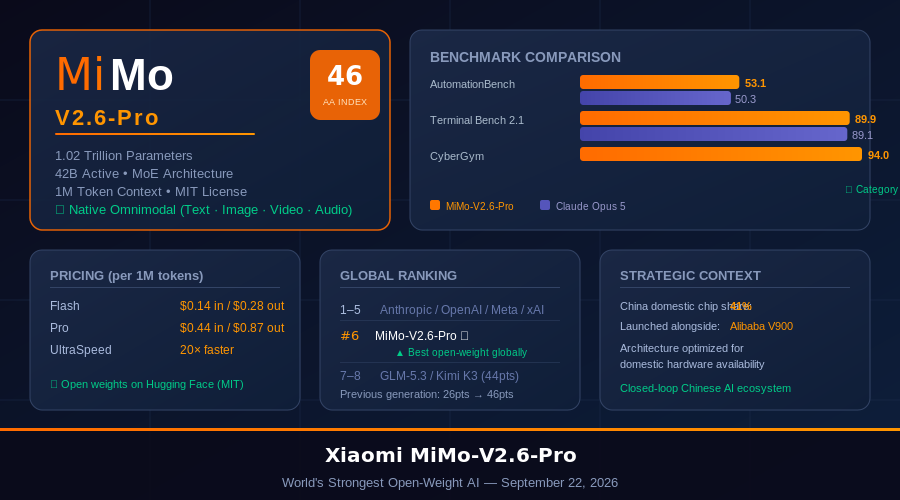
The headline number is 46 points on the Artificial Analysis Intelligence Index v4.3 — a composite score that tracks model performance across reasoning, coding, agentic tasks, and multimodal capabilities. That places MiMo-V2.6-Pro dead level with Grok 4.7, xAI’s recently launched flagship, and dramatically ahead of previous open-weight leaders GLM-5.3 and Kimi K3, both of which scored 44. The predecessor, MiMo-V2.5-Pro, scored only 26 points — meaning Xiaomi nearly doubled its performance in a single generation.
In the broader landscape that includes proprietary models, MiMo-V2.6-Pro ranks sixth globally, trailing only commercial systems from Anthropic, OpenAI, Meta, and xAI. For a fully open-weight model released under an MIT license, that is a remarkable achievement.
The benchmarks tell a nuanced story. On agentic tasks — the category the industry increasingly treats as the real measure of practical usefulness — the model holds up well. It scored 53.1 on AutomationBench, compared to 50.3 for Claude Opus 5. On Terminal Bench 2.1, it reached 89.9%, slightly edging Opus 5’s 89.1%. It matched Opus 5 on Agents’ Last Exam. Its most dominant result came on CyberGym, a cybersecurity benchmark where it posted a category-leading 94.0%. Weaknesses include long terminal sessions and exploit detection, where proprietary systems still hold a clear advantage.
One Trillion Parameters, Native Multimodal, MIT License
The technical architecture behind MiMo-V2.6-Pro is substantial. The model uses a sparse frozen-router Mixture-of-Experts design with 1.02 trillion total parameters — but only 42 billion activate per inference, keeping compute costs manageable relative to raw parameter count. It incorporates a 5-layer MTP speculative decoder and supports a one-million-token context window.
Critically, the Pro model is natively omnimodal. It accepts text, images, video, and audio in a single unified model — not through bolted-on adapters but through dedicated sub-components: a 681 million-parameter vision encoder, a 308 million-parameter AudioTokenizer, and a 127 million-parameter audio patch encoder capable of distinguishing speech patterns. Hybrid attention mechanisms round out the architecture.
Three variants ship today:
- MiMo-V2.6-Flash: The efficiency-optimized model, priced at $0.14 per million input tokens and $0.28 per million output tokens through OpenRouter.
- MiMo-V2.6-Pro: The flagship, at $0.435 per million input and $0.87 per million output.
- MiMo-V2.6-Pro-UltraSpeed: A specialized inference-optimized version that delivers output up to 20 times faster than Pro at equivalent quality, priced at $4.35/$8.70 per million tokens.
Both Pro and Flash are available on Hugging Face under an MIT license, allowing unrestricted commercial use, self-hosting, and fine-tuning without royalty obligations. Xiaomi claims Pro’s cost-per-intelligence-task sits at approximately $0.11 per Artificial Analysis Index point — firmly on the Pareto frontier of price-versus-performance.
The Hardware Angle: China’s Closed-Loop Moment
Xiaomi’s model release did not happen in a vacuum. It arrived on the same day as Alibaba’s announcement of the V900, a high-bandwidth AI accelerator chip designed for large-scale inference workloads. The coincidence, if it is one, underscores a broader trend analysts have been tracking for the past 18 months: China’s AI ecosystem is becoming increasingly self-sufficient.
Domestic Chinese chipmakers now supply approximately 41% of the local AI accelerator market, up from effectively zero when the US Commerce Department first expanded its Entity List restrictions on Nvidia H100 and A100 shipments to China. The restriction intended to widen the compute gap between US and Chinese AI labs; instead it catalyzed a domestic semiconductor push that, while still trailing Nvidia’s leading edge on raw FLOPs-per-watt, is now capable of supporting frontier-class training runs when deployed at sufficient scale.
MiMo-V2.6-Pro’s architecture — sparse MoE with high parameter counts but low active-parameter-per-inference ratios — is precisely the kind of design that runs efficiently on domestically available hardware. The frozen router eliminates the communication overhead that typically makes MoE difficult to scale across heterogeneous chips. It reads like a model built for the hardware China has, not the hardware China wishes it had.
Why the Open-Weight Strategy Matters
Releasing under MIT license is a deliberate strategic choice. Xiaomi is not in the AI API business in the way OpenAI or Anthropic are — it has no consumer AI subscription product generating revenue from these weights. The release is, at least in part, a positioning play: establishing Xiaomi as a serious frontier AI lab, attracting talent, building ecosystem relationships with developers who will embed MiMo into downstream products, and demonstrating capability in a domain China’s government has identified as strategically critical.
There is also a competitive logic. Open-weight models at this capability level effectively set a new floor for proprietary pricing. If developers can self-host a model scoring 46 on the Intelligence Index for the cost of compute, providers of closed API models at similar capability levels face sustained downward pricing pressure. The Xiaomi release is not just a product announcement — it is market structure intervention.
For Western developers and enterprises, the MIT license creates a practical question: at what point does a Chinese-origin open-weight model enter enterprise procurement conversations? The capability argument is now compelling. The geopolitical and supply-chain risk assessments will vary by organization.
The Regulatory Paradox
The context surrounding this release is difficult to ignore. The United States has spent the past three years using export controls as its primary tool for maintaining AI leadership, restricting sales of advanced chips and AI accelerators to Chinese entities. The premise was that compute is the binding constraint on AI capability, and controlling compute means controlling the frontier.
MiMo-V2.6 does not prove that premise wrong — Xiaomi almost certainly has access to some level of high-performance compute through various channels. But it does suggest the strategy has a ceiling. When a company known primarily for affordable smartphones ships a model that competes with Grok 4.7 and outperforms Claude Opus 5 on agentic benchmarks, and releases it free to the world under an MIT license, the dynamics of AI competition have clearly shifted beyond what chip export controls alone can contain.
The real constraint on frontier AI capability may be architectural insight, training methodology, and the quality of post-training alignment work — domains where restrictions are far harder to enforce than hardware shipments.
What Comes Next
Xiaomi has not disclosed a training timeline or compute expenditure for MiMo-V2.6, making it difficult to assess exactly how the performance gains were achieved. The jump from 26 to 46 on the Intelligence Index in a single generation — a near-doubling — is the kind of improvement that typically signals a significant architectural or training-data shift, not just incremental scaling.
The release sets up several near-term dynamics worth watching. First, how the open-source community responds: MiMo-V2.6-Pro running at 42 billion active parameters is theoretically deployable on mid-range server hardware, opening fine-tuning and specialization opportunities at a scale the previous generation’s 44-point leaders did not. Second, whether other Chinese labs — particularly those behind GLM-5.3 and Kimi K3 — respond with their own next-generation releases in the weeks ahead. Third, whether the MIT license holds: some enterprises may apply additional scrutiny to models from Chinese-origin developers even absent specific export restrictions on their use.
For now, one thing is clear: the open-weight frontier just moved, and it moved in an unexpected direction. Xiaomi built a smartphone empire on the proposition that premium performance does not require premium pricing. The MiMo-V2.6 release suggests the company is applying the same thesis to large language models — and on September 22, 2026, it appears to be working.


