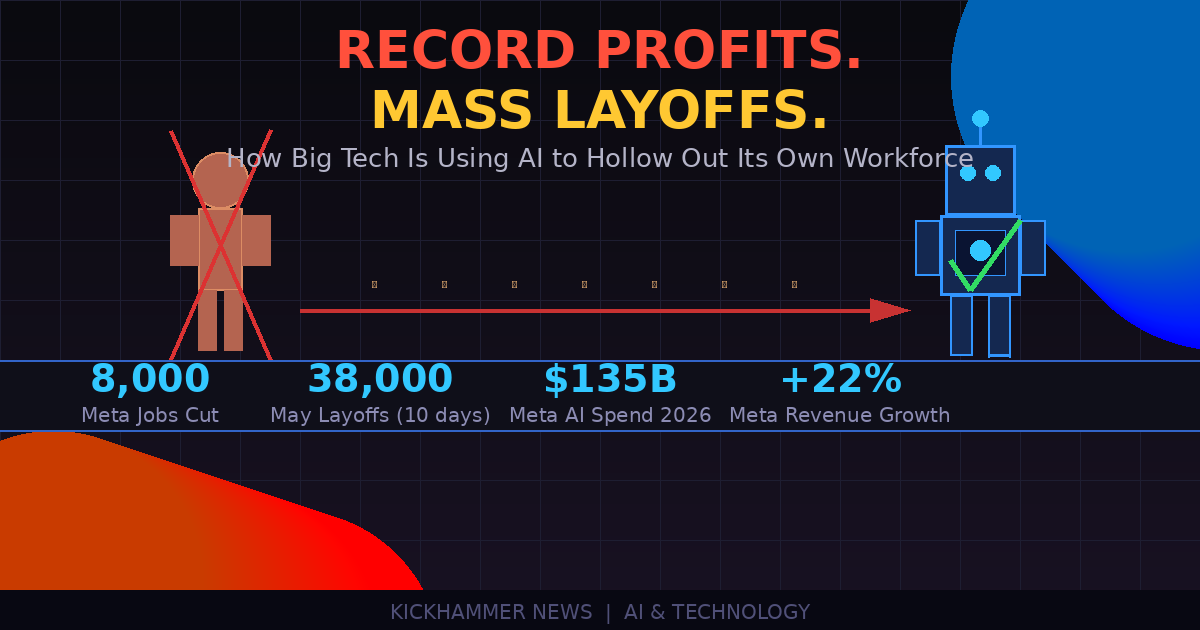
The pattern is undeniable: record revenues, soaring AI budgets, and mass layoffs — all happening simultaneously. May 2026 is the month the contradiction became impossible to ignore.
On May 20, Meta will begin one of the largest single-day layoff events in Silicon Valley history. Approximately 8,000 employees — 10% of the company’s entire workforce — will receive notices. Another 6,000 open positions that were supposed to be filled this year have been quietly cancelled, bringing the effective reduction to 14,000 roles. And in the same breath, Meta’s CFO confirmed that the company will spend between $115 billion and $135 billion this year on AI infrastructure alone — nearly double the $72 billion it deployed in 2025.
This is not a company in distress. Meta posted $201 billion in revenue in 2025, up 22% year over year, with net income of $22.8 billion in Q4 alone. Free cash flow for the year hit $43.6 billion. By every traditional financial metric, Meta is thriving. The layoffs are not a sign of failure. They are a sign of something far more unsettling: that in the AI era, success and mass unemployment are not opposites. They are a package deal.
The Restructuring Playbook
What Meta is doing follows a script that is becoming the defining corporate narrative of 2026. Engineers across the company are being sorted into new AI-focused “pods,” with new job titles like “AI builder,” “AI pod lead,” and “AI org lead.” Teams that once operated independently are being folded into a centralized Applied AI organization overseen by Chief AI Officer Alexandr Wang — a 28-year-old who has become one of the most powerful figures at one of the world’s largest companies.
The logic is brutally simple. If AI can do the work of the humans you were planning to hire, you don’t hire them. If AI can do the work of the humans you already employ, you let them go — and redirect the payroll savings into the infrastructure that made them replaceable.
Meta is not alone. The first ten days of May 2026 saw nearly 38,000 layoffs across the U.S. technology sector. Cloudflare announced it would cut 1,100 jobs — roughly 20% of its workforce — after revealing that internal AI usage had surged more than 600% in just three months. Coinbase cut 14% of its staff. Upwork, the freelance platform, eliminated a quarter of its workforce. IT services giant Cognizant announced 15,000 cuts. The common thread in nearly every announcement: AI efficiency, AI restructuring, AI-driven operational overhaul.
Record Profits, Fewer People
The economic paradox at the heart of this moment deserves to be stated plainly. The companies cutting the most jobs are also, in many cases, posting the strongest results. Google Cloud grew revenue by 63% year over year in Q1 2026, powered almost entirely by enterprise AI demand. Big tech companies have collectively signaled that AI capital expenditures will surpass $700 billion this year — a figure that would have been unthinkable just three years ago.
The pattern is consistent across the board: companies are reporting record revenues and simultaneously cutting headcount, redirecting the savings into AI infrastructure that they believe will generate more value than the employees it replaces. It is not that AI has made these businesses worse at making money. It has made them better — and that is precisely what is eliminating jobs.
For decades, the standard reassurance about automation was that it would destroy old jobs while creating new ones. And that has historically been true, if painfully slow and uneven. But the speed and scope of what is happening in 2026 is straining that reassurance. When a company like Upwork — whose entire business model was connecting freelance workers with clients — eliminates 25% of its own employees because AI has made human workers less necessary, it signals something beyond a typical business cycle.
What $135 Billion Buys
Meta’s AI spending is not abstract. The company is building data center campuses across the United States and internationally, with a $27 billion joint venture with Nebius for a gigawatt-scale AI data center campus in Louisiana. It is purchasing hundreds of thousands of NVIDIA GPUs. It is training ever-larger versions of its Llama models. It is building recommendation systems that it believes will drive the next generation of advertising revenue.
The employees being cut in May are largely engineers and operations staff whose roles have been automated or whose functions have been absorbed into AI-powered workflows. The employees being hired — in much smaller numbers — are AI researchers, infrastructure specialists, and the new class of “AI builders” who will manage the systems replacing their colleagues.
This is not unique to Meta. Across the industry, companies are converging on the same architecture: smaller human workforces managing larger AI workforces. The question that nobody in Silicon Valley wants to answer too loudly is: where does that process end?
The Human Cost
For the 8,000 Meta employees receiving notices on May 20, the financial terms are not ungenerous: 16 weeks of base pay, plus two additional weeks per year of service, and 18 months of health coverage. In absolute terms, these are better severance packages than most American workers receive. But they do not answer the harder question, which is what happens when an entire class of skilled, well-paid knowledge workers finds itself competing for a shrinking pool of jobs at companies that have learned to do more with fewer people.
AI adoption in the American workplace has doubled in the past three years. By early 2026, 50% of employed American adults reported using AI in their work at least a few times per year, according to survey data. AI is not some distant future threat to employment — it is already deeply embedded in how work gets done. The layoffs of May 2026 are not a warning of what is coming. They are the first clear evidence of what is already here.
The companies making these decisions are not villains by any traditional definition. They are responding to competitive pressure, shareholder expectations, and a genuine technological transformation. But the speed and scale of the transition is outpacing any serious policy response, any meaningful retraining infrastructure, or any honest public reckoning with what it means when the most profitable companies in human history become, simultaneously, some of the most aggressive at eliminating the need for human labor.
Meta will fire 8,000 people on May 20. It will spend $135 billion building the machines that will do their work. Both of those things are true at the same time. That is the new tech economy. And 2026 is the year we can no longer pretend otherwise.


