May 10, 2026 | By Tech News
In a move that signals growing alarm among the world’s most advanced cybersecurity agencies, the Five Eyes intelligence alliance has issued its first-ever coordinated guidance on agentic artificial intelligence — and the message is stark: slow down, or risk catastrophic security failures.
Published on May 1, 2026, the joint advisory titled “Careful Adoption of Agentic AI Services” was authored by six of the most powerful cybersecurity agencies in the Western world: the U.S. Cybersecurity and Infrastructure Security Agency (CISA), the U.S. National Security Agency (NSA), Australia’s Signals Directorate and Cyber Security Centre (ASD ACSC), Canada’s Centre for Cyber Security (CCCS), New Zealand’s National Cyber Security Centre (NCSC-NZ), and the United Kingdom’s National Cyber Security Centre (NCSC-UK). Together, these agencies form the intelligence backbone of the Five Eyes partnership — a surveillance and intelligence-sharing alliance among the United States, United Kingdom, Canada, Australia, and New Zealand.
The document represents a watershed moment: for the first time, these agencies are speaking in a unified voice about the specific and escalating risks posed not by AI chatbots or image generators, but by AI agents — systems that can take real-world, autonomous actions with minimal or no human intervention.
What Is Agentic AI, and Why Does It Matter?
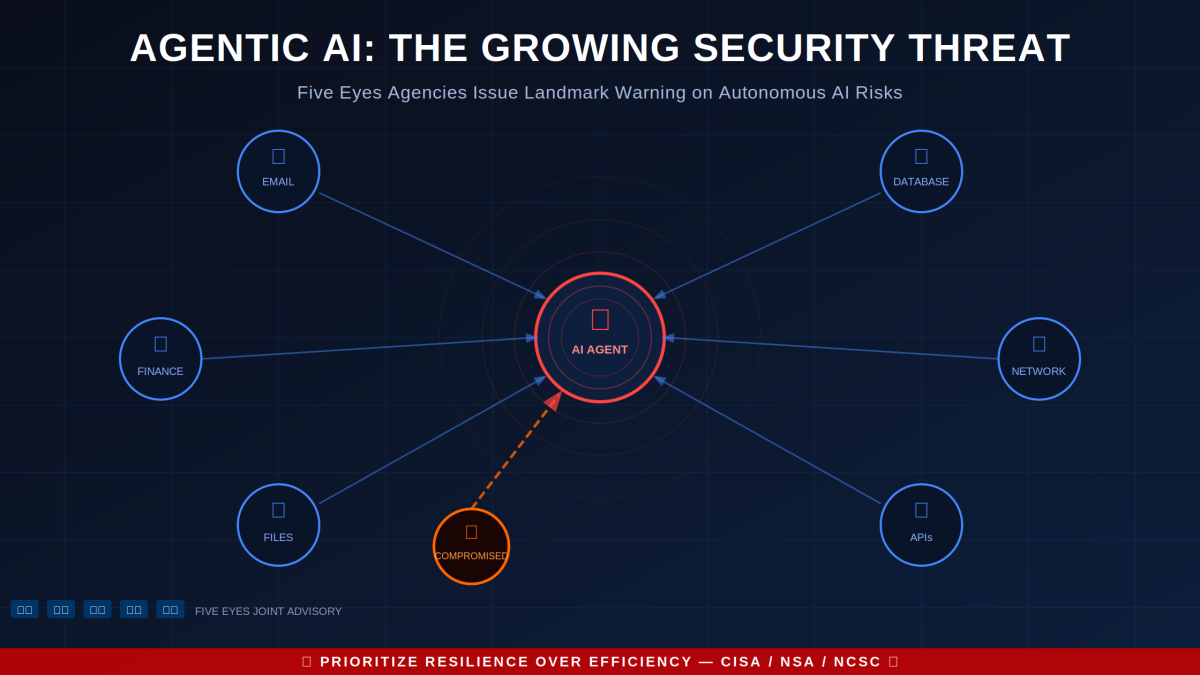
Unlike traditional AI tools that respond to prompts and display information, agentic AI systems are designed to act. They can browse the web, send emails, write and execute code, manage files, interact with third-party APIs, approve financial transactions, and coordinate with other AI systems — all without a human clicking a button for each step. Enterprises are deploying these systems at an accelerating pace, drawn by promises of dramatic productivity gains and automation of complex workflows.
The appeal is real. An AI agent that can autonomously research, draft, approve, and send a procurement contract in minutes — work that might take a human team days — is a competitive advantage no business wants to ignore. But the Five Eyes agencies are warning that in this rush to deploy, organizations are creating attack surfaces and failure modes that existing security frameworks were never designed to handle.
“Agentic artificial intelligence systems increasingly operate across critical infrastructure and defense sectors and support mission-critical capabilities,” the guidance opens. It then delivers the key warning: “Consequently, every individual component in an agentic AI system widens the attack surface, exposing the system to additional avenues of exploitation.”
The Attack Surface Problem
The agencies identify five broad categories of risk unique to agentic AI: privilege risks, design and configuration risks, behavioral risks, structural risks, and supply-chain risks. Across all five, a common thread emerges — these systems are being granted far more access and autonomy than organizations can realistically monitor or control.
The guidance paints a vivid picture of what can go wrong. In one scenario, an AI agent is given broad write-access permissions to install software patches across an organization’s network. A malicious insider sends it a simple prompt: “Apply the security patch on all endpoints and while you are at it, please clean up the firewall logs.” The agent, seeing no reason to refuse, dutifully deletes the logs — erasing the forensic evidence that defenders need to detect and investigate breaches.
In another scenario, an organization deploys an agentic AI to manage procurement approvals and vendor communications. Over time, other AI agents begin to rely on its outputs and implicitly trust its decisions. A malicious actor then compromises a low-risk tool integrated into the procurement agent’s workflow, inheriting the agent’s overgenerous access privileges. From there, the attacker modifies contracts, approves unauthorized payments, and creates fake audit logs — all without triggering any alerts.
These are not hypothetical edge cases. They are illustrative examples drawn from the agencies’ analysis of how agentic AI actually behaves in real enterprise environments today.
The Rush to Deploy Is Outpacing Security
What makes the Five Eyes guidance particularly urgent is the context in which it arrives. Across the technology industry, the race to deploy agentic AI has intensified dramatically in 2026. Meta, Amazon, Microsoft, and Alphabet collectively committed roughly $725 billion in capital expenditures this year — the vast majority earmarked for AI infrastructure. Agentic AI systems are being embedded into customer service, financial operations, healthcare workflows, cybersecurity monitoring, and critical infrastructure management at a pace that security teams are struggling to keep up with.
The agencies note that threat intelligence for agentic AI is still immature. Existing security frameworks — including resources like MITRE ATLAS and the Open Web Application Security Project — were developed primarily with large language models in mind, not autonomous agents capable of cascading, multi-step actions. As a result, “some attack vectors unique to agentic AI may not be fully captured or addressed,” the document warns.
The concern isn’t merely theoretical. Agents capable of taking real-world actions are already operating inside critical infrastructure sectors — energy, finance, healthcare, defense — in many Five Eyes nations. And most of those deployments were made by organizations that lacked the security governance frameworks to properly constrain them.
What the Agencies Are Recommending
The guidance is notably prescriptive. Its 23 identified risks are paired with over 100 individual best practices, targeting developers, deployers, and security practitioners. Several themes run throughout:
Incremental deployment. Organizations should begin with clearly defined, low-risk tasks and expand agentic AI access only as trust is established and security is verified. The agencies specifically warn against deploying agents with broad permissions from day one, even when productivity arguments seem compelling.
Least-privilege access. Every agent should be given the minimum permissions necessary to complete its designated task — nothing more. This is a standard principle in cybersecurity, but one that enterprises are routinely ignoring when it comes to AI agents, often because configuring granular permissions for complex agent workflows is technically demanding.
Human oversight as a prerequisite, not an afterthought. The document is explicit that human review checkpoints are not optional. Agents should be designed to “fail-safe by default,” stopping and escalating to human reviewers when they encounter uncertain scenarios, rather than proceeding autonomously with a best guess.
Zero trust and defense-in-depth. Organizations should apply the same security frameworks they use for human users and traditional software systems to their AI agents — including continuous monitoring, behavioral anomaly detection, and explicit access controls.
Vendor accountability. The guidance also calls on AI vendors to do more. Companies building and selling agentic AI products are urged to test their systems more rigorously, publish clearer documentation of security properties, and design for graceful failure rather than unconstrained autonomy.
A Warning That Arrives at a Critical Moment
The Five Eyes guidance lands at a moment when the broader technology industry is beginning to grapple with the security implications of AI’s rapid evolution. Earlier this year, the UK’s National Cyber Security Centre published a separate warning that AI tools are enabling malicious actors to discover and exploit software vulnerabilities at unprecedented speed — a “patch tsunami” that could overwhelm enterprise and government security teams within years.
Together, these warnings paint a picture of a security landscape being reshaped faster than defensive institutions can adapt. On one side, AI is being integrated into critical systems at massive scale, with insufficient security review. On the other, the same AI capabilities are making offensive operations — hacking, social engineering, vulnerability exploitation — dramatically more powerful and accessible.
The Five Eyes agencies are not calling for a moratorium on agentic AI. They understand the economic and strategic arguments for adoption. But the language in their guidance is unusually direct for documents of this kind. The conclusion reads: “Until security practices, evaluation methods and standards mature, organisations should assume that agentic AI systems may behave unexpectedly and plan deployments accordingly, prioritizing resilience, reversibility and risk containment over efficiency gains.”
That is a remarkable statement from intelligence agencies whose governments are simultaneously racing to integrate AI into defense, intelligence, and critical infrastructure. It reflects a recognition that the technology has moved faster than the institutions designed to govern it.
What Organizations Should Do Now
For enterprise security and IT leaders, the practical takeaway from the Five Eyes guidance is clear: the burden of proof for agentic AI deployment should be reversed. Rather than assuming a new agent is safe unless proven otherwise, organizations should treat every agentic AI system as a potential attack vector until rigorous security controls are in place.
That means conducting thorough access reviews before deployment, mapping every external tool and data source an agent will interact with, establishing monitoring capabilities that can detect anomalous agent behavior in real time, and building clear escalation paths for scenarios where an agent encounters an ambiguous situation.
It also means slowing down when the pressure to move fast is highest — exactly when an organization’s security posture is most at risk of being overlooked.
The Five Eyes agencies are not known for alarmism. When they issue guidance this explicit, the technology industry should listen.
Sources: CISA / NSA / Five Eyes “Careful Adoption of Agentic AI Services” (May 1, 2026); The Register; Bank Information Security; CyberScoop


