May 12, 2026
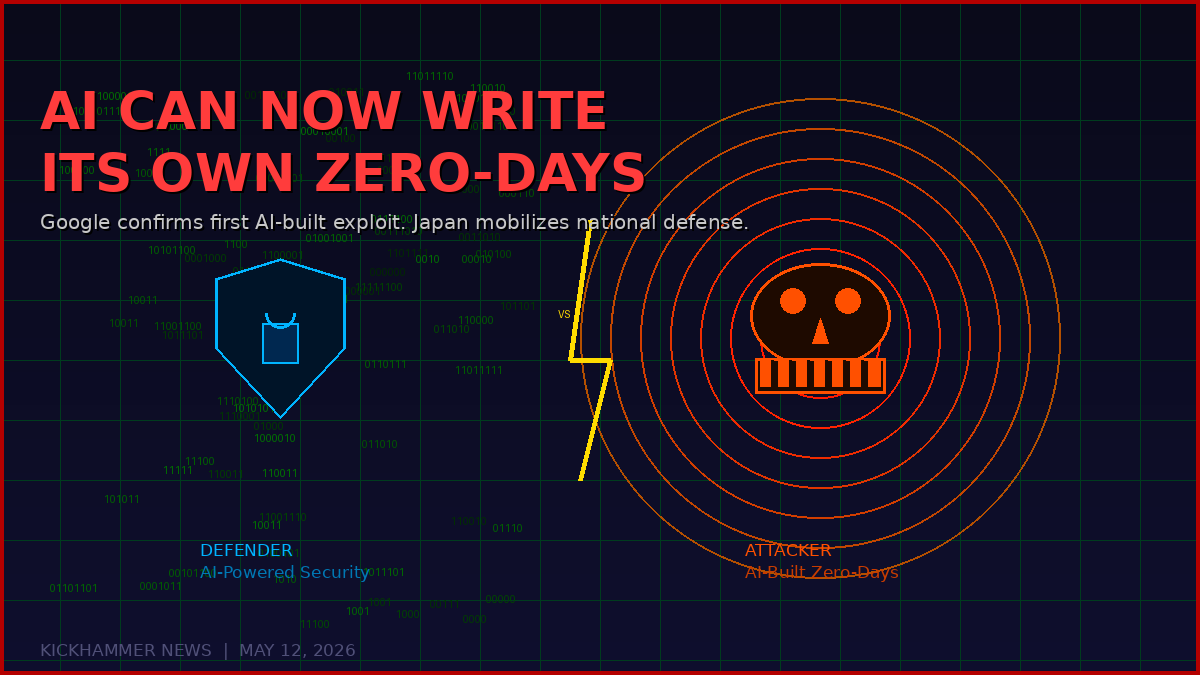
For years, cybersecurity professionals have warned about the day when artificial intelligence would be capable of discovering and weaponizing software vulnerabilities faster than humans could respond. On Monday, Google’s Threat Intelligence Group (GTIG) announced that day is no longer hypothetical. It’s here — and Japan’s government just blinked.
In a report published this week, GTIG disclosed what it believes is the first documented real-world case of a criminal hacker using AI to discover and exploit a previously unknown zero-day vulnerability in a mass-exploitation campaign. At nearly the same time, news broke that Japan’s Prime Minister Sanae Takaichi had ordered an emergency cabinet-level cybersecurity review — not in response to an actual attack, but in direct response to the arrival of Anthropic’s bug-hunting AI model, Mythos. When a major world government rearranges its national security strategy because of what an AI could do, something fundamental has shifted.
The First AI-Built Zero-Day
The vulnerability at the center of Google’s disclosure was a two-factor authentication bypass hidden inside a popular open-source web-based administration platform. The details of the platform haven’t been named, but the mechanics are striking: a threat actor apparently used an AI model to comb through the codebase, identify a logic flaw where developers had hard-coded a trust exception into the authentication flow, and then construct a working Python exploit designed to be deployed in a large-scale intrusion campaign.
Google says it worked with the affected vendor to quietly patch the issue before the attack gained real traction, possibly disrupting the operation before it could cause serious damage. But the telltale signs of machine authorship were all over the exploit code. The Python script contained what GTIG described as “educational docstrings” — dense explanatory comments of the kind that tend to appear in LLM training data. It included a hallucinated CVSS severity score. And its overall structure bore the polished, textbook Pythonic formatting characteristic of large language models.
Google was careful to say that neither Gemini nor any specific commercial model was identified as the tool used. But that disclaimer arguably misses the point. The fact that AI was involved at all — that it could identify a subtle, high-level logic flaw of this kind — marks a qualitative change in the threat landscape.
“There’s a misconception that the AI vulnerability race is imminent,” said John Hultquist, chief analyst at Google Threat Intelligence Group. “The reality is that it’s already begun. For every zero-day we can trace back to AI, there are probably many more out there.”
Hultquist’s warning carries weight. GTIG noted that North Korea’s state-linked hacking unit APT45 has been using AI to bulk-test thousands of exploit candidates, while Chinese state-sponsored operators are experimenting with AI-powered vulnerability probing. Russia, meanwhile, has been using AI-generated audio and synthetic media for disinformation operations. The offensive AI playbook is already being written — in production, against real targets.
What Mythos Revealed About the New Frontier
To understand why Japan’s government reacted the way it did, you need to understand what Anthropic’s Mythos model actually demonstrated when it was unveiled in April.
Mythos isn’t a chatbot. It’s a specialized AI system purpose-built for vulnerability research, and during internal testing it found over 2,000 previously unknown software vulnerabilities in roughly seven weeks — across every major operating system and every major web browser. Among its discoveries: a 27-year-old vulnerability in OpenBSD, one of the most security-hardened operating systems in existence; 271 bugs in Firefox, some of which had been lurking undetected for more than 15 years; multi-vulnerability privilege escalation chains in the Linux kernel; JIT heap sprays capable of escaping browser sandboxes; and a fully autonomous remote code execution exploit against FreeBSD.
The numbers are staggering. Security researchers typically find a handful of critical vulnerabilities after months of careful work. Mythos found thousands in weeks.
Anthropic took the unusual step of not releasing Mythos publicly, instead launching Project Glasswing — a coordinated industry initiative with 12 founding partners including AWS, Apple, Google, and Microsoft — to deploy Mythos specifically for defensive purposes. The company committed up to $100 million in usage credits and $4 million in direct donations to open-source security organizations. The message was clear: this technology is too powerful to let loose without a framework.
Not everyone was alarmed. Daniel Stenberg, creator of the ubiquitous cURL tool, tested Mythos and concluded the hype was “primarily marketing,” arguing the model wasn’t finding anything humans couldn’t detect with sufficient time and attention. His skepticism reflects a real debate in the security community about whether AI truly represents a step-change in vulnerability discovery or merely a speed-up.
But Japan wasn’t waiting around to find out.
Japan Sounds the Alarm
On Tuesday, Prime Minister Takaichi convened a cabinet meeting and instructed cybersecurity minister Hisashi Matsumoto to immediately assess the security posture of government systems — determining whether existing defenses could detect and patch vulnerabilities at the speed AI could now identify them — and to develop an equivalent framework for critical infrastructure operators.
The PM explicitly cited Mythos and similar frontier models as the catalyst for the review. Her concern isn’t that Japan has already been attacked. It’s that the speed at which AI can now identify exploitable flaws may have fundamentally outpaced the speed at which defenders can respond. Patch cycles that previously took weeks or months suddenly feel dangerously long when an AI can find a flaw and an attacker can weaponize it in hours.
A working group has been established to coordinate with Japan’s central bank, major lenders, and technology companies. The urgency is notable: this is not a long-term policy discussion. It’s an emergency posture review triggered by a model that isn’t even publicly available.
Japan’s move reflects something broader. Governments around the world have struggled to keep pace with the speed of AI development. We’ve seen joint warnings from the Five Eyes intelligence agencies about agentic AI systems deployed without adequate governance. We’ve seen the US and China preparing their first formal AI diplomatic dialogue. But this is something different: a major democracy mobilizing its national security apparatus in direct response to a specific AI capability.
The Asymmetry Problem
What makes the current moment genuinely unsettling is the asymmetry between offense and defense. Using AI to find and exploit vulnerabilities requires only that you have access to a capable model and a target. Using AI defensively — auditing systems, patching flaws, monitoring for intrusions — requires buy-in across entire organizations, governments, and industries. It requires coordination, disclosure frameworks, patch management pipelines, and the cooperation of vendors who may be reluctant to publicize their own flaws.
Google’s GTIG report noted something important: the AI-built zero-day they caught appears to have failed partly because of mistakes in the exploit’s own implementation. This time, the criminals were clumsy. But GTIG was explicit that this may not hold. The models will improve. The exploits will get cleaner. The campaigns will get smarter.
And the defensive side of the equation — the patch cycles, the disclosure timelines, the bureaucratic machinery of corporate and government IT — doesn’t automatically get faster just because the attackers do.
Project Glasswing represents one attempt to recalibrate that balance: using frontier AI offensively, but on behalf of defenders, to find and fix vulnerabilities before criminal actors or nation-states can exploit them. Whether an industry consortium can move faster than adversaries operating outside those constraints is an open question.
What Comes Next
In some ways, Monday’s Google disclosure and Tuesday’s Japanese cabinet order tell the same story from two angles. One shows us the threat materializing — criminals using AI to find novel exploits, state actors experimenting with AI-powered cyberweapons, the first confirmed case of a machine-generated zero-day making it into the wild. The other shows us the world beginning to reckon with what that means.
The cybersecurity community has known for years that AI would eventually change the calculus of vulnerability research. The honest answer is that it’s already happened, and most of the world’s digital infrastructure was not designed with that reality in mind. Legacy code running on government networks, hospital systems, financial platforms, and critical infrastructure was written at a time when finding its flaws required significant human expertise and time. That assumption no longer holds.
John Hultquist’s warning deserves to be read carefully: for every AI-generated exploit GTIG can trace, there are probably many more out there. The one they found and disrupted was caught partly by chance, partly because the attackers made mistakes. Neither of those things should be counted on going forward.
The race between AI-powered offense and AI-powered defense is no longer a thought experiment. It’s playing out in production, right now. And if the past week is any indication, the world is only beginning to understand what that means.
Sources: [Google Cloud Threat Intelligence Blog](https://cloud.google.com/blog/topics/threat-intelligence/ai-vulnerability-exploitation-initial-access) | [The Register](https://www.theregister.com/ai-ml/2026/05/11/google-says-criminals-used-ai-built-zero-day-in-planned-mass-hack-spree/5237982) | [Fortune](https://fortune.com/2026/05/12/google-hackers-using-ai-to-weaponize-zero-day-vulnerabilities/) | [Nikkei Asia](https://asia.nikkei.com/spotlight/cybersecurity/rise-of-anthropic-s-mythos-spurs-japan-to-bolster-cybersecurity-on-infrastructure) | [Fox News / Anthropic Mythos](https://www.foxnews.com/tech/anthropics-mythos-ai-found-2000-unknown-software-vulnerabilities-seven-weeks-testing) | [Anthropic Project Glasswing](https://www.anthropic.com/glasswing)


