May 12, 2026
It used to be that the most fiercely contested resource in the artificial intelligence arms race was talent — brilliant researchers poached from universities, paid seven-figure salaries to coax a few more percentage points of performance from language models. Then the battle shifted to chips. Nvidia’s H100s and B200s became the new oil barrels, rationed and hoarded, with nations treating GPU allocations as matters of national security. But in 2026, the AI industry is fighting a new war, and its front lines run through power grids, gas pipelines, battery factories, and data center campuses measured not in square footage but in megawatts.
The message from the industry this week was unambiguous: electricity is now the defining constraint of the AI era, and whoever solves the power problem will shape the trajectory of artificial intelligence itself.
VoltaGrid’s $1 Billion Moment
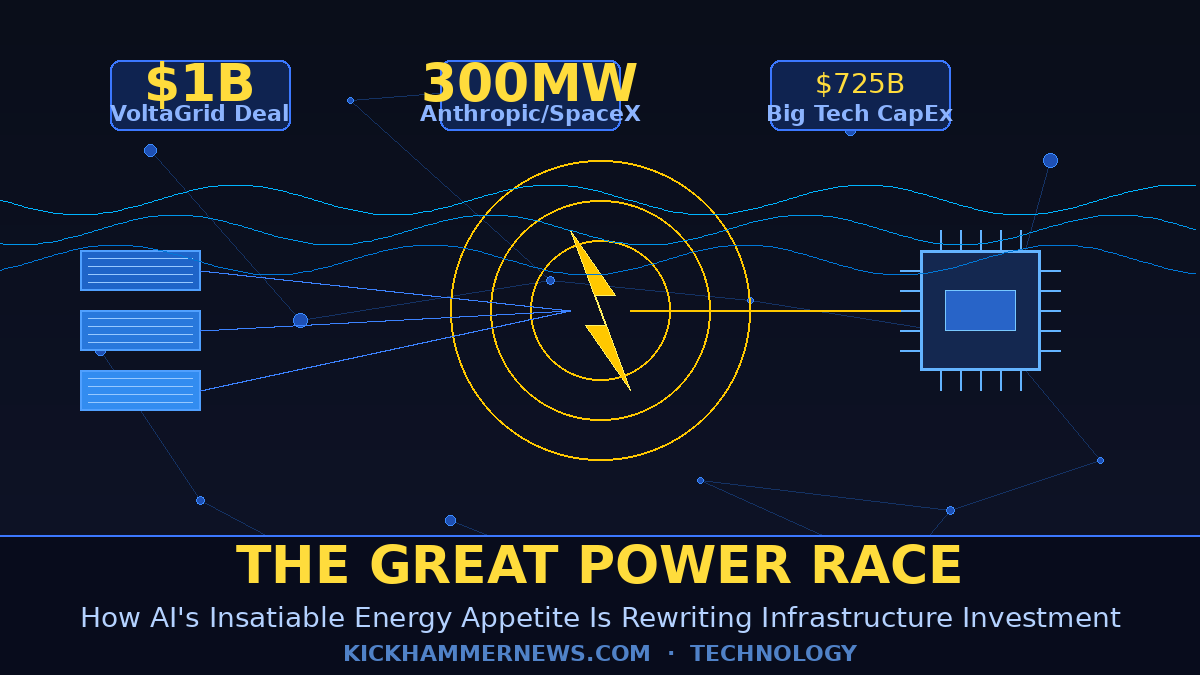
The clearest signal came on May 11, when Houston-based VoltaGrid announced it had secured a $1 billion strategic equity investment from Blackstone Tactical Opportunities and Halliburton — a pairing that would have seemed eccentric just a few years ago. An energy services giant and a private equity titan investing in a company that builds gas-powered microgrids for data centers? In 2026, it’s not eccentric. It’s inevitable.
The deal, composed of $775 million in primary capital and $225 million in secondary purchases from existing investors, is designed to accelerate VoltaGrid’s deployment of behind-the-meter power generation solutions. The company’s pitch is simple but powerful: the electrical grid moves slowly, and AI data centers cannot wait. Permitting new grid connections can take years. Building a gas microgrid on-site takes months. For hyperscalers racing to bring compute online, the math is obvious.
What makes VoltaGrid’s moment especially significant is the Oracle contract sitting beneath the headline: the company has already signed a 2.3 gigawatt agreement with Oracle to power the cloud provider’s AI data centers. That’s not a pilot project. That’s industrial-scale infrastructure, and it signals that the behind-the-meter model has crossed from experimental to enterprise-grade.
VoltaGrid also announced it will acquire Propell Energy Technology Ltd., a key supplier, and immediately invest in expanding Propell’s facilities in Granbury, Texas with two additional automated manufacturing plants — pushing toward roughly 300 megawatts per month of capacity. When the bottleneck is power, owning your supply chain becomes a competitive weapon.
Anthropic and SpaceX Rewrite the Compute Map
If VoltaGrid’s deal illustrated the demand problem, Anthropic’s agreement with SpaceX illustrated the extraordinary lengths AI labs will go to solve it.
On May 6, Anthropic announced it would rent all of the compute capacity at SpaceX’s Colossus 1 data center in Memphis, Tennessee — more than 300 megawatts backed by over 220,000 Nvidia AI chips. The deal will make capacity available to Anthropic within one month, a timeline that would be impossible through traditional cloud procurement channels.
The arrangement carries a certain geopolitical irony. Elon Musk, who merged SpaceX with his own AI company xAI earlier this year, has spent considerable energy criticizing Anthropic and its role in an ongoing Pentagon dispute. Yet even that rivalry bowed to infrastructure necessity. Musk subsequently posted on X that he had been “impressed” after spending time with senior Anthropic staff, calling them “highly competent” people who “cared a great deal about doing the right thing.” Whatever the diplomatic mechanics, the deal is real: Anthropic will double the compute available to Claude Pro and Max subscribers, while eliminating the rate restrictions that had frustrated users during peak periods.
Anthropic also disclosed that it has expressed interest in working with SpaceX to develop multiple gigawatts of compute capacity — in space. That detail moved through the industry quickly. It may be visionary or premature, but it underscores how seriously AI labs are thinking about every possible avenue to secure computing resources at a scale that terrestrial infrastructure is struggling to provide.
SoftBank Goes Upstream
While American companies are racing to deploy power infrastructure faster, Japan’s SoftBank is attacking the problem from a different angle: manufacturing the batteries that will store and deliver that power.
SoftBank Group’s mobile unit announced this week that it will begin manufacturing large-scale battery cells at its Sakai, Osaka facility. The initiative is organized under two new ventures: AX Factory, focused on AI data center operations and hardware, and GX Factory, targeting next-generation batteries, solar panels, and related green energy products. Capacity is expected to reach several gigawatt-hours, with plans for global expansion.
The strategic logic is straightforward. SoftBank is a telecom giant sitting at the intersection of AI infrastructure and consumer services. As those services consume exponentially more power, building the energy storage layer isn’t a diversification bet — it’s vertical integration in a sector where the supply chain itself is the competitive battleground.
The Numbers Behind the Crisis
To understand why these deals are happening now, it helps to look at the capital commitments that have made power the defining constraint. Meta, Amazon, Microsoft, and Alphabet have collectively signaled roughly $725 billion in capital expenditures for 2026, overwhelmingly directed at data centers, custom chips, and AI infrastructure. These are not incremental investments; they represent a fundamental rewiring of how these companies allocate capital.
Data centers, even before the AI era, were significant power consumers. A hyperscale facility might draw 100 to 200 megawatts. The new generation of AI training clusters being built today routinely exceed 500 megawatts, and the gigawatt-scale campuses that labs are planning for future models will require more electricity than many mid-sized cities. The United States’ electrical grid, built over a century for a different kind of demand, was not designed to accommodate this.
Utilities are trying to respond. Grid interconnection queues are backed up by years in many regions. New transmission lines take a decade or more to permit and build. In the interim, the companies best positioned to advance the AI race are those that can generate their own power — or, like Anthropic, secure exclusive access to infrastructure that already exists.
A New Kind of Infrastructure Race
What’s emerging is a bifurcated infrastructure landscape. On one side, companies with the capital and connections to build or secure private power generation — microgrids, dedicated campuses, exclusive data center deals — will be able to expand AI compute as fast as their hardware supply chains allow. On the other side, organizations dependent on shared grid capacity and traditional cloud procurement will face wait times and constraints that compound with every new model generation.
This dynamic has consequences beyond the AI industry itself. As power becomes a scarce input for AI, the companies controlling that resource gain extraordinary leverage. Blackstone’s investment in VoltaGrid is not a bet on a power company — it’s a bet that whoever owns behind-the-meter generation for AI infrastructure owns a piece of the AI economy itself.
It also reshapes the geography of AI. Memphis, Tennessee; Granbury, Texas; Sakai, Osaka — these are not traditional tech hubs. They are places with available land, proximity to energy resources, and the physical infrastructure to support industrial-scale compute. The AI revolution is increasingly a story told not in Silicon Valley boardrooms but in power plants and transformer yards.
What Comes Next
The race to solve AI’s power problem will accelerate. Several dynamics are converging. Advanced nuclear, including small modular reactors, has attracted billions in investment and the first commercial units are approaching deployment. Offshore wind is expanding, though interconnection challenges remain. The efficiency of AI chips is also improving — Nvidia’s latest architectures deliver substantially more compute per watt than their predecessors — which will help at the margin.
But the fundamental tension won’t resolve quickly. The models being trained today are larger than last year’s. The inference workloads serving hundreds of millions of users are growing faster than efficiency gains can offset. Every improvement in model capability tends to generate more demand, not less.
VoltaGrid’s billion-dollar moment, Anthropic’s Memphis deal, SoftBank’s battery factories — these are not isolated corporate announcements. They are early chapters in a story about what it costs to build intelligence at scale, and who gets to decide how the power flows.
Sources: Bloomberg, CNBC, Financial Times, TechStartups.com, Blackstone Press Release