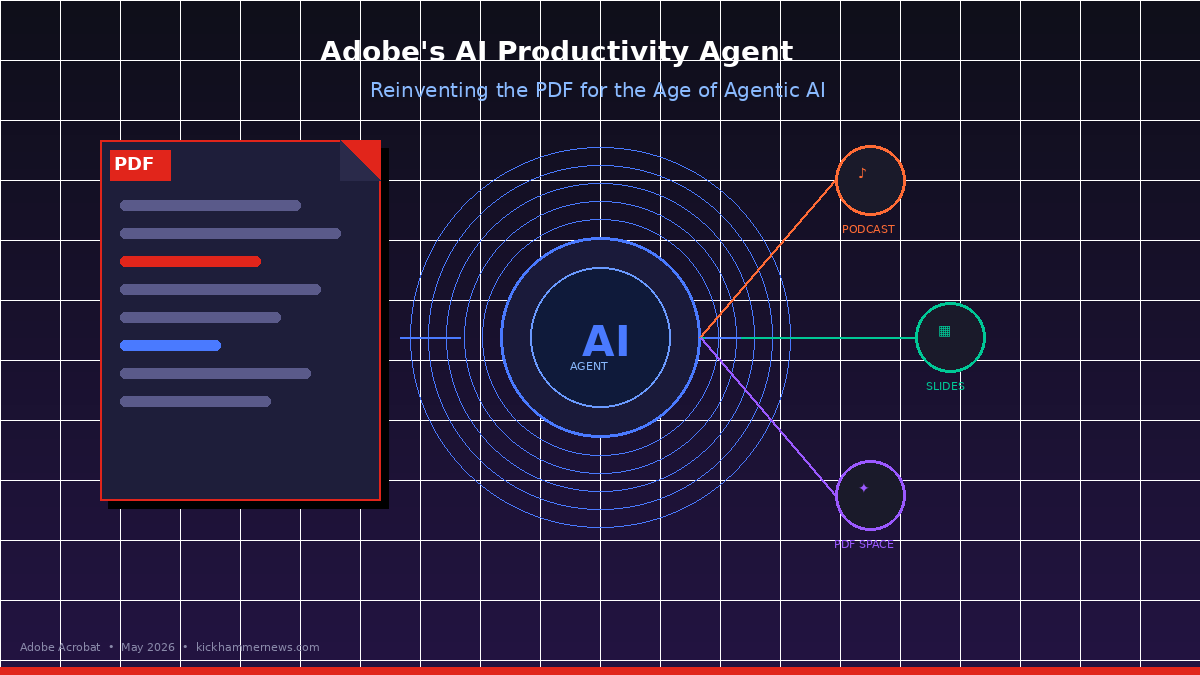
Adobe’s latest AI breakthrough may finally break the tyranny of the static document — turning PDFs into interactive, personalized experiences powered by an intelligent productivity agent.
For three decades, the PDF has been the gold standard of digital communication. Reliable, portable, and precise, it became the de facto format for contracts, reports, proposals, and virtually every other piece of important business information. But for all its strengths, the humble PDF has always had one fundamental flaw: it’s a one-way street. You create it, send it, and hope the person on the other end actually reads it.
Adobe wants to change that — for good.
On May 6, 2026, the company unveiled its new productivity agent for Acrobat, a sweeping reinvention of how information is packaged, shared, and consumed. The announcement marks one of the most significant updates to the Acrobat platform since Adobe first shipped PDF technology in 1993, and it signals Adobe’s full-throttle push into the age of agentic AI.
The Problem Adobe Is Solving
In a blog post accompanying the launch, David Wadhwani, president of Adobe’s digital media business, laid out the core problem with refreshing candor. Most knowledge workers spend the bulk of their time not on deep thinking or crafting compelling ideas, but on mechanics: finding key stats, reformatting documents, converting files, managing attachments. “We spend the most time on tasks that matter least,” Wadhwani wrote, “and the least time on work that matters most.”
The new productivity agent is Adobe’s answer to that imbalance. Rather than helping users work faster within the same old workflow, Adobe is proposing an entirely new model for how information moves between people.
What the Productivity Agent Can Do
At the heart of the announcement is a suite of capabilities that, taken together, amount to a fundamental rethinking of the document.
Conversational PDF editing. Instead of navigating menus and toolbars, users can now simply tell the agent what they need in plain language. “Shorten the executive summary.” “Move the payment terms to the end.” “Flag anything that changed from the last version.” The agent handles the mechanics while the user focuses on the substance.
Documents to podcasts. Perhaps the most attention-grabbing feature is the ability to turn any document — or collection of documents — into an audio walkthrough. Faced with three industry reports to read before a morning meeting, a user can ask the agent to synthesize them into a podcast-style summary to consume on the commute. It’s a direct acknowledgment that reading long documents is often simply not how busy professionals process information.
Documents to presentations. The agent can also transform research documents and PDFs into polished slide decks. Users describe what they want, the agent builds the presentation from the source material, and the user refines and shares. What used to take hours of reformatting is compressed into minutes.
PDF Spaces: From files to experiences. The most ambitious piece of the announcement is a new concept called PDF Spaces — collaborative, AI-powered workspaces that bundle multiple documents, links, notes, and media into a single shareable environment. Rather than sending a file and hoping for the best, senders can now deploy a curated experience complete with an embedded AI Assistant that knows the material, can answer questions, and is tuned to the specific audience and purpose.
The AI Assistant within a PDF Space can be customized with tone and focus instructions. Engagement analytics tell the sender how recipients are interacting with the content — what they read, what they skipped, where they lingered.
Real-World Use Cases
Adobe offered a range of industry scenarios to illustrate the potential impact. A real estate agent could share an interactive space where clients explore neighborhoods, compare schools, and run mortgage numbers — closing deals faster without additional meetings. An HR leader could build an onboarding hub packed with checklists and setup guides, letting new hires get answers on day one without knowing who to ask. A sales rep could create a deal room where prospects explore solutions at their own pace, with engagement data revealing exactly where interest is highest before the follow-up call.
The vision Adobe is painting is one where documents stop being static artifacts that recipients endure and start becoming dynamic experiences tailored to whoever is on the receiving end. The company frames it as moving from “sending files” to “sharing experiences.”
Adobe’s Agentic Architecture
The productivity agent doesn’t exist in isolation. It’s part of a broader agentic ecosystem that Adobe has been building across its product suite. The agent coordinates with Adobe’s creative agent — announced in April alongside the Firefly AI Assistant public beta — as well as third-party agents, enabling complex, multi-step workflows that span content creation, editing, and distribution.
This architecture reflects a broader industry shift. Rather than offering point solutions bolted onto existing software, Adobe and its competitors are increasingly building AI that can orchestrate entire workflows autonomously, with humans providing direction rather than handling execution.
Adobe has also extended its Acrobat ecosystem in other directions recently. In late April, the company announced that Acrobat workflows are now available directly inside WhatsApp Web, allowing users to open, review, and act on PDFs in chat without downloading anything. And in the same week as the productivity agent launch, Adobe announced a Claude integration that brings more than 50 professional tools from Photoshop, Firefly, Premiere, and other Adobe applications directly into the Claude AI assistant.
Availability and Pricing
The productivity agent and PDF Spaces capabilities are available as part of two new Acrobat offering tiers. Acrobat Express bundles the productivity agent together with premium content generation tools, while Acrobat Studio adds the full PDF toolset alongside AI-powered productivity and creativity features.
Adobe has not publicly disclosed standalone pricing for the new capabilities.
Why This Matters
The announcement arrives at a pivotal moment for the document management industry. Microsoft has been aggressively integrating Copilot across its 365 suite, including deep hooks into Word and Teams. Google continues to evolve Workspace with its Gemini AI features. The competition for the enterprise knowledge worker’s attention — and subscription budget — has never been more intense.
Adobe’s answer is to reframe the question. Rather than trying to make existing document workflows marginally faster, the company is betting that the format itself needs to evolve. The PDF was invented for a world of desktop monitors, email attachments, and one-way information transfer. The productivity agent is Adobe’s attempt to bring it into a world of mobile consumption, AI-assisted understanding, and personalized, interactive communication.
Whether users will embrace PDF Spaces as enthusiastically as Adobe hopes remains to be seen. Changing habits around document sharing is notoriously difficult — the attachment-and-inbox model has stubbornly persisted for decades despite countless attempts to replace it. But the underlying premise is hard to argue with: if the goal of sharing a document is to help the recipient understand something and take action, a static file is rarely the best tool for the job.
Adobe has a 30-year head start on everyone else in the PDF business. Now it’s using that foundation to build something that might finally transcend it.
Sources: Adobe Blog – “Adobe’s new productivity agent: Redefining how we understand, create and share” | Adobe Press Release | 9to5Mac