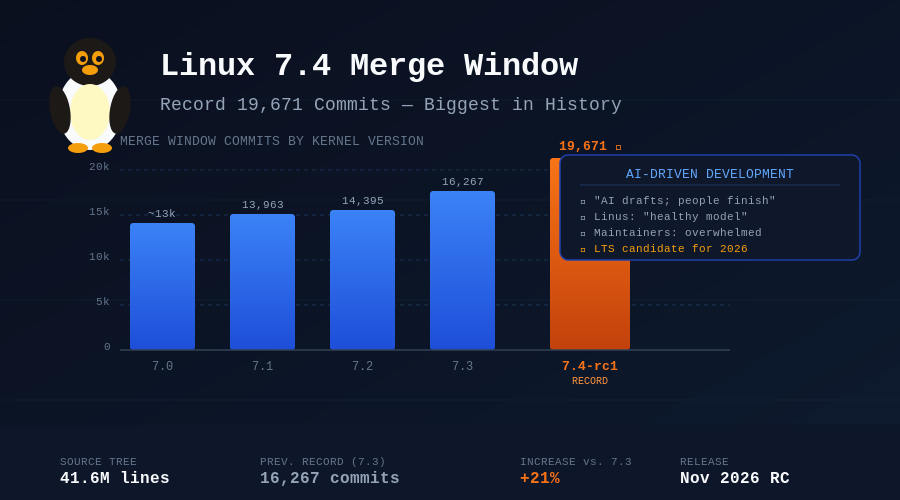
The Linux 7.4 merge window closed last weekend with 19,671 commits — the most ever recorded in the kernel’s more than three-decade history. To put that in perspective: the previous record was Linux 7.3 at 16,267 commits, 7.2 managed 14,395, and a typical merge window lands somewhere around 13,000–15,000. In a single cycle, the volume of changes heading into the next Linux release jumped roughly 21 percent over the previous record-holder. That is not a blip. That is a structural shift in how fast the kernel is moving, and enterprise infrastructure teams that aren’t already paying attention should be.
Linus Torvalds attributed part of the size to AMD GPU register offset and bitmask definitions — bookkeeping changes he described as “noise” — but even stripping those out, the underlying change volume is historically large. Roughly half the real diff concerns drivers, with notable hardware additions including AMD Zen 6 preparation, Intel IPU8 image processing for Nova Lake, expanded Qualcomm Snapdragon X2 laptop support, initial Apple M4 code, and mainline Google Tensor G5 / Pixel 10 support. The EXT4 filesystem gained a buffered iomap option, build times are shorter, and the ancient BFS filesystem (vintage 1999) has finally been removed after decades. The source tree itself now sits at approximately 41.61 million lines.
The AI Factor: Helpful, But Overhyped
Torvalds acknowledged AI’s growing role, calling AI-prompted fixes that arrive during the merge window rather than the RC testing period a “healthy model.” His line — “AI drafts; people finish” — has already become the headline on a dozen tech blogs, and the framing is almost uniformly positive. Most coverage treats this as a straightforward productivity story: AI writes more patches, more patches ship faster, Linux gets better quicker.
That is probably the wrong read. The more likely consequence is that AI is generating substantial overhead for kernel maintainers — overhead that disproportionately hits the humans in the chain, not the models. Maintainers are reportedly overwhelmed by the volume of AI-generated bug reports and patch proposals, most of which require human review, revision, and judgment before they can merge. The “AI drafts; people finish” workflow is less a multiplier on developer output and more a funnel that routes increasing volumes of rough material through a fixed number of experienced humans. That constraint doesn’t scale the same way compute does. Watch the RC period: if rc2, rc3 and rc4 carry an unusually high fix volume relative to a typical 7.x cycle, it will suggest the “healthy” framing was premature.
The secondary driver Torvalds mentioned is that 7.4 may carry LTS (Long-Term Support) designation — and developers tend to front-load features when they believe a release will be the year’s LTS kernel, because LTS designation typically means five years of backported fixes and broad enterprise adoption. That incentive is real and separate from AI entirely.
What 19,671 Commits Actually Means for Your Servers
Enterprise teams don’t track kernel merge windows the way hobbyists do, but the downstream implications are concrete. A faster-moving upstream means distribution vendors — Red Hat, Ubuntu LTS, SUSE — face larger integration backlogs before they can certify a kernel for enterprise use. That delay is not fixed; it scales roughly with diff size, QA surface area, and the number of subsystem owners who need to sign off.
Here is what the numbers look like in practice for a typical enterprise fleet:
Maintenance cost per kernel generation, rough estimate:
Assume an organization running Linux on servers at $0.08/CPU-hour (on-prem equivalent cost), with an average of 8 vCPUs per instance and a planned kernel upgrade window of 4 hours downtime per instance:
- 100-server fleet: 100 × 4 hrs × 8 vCPUs × $0.08 = $2,560 in lost compute per upgrade cycle. At two major kernel upgrades per year, that’s $5,120 annually — trivial.
- 500-server fleet: 500 × 4 × 8 × $0.08 = $12,800 per upgrade cycle, $25,600 annually. At this scale, scheduling complexity and change-freeze coordination become real costs, potentially 2–3x the compute cost.
- 1,000-server fleet: 1,000 × 4 × 8 × $0.08 = $25,600 per upgrade cycle, roughly $51,200 annually in compute alone — plus engineer time (conservatively 0.5 FTE at $120k/year = $60,000) for patch testing, staging, and rollout. Total annual kernel-upgrade overhead: $111,200.
The implication: a faster-moving kernel is not free. Every 10,000 extra commits upstream adds testing surface for downstream maintainers, which adds validation cycles before enterprise distributions certify the kernel, which compresses the window between “available” and “validated for production.” Larger fleets that run on point releases of RHEL, Ubuntu LTS, or SLES don’t absorb this directly — but they do feel it when distribution releases lag, when kernel backport patches carry unexpected regressions, or when hardware support for new accelerators (AMD Zen 6, Intel NPUs) takes longer to land in the stable branch they’re actually running.
Decision Framework: Which Kernel Track Should Your Fleet Be On?
The Linux 7.4 release raises a practical question for infrastructure teams: which kernel track deserves your attention right now? Here is a simple framework with concrete thresholds:
Stay on your current enterprise distro kernel if:
- Your fleet is 90 percent or more on hardware that has been in production for more than 18 months.
- You have no immediate AI/ML workloads requiring AMD Zen 6 or Intel NPU support.
- Your security posture prioritizes CVE backport cadence over feature velocity.
- You have fewer than three kernel engineers and no dedicated kernel QA capability.
In this case, RHEL 9.x, Ubuntu 22.04 LTS, or SLES 15 SP6 give you everything you need. Ignore 7.4 until it lands in your vendor’s next major release, which won’t be until late 2027 at the earliest.
Start tracking 7.4 RC if:
- You are deploying new hardware with AMD Zen 6 CPUs, Intel Nova Lake IPUs, or Snapdragon X2-based devices in your fleet in Q1 2027.
- Your Linux kernel team exceeds five engineers and you have an established staging pipeline.
- You run internal applications where shorter kernel build times would shave meaningful time off CI/CD cycles.
Wait for LTS designation before doing anything with 7.4 if:
- You are between those extremes — say, 200–800 servers, a lean infrastructure team, and a mix of old and new hardware.
- In that case, the right move is to watch the rc period (November–December 2026) and wait for official LTS confirmation before any evaluation work begins.
A Dated Action Checklist for Enterprise Linux Teams
These are not generic reminders. Each is tied to a specific source of truth you can open right now.
- By November 10, 2026: Open kernel.org/releases.html and note which 6.x kernel is your current LTS. Confirm its EOL date. If it expires before December 2027, open a ticket now to plan migration to the next LTS candidate.
- By November 30, 2026: Pull the 7.4-rc3 or -rc4 announcement from Linus Torvalds’ kernel mailing list (lkml.org) and count the number of fixes in the rc period. If the weekly fix volume exceeds 600 commits/rc, treat 7.4 as a rougher-than-average release and add 6–8 weeks to your evaluation timeline.
- By December 15, 2026: Check your Red Hat, Canonical, or SUSE vendor advisory newsletter for any 7.4 integration announcements. If none, the enterprise-certified version of 7.4 is likely 18–24 months away — plan accordingly.
- By January 15, 2027: Confirm 7.4’s LTS designation (or lack of it) at kernel.org. If 7.4 is LTS, begin tracking it as your next-generation kernel in your infrastructure roadmap. If not, shift attention to 7.5 or the next candidate.
- By February 1, 2027: Run a hardware compatibility audit against your server inventory using `uname -r` baseline checks and the new hardware support list for 7.4 drivers. Flag any servers that will require 7.4 for new silicon support.
The Bigger Picture: What This Really Means
The framing in most coverage is that Linux 7.4 demonstrates the kernel community’s health and momentum. I think that framing is too comfortable. The more important story is that the pace of change in the Linux kernel has now structurally outpaced the review capacity of its human maintainers — and the community has not yet developed a clear answer to that mismatch. Torvalds is optimistic, which is his prerogative. But the merge window metric only measures what went in, not what was rejected or what should have been caught earlier. The real test is the RC period.
For enterprise teams, the practical upshot is straightforward: the kernel is not slowing down, and the gap between upstream velocity and enterprise-certified releases is likely to widen, not narrow. That means longer validation cycles at vendors, potentially more conservative backport policies, and more pressure on internal teams to carry patches between upstream and whatever stable branch they’re actually running. The organizations that will feel this least are the ones who invested early in a disciplined kernel lifecycle management process — knowing their LTS windows, running staging environments on the next candidate kernel 12 months before production adoption, and building relationships with their Linux vendor support teams rather than treating kernel updates as set-and-forget.
The Linux 7.4 merge window is, by the numbers, a remarkable achievement. It is also a stress test that the entire ecosystem — from Linus Torvalds’ inbox to your company’s change advisory board — is about to find out whether it can pass.