For decades, enterprise resource planning systems have been the backbone of global business — reliable, comprehensive, and famously slow to change. This week at SAP Sapphire 2026 in Orlando, that reputation was put to rest. SAP CEO Christian Klein took the stage to announce what the company is calling its most ambitious transformation in its 54-year history: the Autonomous Enterprise, a vision in which AI agents handle the operational complexity of modern business while humans focus on strategy and judgment.
The announcements were sweeping, technically deep, and landed with a clear message to the enterprise software world: the ERP system is no longer just a system of record. It’s becoming a system of action.
From Record-Keeping to Real-Time Action
The central thesis of SAP’s Sapphire keynote was straightforward but radical. For years, ERP platforms stored the most valuable data in any organization — financials, supply chains, HR records, procurement workflows — but that data sat largely dormant, surfaced only through reports and dashboards that required human interpretation and manual follow-up.
With agentic AI, that changes fundamentally. SAP’s new platform strategy revolves around deploying AI agents that don’t just surface data but act on it — autonomously routing exceptions, resolving discrepancies, triggering workflows, and closing loops across systems that used to require armies of analysts.
On stage, SAP demonstrated a procurement agent handling a three-way invoice match exception in real time. The agent pulled data from Outlook emails, Microsoft Teams conversations, Azure AI Search indexes, and SAP Ariba simultaneously — identified the discrepancy, determined the correct resolution based on contract terms, and posted the approved invoice directly into SAP S/4HANA. Total time: under 90 seconds. Average time for the same task in a legacy workflow: three and a half days.
That kind of before-and-after is hard to ignore.
Joule Gets a Studio — and 50 New Assistants
At the center of SAP’s agentic AI strategy is Joule, the company’s enterprise AI assistant that has been evolving rapidly over the past two years. At Sapphire, SAP announced the general availability of Joule Studio, a development environment for building enterprise-grade AI agents and agentic workflows on SAP-managed infrastructure.
Joule Studio supports no-code, low-code, and pro-code development patterns, making it accessible to business analysts building simple automation as well as developers constructing complex multi-agent orchestration pipelines. The platform is built on SAP Business Technology Platform and is designed to meet the security and compliance requirements that enterprise customers have come to expect from SAP.
But perhaps more notable than the tooling was the sheer volume of ready-made intelligence SAP announced. The company unveiled more than 50 domain-specific Joule Assistants covering finance, procurement, supply chain, human capital management, and customer experience. Each assistant is backed by a network of more than 200 specialized sub-agents that can be orchestrated to complete end-to-end business processes without human intervention.
Microsoft and SAP: Agent-to-Agent Integration
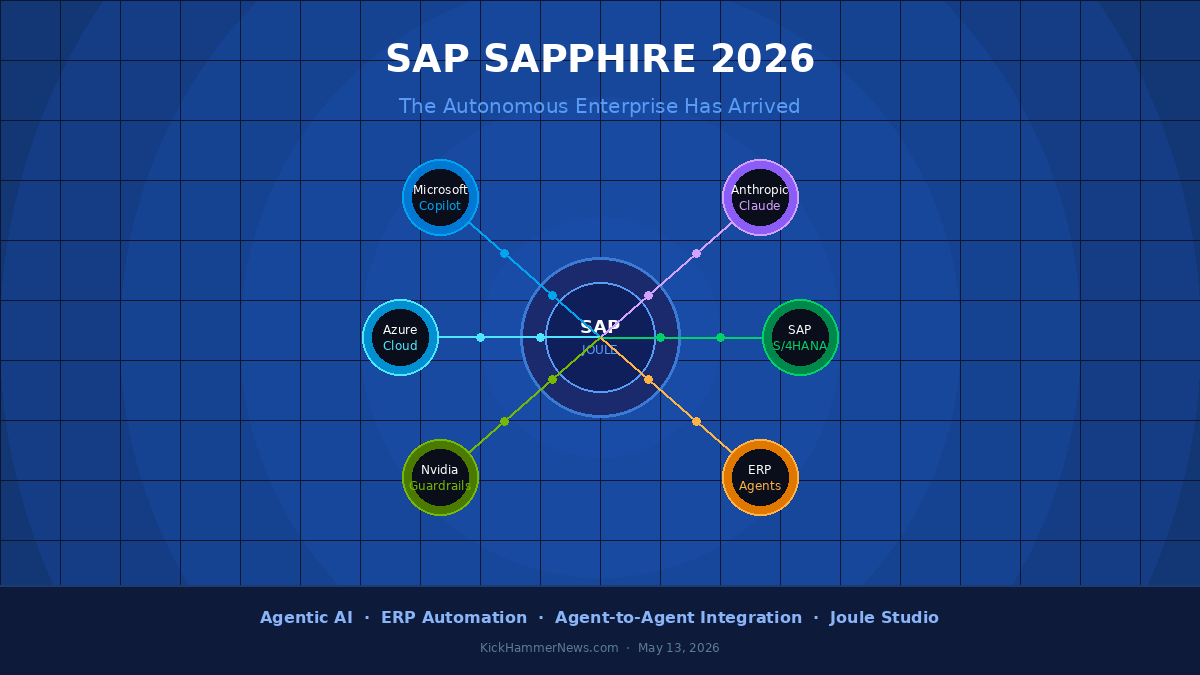
One of the most consequential announcements at Sapphire was not about SAP alone — it was about the deepening integration between SAP’s Joule and Microsoft 365 Copilot. The two companies announced agent-to-agent (A2A) integration, allowing Joule and Copilot to communicate and collaborate directly across their respective environments.
In practical terms, this means that an employee working inside Microsoft Teams, Outlook, or Word can invoke SAP-specific Joule skills without ever leaving the Microsoft productivity environment. Need to approve a supplier invoice from your inbox? Joule handles the back-end SAP transaction while Copilot manages the interaction inside Outlook. Need to run a headcount analysis from a Word document? Joule pulls live SuccessFactors data and surfaces it without requiring the user to log into a separate SAP portal.
This kind of seamless interoperability has been the holy grail of enterprise software integration for years. The A2A protocol, which Microsoft has been developing as an open standard for multi-agent communication, is now powering real workflows at scale.
Microsoft also announced expanded Azure infrastructure for SAP RISE customers and new sovereign cloud configurations designed to meet the data residency requirements of regulated industries in the EU and Asia-Pacific.
A New Foundation: SAP Business AI Platform
Underpinning all of these announcements is a new architectural layer SAP is calling the SAP Business AI Platform — a unified environment that consolidates SAP Business Technology Platform, SAP Business Data Cloud, and SAP Business AI into a single governed foundation.
Central to this platform is the SAP Knowledge Graph, a structured representation of every business entity, process, and relationship across a customer’s SAP landscape. When an AI agent needs context to make a decision — understanding that Vendor X has a 45-day net payment term, or that a particular cost center has a spending freeze — the Knowledge Graph provides that grounding automatically, reducing hallucinations and enabling agents to make accurate, context-aware decisions.
This is a critical differentiator in the enterprise AI space. General-purpose large language models are powerful but context-blind. By anchoring agents to a structured business knowledge graph, SAP is betting that enterprise-specific AI will outperform generic AI for the workflows that actually matter to its customers.
New Partnerships: Anthropic and Nvidia Join the Stack
SAP also used Sapphire to formalize new AI partnerships that reflect the increasingly competitive landscape for enterprise AI model selection. While Microsoft’s models and SAP’s proprietary SAP-RPT-1 foundation model have driven Joule’s capabilities to date, Anthropic’s Claude was announced as an additional foundational model powering agents across the full spectrum of enterprise tasks — from financial analysis to supply chain optimization.
The inclusion of Claude signals SAP’s intent to give enterprise customers optionality in the underlying AI models powering their workflows, rather than locking them into a single provider’s model stack.
Nvidia deepened its partnership with SAP as well, integrating its Open Shell security solution for AI agent guardrails — a mechanism for detecting and blocking unsafe or out-of-policy agent behaviors before they execute.
Governance Built In, Not Bolted On
One of the persistent concerns about deploying autonomous AI in enterprise environments is governance: who is responsible when an agent makes a mistake, and how do you audit what happened? SAP and Microsoft addressed this directly at Sapphire with the announcement of a joint Responsible AI Policy Framework.
The framework enforces role-based access controls at the agent level, requires mandatory human-in-the-loop approval for financial transactions above a configurable threshold, and stores full audit trails in Microsoft Purview — ensuring that every action taken by an AI agent is logged, traceable, and attributable.
The framework is designed to comply with both the EU AI Act and the evolving NIST AI Risk Management Framework, giving multinational enterprises a path to autonomous AI deployment that meets their regulatory obligations.
What It Means for the Enterprise Software Landscape
SAP’s announcements at Sapphire 2026 represent more than a product refresh — they represent a fundamental repositioning of the ERP vendor role in the enterprise technology stack. For decades, the debate in enterprise software was about integration: how do you get your CRM to talk to your ERP, your procurement system to talk to your finance platform?
Agentic AI doesn’t solve integration in the traditional sense. It leaps over it. When an AI agent can natively traverse data across SAP S/4HANA, Microsoft Teams, Outlook, Azure, and SAP Ariba in a single workflow, the question of whether those systems are “integrated” becomes almost academic.
The competitive implications are significant. Oracle, which has been pursuing a similar agentic AI trajectory within its Fusion Cloud ERP platform, will be watching these announcements closely. Workday has made aggressive moves in AI-native HCM. ServiceNow has positioned its Now Platform as an enterprise AI orchestration layer that competes directly with Joule Studio.
But SAP’s combination of installed-base depth — the company’s software runs the back offices of 99 of the 100 largest companies in the world — and the new Joule ecosystem gives it a compelling foundation to execute on the Autonomous Enterprise vision. The question is whether customers, still scarred by slow and expensive SAP implementations of the past, will trust the company to deliver on it.
The Road Ahead
SAP has set aggressive timelines for rolling out the Autonomous Enterprise capabilities. Joule Studio is generally available now. The 50-plus domain-specific assistants will roll out through the remainder of 2026. The A2A integration with Microsoft 365 Copilot is in preview, with general availability expected in Q3. The SAP Business AI Platform unification is expected to be complete for all RISE with SAP customers by year-end.
For CIOs and enterprise architects evaluating their AI strategies, the message from Orlando was clear: the era of autonomous enterprise operations is not a future concept. The technology is here, the governance frameworks are being established, and the first movers are already measuring their returns in days recovered from mundane processes.
The ERP system, it turns out, was just waiting for the right intelligence to wake it up.
KickHammerNews covers enterprise software, cloud infrastructure, and the business of technology. Follow us for ongoing coverage of SAP Sapphire 2026 and the evolving AI enterprise landscape.