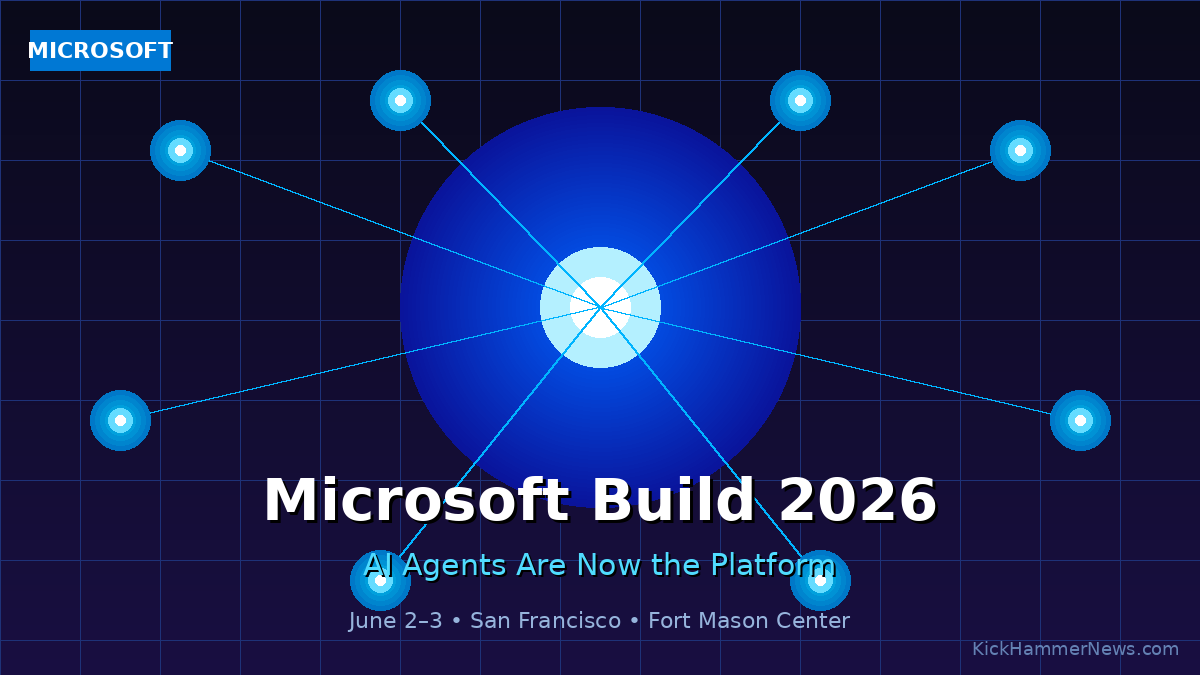
Microsoft’s annual developer conference, Build 2026, is just days away — scheduled for June 2–3 at Fort Mason Center in San Francisco — and the tech world is watching closely. This year’s event marks a decisive pivot: AI agents are no longer a feature or a footnote. They are the platform.
After years of incremental Copilot additions, Microsoft is arriving at Build 2026 with a coherent, fully-articulated vision for agentic computing. The message is clear — developers should stop thinking about AI as a productivity layer and start treating it as an autonomous collaborator capable of writing code, managing workflows, organizing files, and orchestrating complex tasks across Microsoft’s entire software ecosystem.
From Chatbot to Autonomous Agent
The transformation has been gradual but unmistakable. In 2023, Copilot was a clever autocomplete tool. In 2024, it became a multi-modal assistant. In 2025, Microsoft began integrating agentic behaviors into Copilot Studio, allowing businesses to deploy AI agents that could interact with enterprise systems. Now, heading into Build 2026, autonomous agents are the primary lens through which Microsoft is telling its developer story.
This year’s pre-event messaging has leaned heavily into phrases like “agentic workflows,” “multi-agent orchestration,” and “AI production systems.” Microsoft is no longer asking developers to explore what AI can do. It’s urging them to ship it.
Agent 365, Microsoft’s enterprise AI agent platform, was already made generally available in May 2026, with new capabilities to discover and govern “shadow AI agents” — unsanctioned AI tools operating inside organizations without IT visibility. The general availability of Agent 365 is not just a product milestone; it signals Microsoft’s intent to make agentic AI an enterprise-managed discipline, not a grassroots experiment.
What Developers Can Expect at Build 2026
While Microsoft has not yet released the full Build 2026 session catalog, the contours of the event are clear from pre-conference briefings and leaked session descriptions.
New Tooling for Agent Development: Developers can expect new APIs, runtime environments, and debugging frameworks purpose-built for AI agents. The emphasis will be on helping developers create agents that act reliably across Microsoft’s platforms — Azure, Microsoft 365, GitHub, and Windows itself.
GitHub Copilot’s Next Chapter: GitHub Copilot is graduating from an autocomplete tool into what Microsoft calls a “collaborative development partner.” Expected announcements include deeper Copilot integrations with Azure DevOps, the ability for Copilot to write entire functions and modules based on natural language specifications, and enhanced multi-agent orchestration where separate Copilot agents can work together on different parts of a codebase in parallel.
Azure AI Foundry Upgrades: Azure AI Foundry — Microsoft’s unified platform for building AI applications — is expected to receive significant updates. Developers will get new tools for combining OpenAI models, open-source models from Azure’s model catalog, and proprietary small language models optimized for local Windows execution on Copilot+ PCs.
Windows Agentic Functions: Windows itself is becoming a more receptive host for AI agents. Experimental agentic settings already surfaced in recent Windows Insider builds, where Copilot can take on automated tasks related to file organization, scheduling, and email — all opt-in, and all tied to a new agentic permissions framework that Microsoft is expected to formalize at Build.
A Smaller, More Intense Conference
Unlike Build events of the past, which spread sessions across a massive convention center with broad product announcements, Build 2026 is deliberately compact. With only approximately 2,500 in-person spots at Fort Mason Center — an intimate San Francisco venue compared to the cavernous Seattle Convention Center — Microsoft is curating the experience.
Fewer keynotes. More hands-on workshops. Deeper technical sessions. The format shift reflects the maturity of the developer audience Microsoft is now addressing. Developers at Build 2026 are not there to hear that AI exists. They’re there to learn how to ship AI products that work reliably at scale.
This is also reflected in Microsoft’s “Startup Playbook,” a Build 2026 pre-conference guide targeting startups and independent developers. The document, released May 5, emphasizes model-cost control, moving prototypes into production, and building autonomous agents that can survive the economics of a maturing AI market. The message resonates well beyond startups — it’s essentially the manifesto for how Microsoft thinks serious developers should be thinking right now.
The Trust Problem
If there is one undercurrent that will define Build 2026 beyond the excitement of new tools, it is trust. As AI agents become more autonomous — taking actions, executing code, sending emails, modifying files — the question of how much users and organizations should trust them becomes critically important.
Microsoft has been thinking carefully about this. Agent 365’s governance tools for shadow AI are one manifestation. The opt-in design of Windows’ experimental agentic functions is another. At Build 2026, expect significant discussion around agent auditability, permission scoping, and the emerging discipline of AI governance in enterprise environments.
This is a genuine technical and cultural challenge. Developers building AI agents need clear frameworks for declaring what their agents can and cannot do, how they log decisions, and what happens when something goes wrong. Microsoft appears poised to offer concrete answers at Build 2026.
The Competitive Stakes
Microsoft is not building agentic AI in a vacuum. Google is advancing its own agent frameworks through Gemini and Android AI. Apple has signaled deeper on-device AI agent capabilities coming to macOS and iOS. Startups like Anthropic and OpenAI are shipping their own agentic developer tools.
What Microsoft has that most competitors lack is the breadth of the enterprise software ecosystem: Azure, Microsoft 365, Windows, GitHub, Teams, Dynamics 365, and Power Platform. The developer who builds an agent on Microsoft’s stack can, in theory, reach across all of those services through a unified API surface. That integration depth is Microsoft’s strongest card, and Build 2026 is the moment to play it.
Looking Ahead
For enterprise software teams, Build 2026 is worth watching even if you’re not attending in person. The APIs and frameworks announced there will define what enterprise AI development looks like for the next two to three years. For developers already building on Azure, GitHub, or Microsoft 365, the session catalog will be essential reading once it drops in the days before the event.
For everyone else, the signal is simple: the age of AI as a feature is ending. The age of AI as the operating layer is beginning. Microsoft Build 2026 is where the developer community will get its clearest view of what that actually means.
Microsoft Build 2026 takes place June 2–3, 2026, at Fort Mason Center in San Francisco. Registration is open at microsoft.com/build.