For the first time in over a decade, Microsoft is letting users take control of when — and whether — Windows Update runs on their machines.
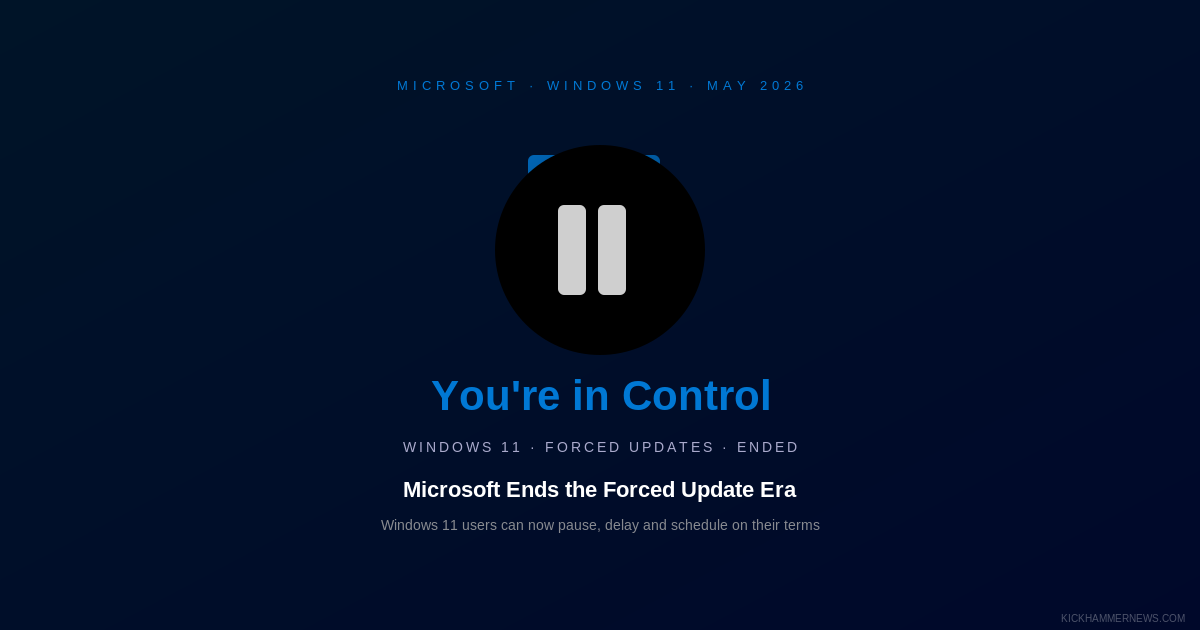
After years of user complaints, workarounds, and frustration with forced reboots, Microsoft has quietly made one of the most significant policy reversals in Windows history. A new Windows 11 update experience, currently rolling out to Insider testers but expected to reach all users later in 2026, allows people to pause Windows Update for up to 35 days — and then extend that pause an unlimited number of times. In practice, this means Windows 11 can go without installing updates indefinitely, so long as the user keeps clicking “extend.”
It’s a move that would have seemed unthinkable just a few years ago, and it signals a meaningful shift in Microsoft’s philosophy around software updates: from coercion to cooperation.
A Decade of Frustration
To understand why this matters, it’s worth remembering just how contentious Windows Update has been since the Windows 10 era. Beginning in 2015, Microsoft shifted to a mandatory update model that gave home users virtually no ability to defer or skip security patches. The intent was clear: keep Windows machines patched and secure, reducing the sprawling attack surface that unpatched systems represent.
But the execution was often brutal. Users lost work when their PCs rebooted unexpectedly during the night. Updates failed mid-installation and left machines in broken states. Cumulative patches swallowed bandwidth on slow connections. And despite Microsoft’s best intentions, forced updates sometimes introduced new bugs — making “patch now” feel as risky as “patch never.”
Over the years, Microsoft made incremental concessions: the ability to defer updates for up to 35 days, Active Hours to prevent reboots during work time, and better scheduling controls. But the fundamental posture remained: Microsoft decides when Windows updates, not you.
What’s Changing
The new Windows Update experience, first spotted in Insider builds in late April 2026 and detailed in a May 2026 blog post from the Windows Insider team, overhauls several interconnected parts of how updates work.
Indefinite Pause: The most dramatic change is to the Pause Updates control. Previously, users could pause updates for a fixed duration — 1, 2, 3, 4, or 5 weeks — after which Windows would force an update before allowing another pause. The new system replaces that dropdown with a calendar picker. Users select a date up to 35 days out. When that date arrives, they can simply pick another date. There is no limit on how many times this can be done.
A spokesperson for Microsoft described the change pragmatically: the company wants users to feel confident that updates happen at a time that works for them, not at Windows’ discretion.
Fewer Restarts: Microsoft is also consolidating how updates are applied. Starting now, drivers, .NET framework updates, and firmware changes that previously required separate reboots will be bundled and applied alongside the monthly cumulative quality update. The goal is a single restart per month, rather than the scattered reboots that currently punctuate Windows maintenance.
Better Transparency: The Settings app’s Windows Update section is getting a cleaner layout, with available updates grouped in a dedicated “Available updates” section. Drivers will now display clear category labels — display, audio, battery — making it easier for users to understand what’s being installed and why.
Skippable Setup Updates: Microsoft is also testing the ability for users to skip optional updates during the initial Windows setup process, a long-requested quality-of-life improvement that eliminates the tedious wait for cumulative patches to install before even reaching the desktop.
Reading Between the Lines
Microsoft hasn’t framed this as a reversal — officially, it’s described as giving users “more choice and control.” But the subtext is hard to miss. The company is acknowledging, in practice if not in word, that a decade of mandatory updates eroded user trust. Power users found workarounds. IT departments deployed Group Policies. Enterprises routed around the consumer experience entirely. And ordinary users just resented the interruptions.
The indefinite pause option is particularly telling. It creates a path to effectively opt out of updates altogether — not just delay them — which is exactly the behavior Microsoft spent ten years trying to prevent. The security implications are real: a machine that never installs updates is a machine accumulating unpatched vulnerabilities. But Microsoft appears to be betting that users who trust the update process will update, while users who feel coerced won’t — and that coercion has costs of its own.
It’s a more mature position, and one informed by competitive pressure. macOS has long offered users meaningful control over when system updates apply. Linux users have always dictated their own patch cadence. Even iOS, in recent years, has backed away from aggressive forced-update behaviors. Windows was increasingly the outlier.
Enterprise and Security Implications
For enterprise IT administrators, the consumer-facing changes come with important caveats. Business editions of Windows 11 have always offered more granular update controls through Group Policy and Windows Server Update Services (WSUS), and those capabilities aren’t going away. The new indefinite pause is primarily targeted at home users and small businesses without centralized management.
Security professionals will rightly flag the risk: a user who pauses updates indefinitely and then falls victim to a vulnerability that a skipped patch would have fixed is a real scenario. Microsoft’s own security team has noted this concern. The company is threading a needle — offering flexibility while making clear that the recommended path is still to stay current.
Still, for most users, the practical effect is likely positive. People who were gaming the system to avoid updates will now have a sanctioned way to do so. People who were simply annoyed by poorly timed reboots now have a legitimate, first-class tool to schedule around them. And people who were already letting Windows update normally will notice little difference.
What Comes Next
As of late May 2026, the new Windows Update experience is live in the Beta and Experimental channels of the Windows Insider Program. Microsoft has signaled it intends to bring these changes to the stable release for all Windows 11 users, though no firm date has been given.
The rollout is another chapter in what has been a notably user-focused year for Windows. The May 2026 Patch Tuesday update introduced Xbox Mode for gaming handhelds, richer File Explorer archiving support, and system-wide haptic feedback. The Windows Insider Program itself was restructured earlier this month to better separate experimental from production-track features. And the company’s broader Build 2026 announcements positioned AI-powered agents as a core part of Windows’ future.
But none of those changes carry quite the symbolic weight of this one. Giving users back control over when their computer updates is, in a quiet way, Microsoft admitting that it overreached — and that the path forward is partnership, not mandate. For Windows users who have spent years fighting with their own operating system over something as basic as a scheduled reboot, that’s no small thing.
*Sources: Tom’s Hardware, Windows Central, Windows Insider Blog, WindowsLatest, Digital Citizen Life*