Microsoft’s biggest announcement at Build 2026 wasn’t about Windows or Azure — it was about independence.
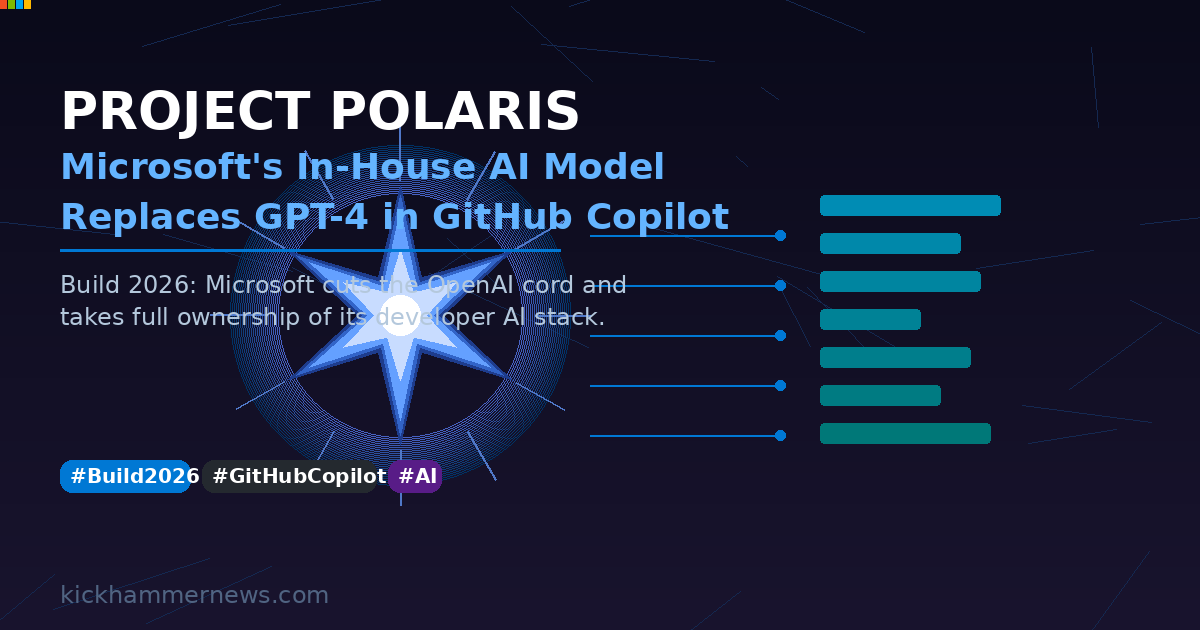
At its annual developer conference in San Francisco, Microsoft unveiled Project Polaris, an in-house AI coding model set to replace GPT-4 Turbo as the default reasoning engine inside GitHub Copilot starting August 2026. The announcement signals a fundamental shift in Microsoft’s AI strategy: after years of relying on OpenAI models to power its most popular developer tool, Microsoft is now betting on its own technology.
What Is Project Polaris?
Project Polaris is a mixture-of-experts (MoE) AI architecture purpose-built for software development tasks. Unlike a monolithic model, it uses specialized sub-modules tuned for specific programming languages and frameworks, routing each code completion or analysis request to the most relevant expert.
Microsoft claims Polaris outperforms GPT-4 Turbo on both HumanEval and MBPP benchmarks — two of the most widely cited code generation evaluations in the industry. The gains are especially notable in low-resource languages like Rust and Haskell, where existing models have historically struggled.
Key capabilities shipping with the August rollout include:
Migration will be automatic for existing Copilot subscribers. Teams that want to stay on GPT-4 Turbo will have a three-month fallback window — after which Polaris becomes the only option.
Why This Matters: The OpenAI Split
Project Polaris doesn’t exist in a vacuum. Microsoft and OpenAI ended their seven-year exclusive partnership in April 2026, dissolving an arrangement that had shaped the AI landscape since GPT-3. The split was publicly described as amicable, but the commercial reality was always complicated: OpenAI’s ChatGPT competes directly with Microsoft 365 Copilot, and GitHub Copilot — Microsoft’s most developer-facing product — was powered by the same models fueling that competition.
With Polaris, Microsoft resolves that tension. It now controls the model, the inference infrastructure (Maia chips), and the developer experience end-to-end. For enterprise customers, this means a Copilot experience that no longer depends on a third-party AI company’s roadmap, pricing decisions, or strategic pivots.
It also positions Microsoft to compete more directly with Anthropic’s Claude Code and Google’s Gemini Code Assist — both of which run on proprietary models their parent companies fully control.
The Windows Agent Platform Announcement
Project Polaris was the headline, but Build 2026 delivered an entire stack of agent-focused announcements that together represent the most significant platform shift Microsoft has made since the introduction of Azure.
Windows Agent Framework (WAF) v1.0 was officially MIT-licensed at Build, following its April 2 release. WAF lets developers define agents in portable YAML manifests that run identically across local Windows machines, Windows 365 Cloud PCs, and Azure Arc-enabled edge devices. No re-architecture required as workloads scale. Early design partners include Adobe (agents that learn designer layout habits and automate InDesign template preparation) and Zoom (agents that attend meetings on behalf of a user and push action items into Microsoft Planner).
Windows Agent Runtime, currently in preview for Windows Insiders, embeds agent APIs directly into the OS shell — making agents first-class Windows citizens rather than application-layer processes. The Runtime initially supports agents operating on structured data formats: JSON, XML, and PDF files.
Windows Agent Store was announced alongside the Runtime: a curated marketplace for agent manifests and companion services offering an 85% revenue share to developers. That split matches Microsoft’s existing Store economics and provides a meaningful distribution and monetization path for teams building Windows-native agents for enterprise environments.
Azure Agent Mesh rounds out the infrastructure story. It’s a control plane that federates agent execution across on-premises Windows servers, Windows 365 Cloud PCs, and Azure Arc-enabled edge devices — automatically routing each task to the nearest available node based on latency and GPU availability. GA is targeted for Q4 2026.
GitHub Copilot Workspace Goes GA
Also at Build: Copilot Workspace graduated from beta to general availability. The agentic programming environment — which lets Copilot reason across an entire repository, propose multi-file edits, run tests, and iterate autonomously — now ships with three production features:
Autopilot mode in particular represents the clearest path to “AI-delegated coding” that Microsoft has shipped. Developers can assign Copilot a bounded issue in GitHub and walk away; Copilot submits a pull request when done.
The MAI Model Suite v2
Alongside Polaris, Microsoft announced the second generation of its MAI model suite — covering image generation, voice synthesis, and transcription:
Pricing for v2 models has not yet been disclosed. The v1 generation launched at $0.36/hour for transcription, $22/million characters for voice, and $5/$33 per million tokens for image generation. The v2 suite is expected to be competitively priced when it reaches GA in Microsoft Foundry.
DirectML 2.0 and WSL 3: Infrastructure Under the Hood
Two lower-profile announcements may have the broadest long-term impact for developers working on Windows hardware.
DirectML 2.0 abstracts hardware differences across Intel, AMD, Qualcomm, and now Nvidia NPUs — following the joint announcement of the first Nvidia-powered Windows PCs. A Windows app using DirectML 2.0 can run transcription, image generation, and lightweight LLM inference entirely on-device, without cloud round-trips and without maintaining separate code paths per chip vendor.
WSL 3 (Windows Subsystem for Linux 3) re-architects the Linux kernel integration to run in a lightweight VM with paravirtualized GPU and NPU access. The result: PyTorch, JAX, and CUDA workloads inside WSL now run at near-native speed, eliminating the performance penalty that has pushed ML developers toward dedicated Linux machines or dual-boot setups.
Together, DirectML 2.0 and WSL 3 make Windows a credible on-device AI development environment — a claim that would have been genuinely controversial even two years ago.
What Wasn’t Announced
Windows 12 — codenamed “Hudson Valley” internally — did not appear at Build. Microsoft engineering teams indicated a potential preview in late 2026 or early 2027 at the earliest. Build was explicitly a developer platform event, not an OS release event.
The Bottom Line
Microsoft Build 2026 is best understood as the moment Microsoft stopped being an AI distributor and became an AI builder. Project Polaris, the MAI v2 suite, and the Windows agent stack collectively represent an end-to-end platform that no longer requires OpenAI at any layer. For developers, the practical implications are significant: GitHub Copilot will behave differently starting August, Copilot Workspace is now a production tool rather than a research preview, and Windows itself is now a viable host for autonomous AI agents.
Whether Polaris delivers on its benchmark claims in real-world codebases remains to be seen. But Microsoft’s direction is now unambiguous: it intends to own the entire AI developer stack, from silicon to model to IDE.
Sources: Microsoft Build 2026 Recap — ChatForest, GitHub Copilot Replaces GPT-4 With Project Polaris — TechTimes, Build 2026: Agentic AI Makes Windows the Next Developer Platform — Windows News