The world’s most valuable company just made its biggest AI bet — and it didn’t build a model.
On June 8, 2026, Tim Cook walked onto the stage at Apple Park for the last time as CEO of Apple. He will hand the reins to hardware chief John Ternus on September 1. It was a moment the tech world knew was coming, and Apple ensured the farewell would be memorable — not with nostalgia, but with a complete reinvention of the product that defines the company’s relationship with its users: Siri.
After two years of missed promises, a $250 million legal settlement over advertised-but-undelivered AI features, and repeated criticism that Apple had fallen dangerously behind in the AI race, WWDC 2026 was Apple’s answer. The answer was not an in-house model. It was Google Gemini — and it opens the door to Anthropic’s Claude on over two billion active Apple devices.
The Siri Rebuild Nobody Expected Apple to Deliver This Way
The new Siri runs on a custom 1.2-trillion-parameter Gemini model that Apple licensed from Google in a deal worth approximately $1 billion per year — a number Apple confirmed on stage for the first time. The rebuilt assistant features a chatbot-style interface similar to ChatGPT and Claude, a standalone Siri app with a system-wide “Search or Ask” gesture, Dynamic Island integration on iPhone 16 and newer, full personal context access covering emails, photos, messages, calendar, and files, and on-screen awareness that lets Siri understand what you’re looking at.
Alongside iOS 27, Apple announced matching updates across its entire operating system lineup: macOS 27, iPadOS 27, watchOS 27, tvOS 27, and visionOS 27. iOS 27 Beta 1launched the same afternoon for Apple Developer Program members. The AI features are limited to iPhone 15 Pro or newer at launch, and iPhone 11 has been dropped from iOS 27 support entirely.
The privacy architecture is Apple’s attempt to thread a needle that many thought was impossible. The heavy Gemini reasoning runs on Apple Private Cloud Compute servers — not Google’s infrastructure — with Apple retaining control over what data leaves the device. Lightweight personal tasks stay on-device. Apple’s answer to the obvious question of whether using Gemini compromises privacy is: we control the compute layer. Regulators and security researchers will have months to probe whether that distinction holds.
Claude Becomes an iPhone Option — Anthropic’s Biggest Consumer Moment
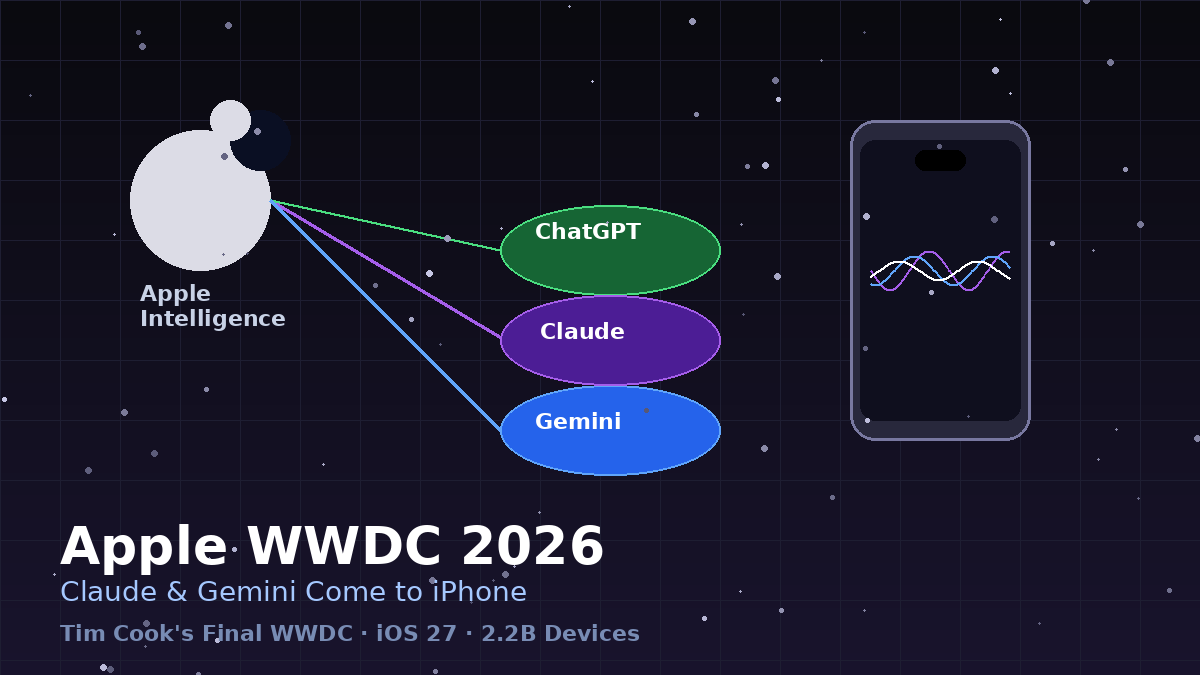
Here is the detail that most WWDC coverage is underplaying: Apple confirmed that iOS 27, iPadOS 27, and macOS 27 will let users choose which AI model powers Apple Intelligence features. The options are ChatGPT, Google Gemini (the default), and Anthropic’s Claude. Each has its own distinct voice so users always know which AI responded.
For Anthropic, the scale of this expansion is difficult to overstate. Apple has approximately 2.2 billion active devices globally. Even a 5% adoption rate among iOS 27 users choosing Claude as their preferred AI provider would translate to more than 100 million new Claude users — more than double Anthropic’s current estimated user base. The consumer brand exposure alone exceeds what any advertising spend could achieve.
Claude was previously available only through Anthropic’s own apps and APIs. Integration into Apple Intelligence represents the first native distribution partnership with a hardware platform, arriving precisely as Anthropic finalizes its confidential IPO filing submitted on June 1. The commercial structure of the deal has not been disclosed, but industry analysts assume a revenue-share arrangement where Anthropic receives per-query or per-active-user fees for Claude responses delivered through Apple Intelligence.
This creates a new, recurring consumer revenue stream for Anthropic that is structurally distinct from its enterprise API business and Claude.ai subscriptions — potentially adding meaningful revenue visibility ahead of its public market debut. However, it comes with a caveat: Apple’s Private Cloud Compute architecture means Anthropic does not control the infrastructure for Claude on iPhone the way it does for its own services. Revenue predictability depends heavily on how many users actually navigate settings to select Claude over Gemini.
What This Means for the AI Model Wars
Apple’s decision to license Gemini rather than build its own model is the most consequential AI strategy call any major tech company has made in 2026 — precisely because Apple is the company that could have afforded to build. OpenAI has raised $180 billion and operates at a negative 122% operating margin. Anthropic raised $65 billion and pays SpaceX $1.25 billion per month in compute costs. Apple holds $170 billion in cash and would rather redeploy that into hardware, services, and buybacks than enter a model race it views as commoditizing.
Whether that is the right call will be debated for years. The $1 billion per year Apple pays Google for Gemini is arguably the most profitable enterprise AI contract in history for Google — more reliable than any ad deal, requiring no sales maintenance, and making Google’s model a default on billions of Apple devices. Every time Gemini falls behind Claude or GPT-5.5 on a benchmark, Apple feels it. And unlike building its own model, Apple cannot close that gap through internal investment.
The broader implications for the AI model market are significant. Apple’s Extensions system, which allows ChatGPT, Gemini, and Claude to compete for user preference within Apple Intelligence, could accelerate the commoditization of frontier model output in a way that benefits users but compresses model margins. If iPhone users begin comparing Claude and ChatGPT responses the same way they compare apps, quality and responsiveness become even more determinative of market share than they are today.
The Market Share Context
The timing of Apple’s announcement coincides with the most significant competitive shift in the AI chatbot market since ChatGPT launched. According to the June 2026 Momentic market share report, ChatGPT leads at 54.7% of worldwide web visits among major AI chatbots — down from 76.5% in February 2025. Google Gemini sits second at 27.4%, growing roughly 104% in six months.
Claude’s numbers are the headline: 8.2% worldwide web-visit share, but growing 306% in a single quarter — from 203 million web visits in January to 824 million in April 2026. In the United States, Claude’s share is 12.5%. The Apple WWDC announcement adds a distribution channel that could dwarf anything visible in web traffic metrics.
It is important to note that web visits measure only consumer web products. They exclude mobile apps, embedded surfaces like Microsoft Copilot inside Windows, and API consumption — which accounts for a large share of both OpenAI’s and Anthropic’s token volume. The API market tells a different story from consumer web traffic, and Anthropic’s enterprise revenue has reportedly grown faster than its consumer web numbers suggest.
The Broader WWDC Picture
Beyond Siri and the AI model selection system, WWDC 2026 delivered a set of AI-enhanced software features that demonstrate how deeply machine learning is now embedded in Apple’s software stack. Generative background extension, perspective reframing, and AI-powered Cleanup were demonstrated in Photos. A rebuilt AI-powered Calendar app and a new Health app with Siri integration were shown. Apple Intelligence features across the board leverage the Gemini foundation, but the consumer-facing presentation keeps the Apple brand firmly front and center.
No new hardware was announced, consistent with analyst expectations. Apple’s rumored HomePad — a 7-inch smart home hub with an A18 chip — was not publicly revealed, though internal Apple system references to the device persist.
Tim Cook’s departure marks the end of a 14-year era defined by the iPhone, Apple Watch, and AirPods — and arguably the beginning of a period where the intelligence running those devices matters as much as the devices themselves. His successor John Ternus inherits a company that has made a billion-dollar bet on a competitor’s AI model to power its most important product feature. Whether that bet proves visionary or limiting will define the next chapter of the world’s most valuable company.
What Happens Next
iOS 27 Beta 1 is available to Apple Developer Program members starting today. The public beta is expected later this summer, with the final release anticipated in September 2026 — coinciding with the new iPhone announcement. That is when Claude, ChatGPT, and Gemini will begin competing for user preference inside Apple Intelligence at scale.
For Anthropic, the September launch window is significant. The company’s IPO process is underway, and demonstrating consumer traction on two billion Apple devices — even partially — would provide a fundamentally different narrative than pure enterprise API growth. For Apple, the outcome is simpler: if the new Siri works, the last two years of criticism becomes a footnote. If it doesn’t, Tim Cook will have left his successor a very expensive problem.
The AI race just moved onto Apple’s platform. Every major AI company except Apple is now competing for the default setting in iOS 27. That is a new kind of platform war — and it is starting today.
Sources: Build Fast With AI (June 8, 2026), Bloomberg, MacRumors, TechTimes, Momentic AI Chatbot Market Share Report June 2026


