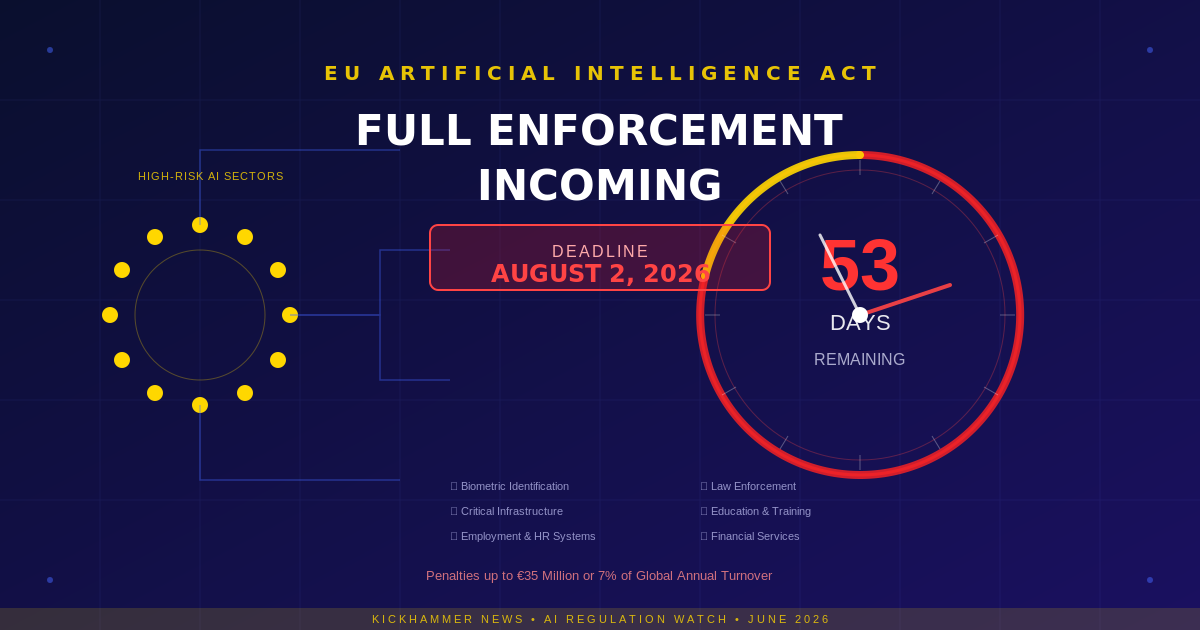
The countdown is real. On August 2, 2026 — just 53 days from today — the European Union’s Artificial Intelligence Act enters full enforcement for high-risk AI systems. For tech companies, startups, and enterprises around the world, the clock is no longer ticking in the background. It’s front and center, and many organizations are nowhere near ready.
The EU AI Act, adopted on May 21, 2024, is the world’s first comprehensive legal framework governing artificial intelligence. It doesn’t just apply to European companies. If your AI system touches EU users, markets, or data — regardless of where your company is headquartered — you’re in scope. That means Silicon Valley firms, Asian tech giants, and global SaaS platforms are all on the hook.
What August 2 Actually Means
The Act has been rolling out in phases since it entered into force in August 2024. The first wave, effective February 2025, banned a list of explicitly prohibited AI practices — things like social scoring systems, real-time biometric surveillance in public spaces, and AI that manipulates individuals using psychological techniques. The second phase, August 2025, activated governance infrastructure and imposed obligations on providers of general-purpose AI (GPAI) models like the large language models powering today’s most popular applications.
August 2, 2026 is the third and most sweeping wave: the full enforcement of requirements for high-risk AI systems. This is where the real teeth of the regulation bite down.
High-risk classification casts a wide net. It covers AI systems used in:
- Biometric identification and surveillance — facial recognition, emotion recognition, biometric categorization
- Critical infrastructure — AI managing power grids, water systems, transportation networks
- Education and vocational training — systems that determine access to educational institutions or assess students
- Employment and HR — automated recruitment tools, performance monitoring, employee management systems
- Access to essential services — credit scoring, insurance pricing, social benefit determinations
- Law enforcement — predictive policing, risk assessment in criminal justice
- Migration and border control — asylum processing, visa assessment tools
- Administration of justice — legal research tools, case analysis systems used in courts
If your product sits in any of these categories, August 2 isn’t a distant concern. It’s a hard deadline.
What Compliance Actually Requires
The compliance burden for high-risk AI providers is substantial. The regulation demands:
Risk Management Systems — providers must establish and maintain documented risk management processes throughout the AI system’s entire lifecycle, not just at launch. This means continuous assessment, ongoing monitoring, and documented corrective actions.
Data Governance — training datasets, validation datasets, and testing data must be scrutinized for biases, errors, and gaps. Organizations must demonstrate that their data is relevant, representative, and free from discriminatory patterns.
Technical Documentation — before placing a high-risk system on the EU market, providers must finalize comprehensive technical documentation covering architecture, design decisions, training methodology, performance metrics, and limitations. This isn’t a checkbox exercise — regulators can and will request it.
Automatic Logging — high-risk systems must generate logs enabling traceability and post-deployment monitoring. These logs must be retained and made available to competent authorities.
Human Oversight — the Act mandates that high-risk AI systems be designed to allow effective human intervention. Organizations must assign trained, competent personnel to monitor system performance and intervene when needed.
Conformity Assessment and CE Marking — before deployment, providers must complete conformity assessments, draw up an EU Declaration of Conformity, affix the CE marking, and register the system in the EU database for high-risk AI systems.
Transparency Obligations — both providers and deployers must ensure clear disclosure when individuals interact with AI, when content is AI-generated, and when emotion recognition or biometric categorization is in use. AI-generated or manipulated content must be labeled in a machine-readable way.
Deployers — organizations that use high-risk AI built by someone else — also face significant obligations. They must follow provider instructions, implement appropriate human oversight, monitor system performance in real-world conditions, and report serious incidents without delay.
The Stakes: Fines That Demand Attention
The EU AI Act’s penalty structure makes GDPR look modest by comparison. Non-compliance with high-risk AI requirements can result in administrative fines of up to €35 million or 7% of global annual worldwide turnover, whichever is higher.
Violations of prohibited practice rules carry even steeper penalties: up to €35 million or 7% of turnover. Providing incorrect or misleading information to regulators carries fines up to €7.5 million or 1% of turnover.
Beyond administrative penalties, organizations face potential civil liability from individuals whose fundamental rights are violated by non-compliant AI systems. And in jurisdictions like Italy, which already enacted national AI legislation in October 2025, criminal penalties apply for offenses like unlawful dissemination of deepfakes — with prison sentences of one to five years.
The Delay Question: Don’t Count On It
There is a wrinkle worth acknowledging. The European Parliament recently voted to delay some compliance deadlines, proposing to push high-risk AI requirements to December 2027 and sector-specific obligations to August 2028. The pressure reportedly came from a combination of tech industry lobbying and diplomatic pressure from the Trump Administration.
But here’s the critical point: the delay has not been enacted into law. For it to take legal effect, the Council of the European Union must also agree and formalize the extension. As of now, that has not happened. Legal experts and compliance advisors are unanimous: organizations must treat August 2, 2026 as the operative deadline. Building a strategy around an unconfirmed extension is a risk no serious compliance team should take.
Who’s Most Exposed Right Now
The compliance gap is significant, particularly for mid-sized companies that built AI products rapidly during the 2024-2025 wave of AI adoption. Research from the Cloud Security Alliance found substantial enterprise readiness gaps — many organizations have not completed risk classifications, lack the technical documentation required, and have not registered systems in the EU database.
US companies face particular exposure. Many built their AI strategies assuming domestic regulatory frameworks (or the absence thereof) provided sufficient guardrails. The EU AI Act changes that calculus entirely for anyone with EU market ambitions. A company offering an AI-driven HR tool that screens job applicants in Germany, France, or Spain is subject to the full weight of the regulation regardless of where its servers sit.
What Organizations Need to Do Right Now
For organizations that haven’t started, the path forward is urgent but manageable:
- Classify all AI use cases immediately — determine which systems fall into high-risk categories and which face transparency obligations.
- Complete conformity assessments — this is not a quick process; it requires third-party involvement for certain categories.
- Finalize technical documentation — document architecture, training data governance, performance benchmarks, and known limitations.
- Implement human oversight mechanisms — identify who is responsible for monitoring each high-risk system and ensure they’re trained.
- Register in the EU database — high-risk systems must be registered before deployment continues post-August 2.
- Establish incident reporting processes — serious incidents and malfunctions must be reported to competent authorities without delay.
The Bigger Picture
The EU AI Act isn’t just a compliance exercise for European bureaucracy. It’s reshaping how AI systems are built, deployed, and governed globally. Companies that achieve compliance will have a competitive advantage — demonstrable trustworthiness in a market where trust is becoming a differentiator. Companies that ignore the deadline risk not just fines, but forced withdrawal from EU markets, reputational damage, and civil liability.
In a year when AI capabilities have leaped forward — from agentic systems handling complex multi-step tasks to models reasoning across million-token contexts — the question of how those systems are governed has never been more urgent. The EU has placed its bet. August 2 is the moment the world finds out who was ready.
The clock is ticking, and 53 days is not as much time as it sounds.


