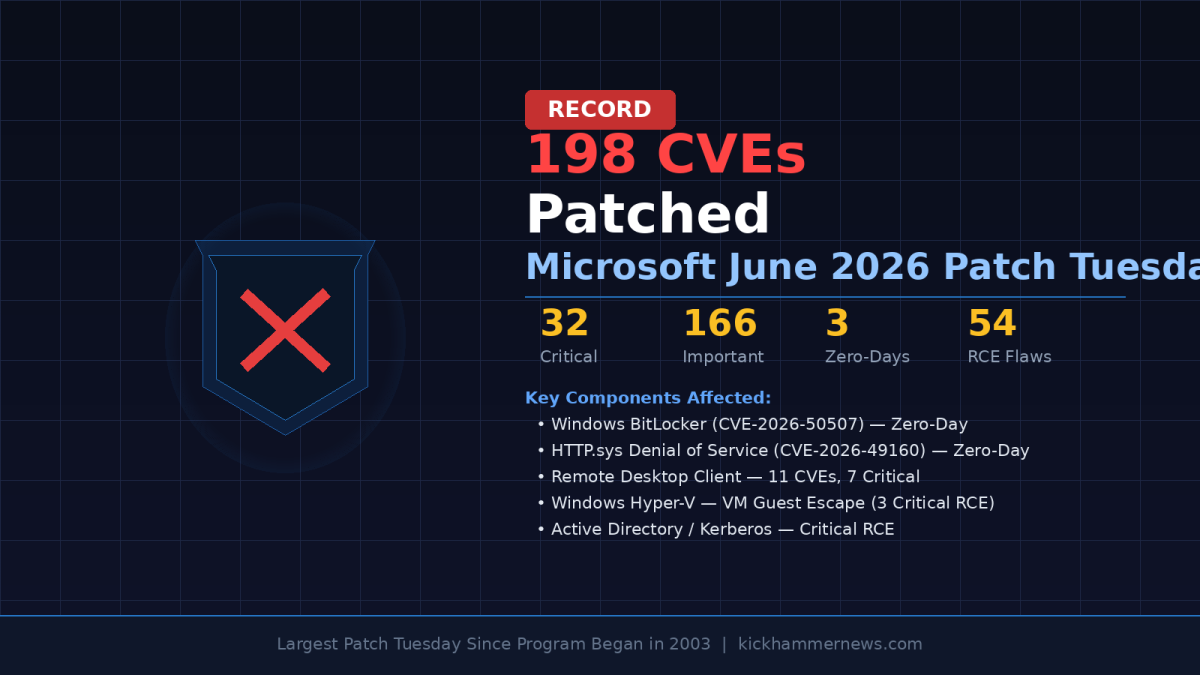
Microsoft’s June 2026 Patch Tuesday update, released on June 9, is the largest security rollout in the history of the Patch Tuesday program. The company addressed 198 vulnerabilities across its product ecosystem in a single cycle, blowing past the previous record of 167 CVEs set just eight months ago in October 2025. With three publicly known zero-days baked into the release — and critical remote code execution bugs targeting Remote Desktop, Hyper-V, and core Windows networking — security teams across the globe are scrambling to assess exposure and deploy patches as fast as possible.
A Record That Speaks for Itself
For context, Patch Tuesday has operated on a monthly cadence since 2003, and over more than two decades, no single release had ever topped 167 CVEs. June 2026 didn’t just break that record — it eclipsed it by nearly 20 percent. Of the 198 CVEs addressed, 32 are rated Critical and 166 are rated Important. Not a single one in this batch was rated Moderate or Low, signaling that Microsoft’s internal triage teams view the entire release as genuinely urgent.
The severity distribution breaks down across vulnerability types as follows: 63 Elevation of Privilege (EoP) flaws, 54 Remote Code Execution (RCE) vulnerabilities, 27 Spoofing issues, 26 Information Disclosure bugs, 18 Security Feature Bypass entries, 7 Denial of Service flaws, and 3 Tampering vulnerabilities. EoP and RCE together account for nearly 60 percent of the patch load — a combination security professionals know all too well, since attackers routinely chain the two to gain initial access and then escalate to SYSTEM-level control.
Three Zero-Days Demand Immediate Attention
The headline concern for most administrators will be the three vulnerabilities that were publicly known — and in some cases already targeted — before Microsoft had patches ready.
CVE-2026-50507 — Windows BitLocker Security Feature Bypass (“Bitskrieg”)
Rated Important with a CVSSv3 score of 6.8, this flaw allows an attacker with physical access to a device to bypass BitLocker’s full-disk encryption protections. The vulnerability was discovered through a collaboration between security researchers known as Chaotic Eclipse (also called Nightmare Eclipse) and Jonas L, and was dubbed “Bitskrieg” before Microsoft issued the patch. While the CVSS score might tempt administrators to deprioritize it, the implications are severe for any organization that relies on BitLocker to protect data on laptops and removable media: a lost or stolen device that should be data-secure is not. Microsoft has assessed it as “Exploitation More Likely.”
CVE-2026-49160 — HTTP.sys Denial of Service (“HTTP/2 Bomb”)
This denial-of-service vulnerability sits in HTTP.sys, the Windows kernel-mode HTTP stack that underlies IIS and a wide range of Windows networking services. Rated Important with a CVSSv3 score of 7.5, it affects HTTP/2 request handling in a way that allows an unauthenticated remote attacker to crash or destabilize affected web servers. Researchers at security firm Calif, credited by Microsoft for the report, dubbed this the “HTTP/2 Bomb” and published a proof-of-concept demonstrating how a specially crafted stream of headers could overwhelm and disable the target service. A MaxHeadersCount registry key has been added alongside the patch as an additional mitigation lever for administrators who cannot immediately deploy.
CVE-2026-45586 — Windows Collaborative Translation Framework EoP (CTFMON)
The third zero-day is an Elevation of Privilege bug in Windows CTFMON, the background process that supports voice and handwriting recognition services. Assigned a CVSSv3 score of 7.8, successful exploitation grants the attacker SYSTEM privileges — the highest level of local access on a Windows machine. Microsoft rates it as “Exploitation More Likely,” and given how commonly EoP vulnerabilities are incorporated into post-exploitation toolkits, this one will likely be weaponized quickly by threat actors looking to escalate access from a standard user account.
Remote Desktop Client: Eleven Flaws, Four Critical
Perhaps the most alarming cluster in this month’s release targets Remote Desktop Client. Microsoft shipped patches for eleven separate RCE vulnerabilities in RDC, seven of which carry Critical ratings. CVE-2026-42985, CVE-2026-44799, CVE-2026-44801, and CVE-2026-42992 are among those flagged Critical, with CVSS scores reaching as high as 8.8. The attack scenario requires a victim to connect to a malicious or compromised RDP server — an increasingly realistic scenario in phishing campaigns that impersonate legitimate IT support portals. With remote work still a dominant enterprise pattern, the footprint of vulnerable RDP clients inside corporate environments remains enormous.
Hyper-V Guest Escape: Cloud Infrastructure at Risk
Three Critical RCE vulnerabilities — CVE-2026-47652, CVE-2026-45641, and CVE-2026-45607 — affect Windows Hyper-V in ways that could allow a virtual machine guest to escape its isolation boundary and execute code on the hypervisor host. Hypervisor escapes are among the most technically demanding and highest-impact categories of exploit in enterprise environments. For cloud service providers and data center operators running multi-tenant Hyper-V infrastructure, these patches are non-negotiable.
Critical Flaws Across the Enterprise Stack
Beyond the headline items, the breadth of this month’s update reflects just how extensively Windows underlies critical enterprise infrastructure.
Active Directory and Kerberos received patches for CVE-2026-47288 (Windows Kerberos KDC RCE) and CVE-2026-45648 (Active Directory Domain Services RCE), both Critical. Exploiting either in a domain environment could give an attacker broad lateral movement capabilities or the ability to compromise the domain controller entirely.
Microsoft Office saw Critical RCE patches for Outlook (CVE-2026-45458), Word (CVE-2026-45456), and two additional Office components — all exploitable through malicious document delivery, the perennial phishing vector.
Azure Kubernetes Service received a Critical RCE patch (CVE-2026-32193) that could allow attackers to compromise containerized workloads, while Nuance PowerScribe (CVE-2026-26142) — a transcription platform widely used in healthcare — was patched for a Critical RCE flaw that puts radiology and clinical documentation systems in scope.
Windows Secure Boot absorbed eight Security Feature Bypass patches, continuing a pattern that has now stretched across multiple months. Attackers have shown sustained investment in undermining pre-OS boot integrity, and with UEFI-level persistence mechanisms increasingly appearing in advanced threat actor playbooks, administrators running older firmware or unsigned boot configurations face meaningful risk.
Privilege Escalation Tsunami: 63 EoP Vulnerabilities
The sheer volume of EoP vulnerabilities in this cycle — 63 in total — is itself a warning signal. Windows DWM Core Library accounted for 11 EoP CVEs. The Windows Ancillary Function Driver for WinSock contributed 7. Windows Push Notifications received 4 patches. The Windows Kernel was addressed through CVE-2026-48583 and CVE-2026-45653. The Critical-rated CVE-2026-44810 targeting Microsoft Cryptographic Services stands out as particularly high-value: a flaw in the cryptographic subsystem that underlies certificate validation, secure channel negotiation, and code signing is a systemic risk, not an isolated one.
Security practitioners widely understand that EoP bugs rarely arrive alone. They are packaged into exploit chains alongside initial access vectors — phishing attachments, browser-based drive-by downloads, or N-day RCE exploits. The sheer density of EoP patches this month suggests that threat intelligence teams have documented extensive adversary interest in Windows privilege escalation pathways.
What Security Teams Should Do Right Now
Given the record scale and the presence of three zero-days, Patch Tuesday for June 2026 does not have the luxury of a phased rollout on a comfortable 30 or 60-day timeline. Microsoft’s guidance and industry security analysts are aligned: test and deploy these updates as rapidly as operational constraints allow. The following components should be at the top of every prioritization list:
- BitLocker (CVE-2026-50507): Patch all endpoints. For devices where patching is delayed, ensure physical security controls are in place.
- HTTP.sys (CVE-2026-49160): Patch all internet-facing IIS and Windows Server deployments. Apply the MaxHeadersCount registry mitigation as an interim measure.
- Remote Desktop Client: Restrict RDP client access to trusted environments. Patch immediately.
- Hyper-V hosts: Apply critical updates to all virtualization infrastructure, prioritizing multi-tenant systems.
- Active Directory / Kerberos: Treat these as tier-one patches for any domain-joined environment.
- Microsoft Office: Push Office updates through SCCM, Intune, or direct deployment; educate users on the continued risk of malicious document attachments.
Where emergency patching is not immediately possible, network segmentation and restricting inbound RDP and HTTP/2 exposure can reduce the attack surface until updates can be applied.
The Bigger Picture: What the Record Count Signals
The question that naturally follows a month like this is why. A record-breaking 198-CVE release does not emerge from a vacuum. Part of the answer lies in Microsoft’s expanded surface area: the company now ships patches for Azure cloud services, GitHub Copilot, Microsoft Teams for Android, Nuance healthcare tools, and AI-integrated productivity features alongside traditional Windows and Office components. The attack surface that Patch Tuesday covers has grown dramatically.
There is also an industry-wide discussion around AI-assisted vulnerability research. Security tooling powered by large language models has accelerated the pace at which researchers — and adversaries — can analyze complex codebases and identify exploitable conditions. If the volume of patches continues trending upward through 2026, it will signal that the rate at which vulnerabilities are being discovered has outpaced the rate at which code is being hardened.
For enterprise security teams, June 2026’s Patch Tuesday is not just a patching task — it is a forcing function for re-examining patch cadence policies, emergency deployment playbooks, and the baseline exposure of Windows infrastructure. The record has been set. Preparing for the next one starts now.
Sources: Tenable Research Special Operations, Cyber Security News, Microsoft Security Response Center, Qualys Security Blog, Ivanti Patch Tuesday Analysis, June 2026.


