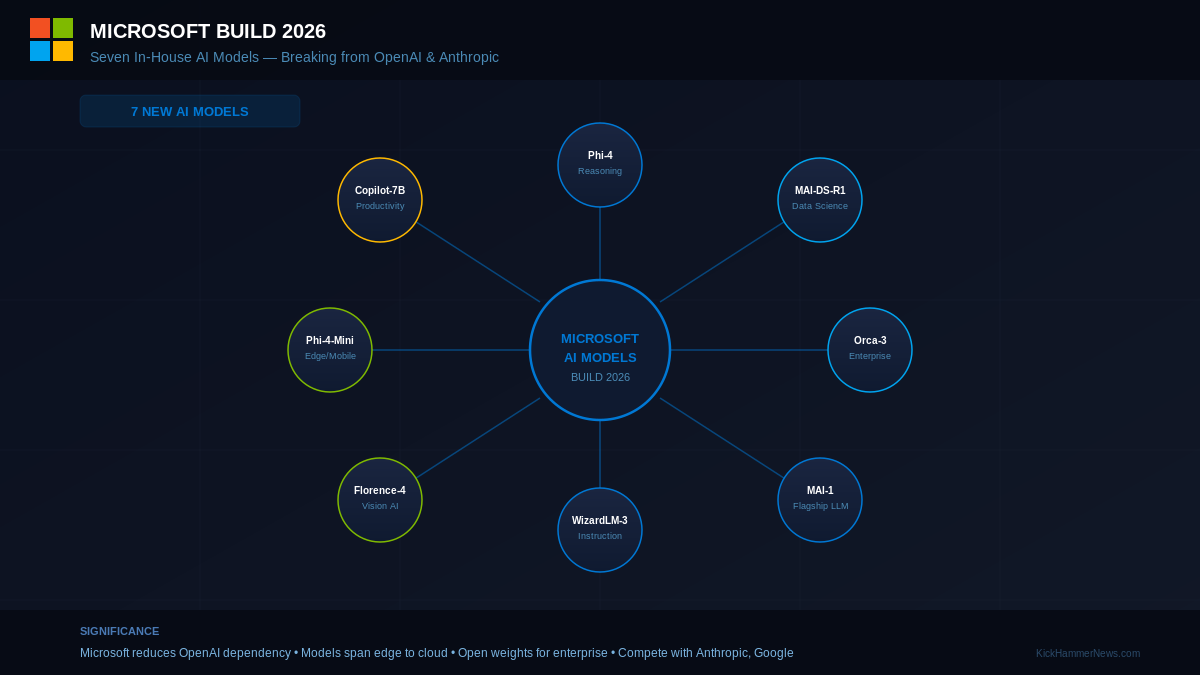
In a move that signals a tectonic shift in the artificial intelligence industry, Microsoft unveiled seven proprietary AI models at its annual Build developer conference in San Francisco on June 2, 2026. The announcement marks the most significant step yet by the software giant to reduce its costly and strategically precarious dependence on OpenAI and Anthropic — two companies it has bankrolled to the tune of tens of billions of dollars.
The new model family, collectively branded as MAI (Microsoft AI), spans reasoning, coding, image generation, transcription, and voice capabilities. More than a product launch, the announcement represents Microsoft’s declaration that it intends to chart its own course in the AI race it helped ignite.
The MAI Family: Seven Models, One Strategic Vision
Microsoft shipped seven first-party models at Build 2026: MAI-Thinking-1, MAI-Thinking-Mini, MAI-Code-1-Flash, MAI-Image-2.5, MAI-Image-2.5-Flash, MAI-Transcribe, MAI-Voice, and MAI-Voice-Turbo. Each model is purpose-built for a specific capability, a deliberate departure from the “do everything” approach that has defined flagship models like GPT-5.5 and Claude Opus 4.8.
The headline model is MAI-Thinking-1, Microsoft’s first fully in-house reasoning model. Crucially, Microsoft’s chief AI executive Mustafa Suleyman emphasized that MAI-Thinking-1 was trained from scratch on clean, commercially licensed data, with no distillation from OpenAI or any other third-party model family. That distinction matters enormously — it means Microsoft is not simply repackaging its partners’ intellectual property, but building genuine, independent AI capability from the ground up.
The results appear to back up the ambition. In blind evaluations, MAI-Thinking-1 was preferred over Anthropic’s Claude Sonnet 4.6, and Microsoft claims the model matches Claude Opus 4.6 on coding benchmarks. In a separate test, after fine-tuning for consulting firm McKinsey, Microsoft’s models outperformed OpenAI’s GPT-5.5 on quality while projecting ten times better cost efficiency. These are bold claims in an era where benchmark wars have become almost meaningless, but they carry weight precisely because Microsoft is willing to stake its name — and its billions in Azure revenue — behind them.
Purpose-Built and Price-Competitive
The strategic philosophy behind the MAI family is specialization over breadth. MAI-Code-1-Flash, for instance, is a lean agentic coding model with only 5 billion active parameters, purpose-built for deep integration with GitHub Copilot and Visual Studio Code. Microsoft compares it favorably to Anthropic’s Claude Haiku in capability, but at a fraction of the cost. For developers running millions of code completions daily, that efficiency gap translates directly into operational savings.
MAI-Image-2.5 and its flash variant are Microsoft’s first models capable of handling both text-to-image and image-to-image workloads natively, and they’ve already made a splash on AI benchmarking leaderboards, claiming second and third positions respectively on the Arena AI leaderboard at launch.
The voice and transcription models round out the portfolio, pointing toward Microsoft’s ambitions in real-time productivity — think AI meeting assistants, live translation, and voice-driven workflows integrated directly into Teams and Office 365.
Microsoft describes the entire MAI initiative as a “hill-climbing machine” — a system designed to achieve continuous, iterative self-improvement through sustained investment in compute resources, data quality, and evaluation rigor. It is, in essence, a long-term bet that Microsoft can compete not just at the model level, but as a vertically integrated AI company.
Why This Matters: The Economics of AI Dependence
To understand why this announcement is so consequential, consider the position Microsoft found itself in just three years ago. Having invested approximately $13 billion in OpenAI and up to $5 billion in Anthropic, the company had become the world’s most powerful AI reseller — offering both companies’ models through Azure at scale — while remaining fundamentally dependent on external parties for its most strategic technology.
That arrangement always carried risk. OpenAI’s turbulent leadership crisis in late 2023, which briefly saw CEO Sam Altman ousted before a dramatic reinstatement, gave Microsoft an uncomfortable preview of what happens when a core technology partner is in chaos. More practically, every dollar a customer spends on OpenAI’s or Anthropic’s models through Azure is a dollar Microsoft earns primarily as a distributor, not as the technology owner.
The MAI launch changes that calculus. If Microsoft can deliver comparable or superior performance at meaningfully lower cost under its own brand, it captures a larger share of AI economics. It also gains negotiating leverage with OpenAI and Anthropic, whose models will still be available through Azure — but now as options rather than necessities.
The Competitive Landscape Gets Crowded
Microsoft’s move lands in an already turbulent AI market. Anthropic confidentially filed for an IPO on June 1 — the day before Build — at a staggering $965 billion valuation, following a $65 billion Series H funding round. The company’s revenue run rate crossed $47 billion in May 2026, driven heavily by Claude Code adoption in enterprise. Just days later, on June 9, Anthropic released Claude Fable 5, the first publicly accessible member of its elite Mythos model class, featuring a 1 million token context window, extended agentic capabilities, and integrated safety routing.
OpenAI, meanwhile, has reportedly been preparing its own counter-moves, with ChatGPT crossing 1 billion users globally in early June 2026. The AI landscape in mid-2026 is no longer a two-horse race between two foundation model labs — it has become a multi-front war involving the world’s most valuable technology companies.
Building for the Long Game
What makes Microsoft’s MAI launch interesting is not just the models themselves, but the institutional signal they send. By training MAI-Thinking-1 without distillation from any third-party model, Microsoft is committing to a genuine research and development pipeline, not just fine-tuning and redistribution. That requires significant infrastructure investment, recruiting world-class AI researchers, and building evaluation systems rigorous enough to compete with frontier labs.
The models are being deployed across Microsoft’s product ecosystem — MAI models power new experiences in Copilot, VS Code, PowerPoint, OneDrive, and a dedicated MAI Playground available to developers through Microsoft Foundry. The integration breadth is a key differentiator: few companies can distribute AI capabilities across a software ecosystem as vast and entrenched as Microsoft’s.
What Comes Next
For enterprise customers, the MAI launch offers something they have long wanted but rarely had: genuine multi-vendor choice from a single, trusted platform provider. They can now access Microsoft’s own models, OpenAI, Anthropic’s Claude, and others through Azure, comparing performance and cost across providers for the same task.
For Microsoft, the question is whether the MAI family can sustain its early momentum. The company has promised a roadmap of model improvements and new releases through 2026. The “hill-climbing machine” metaphor is apt — it acknowledges that today’s benchmarks will be tomorrow’s baseline, and that competition in AI is a continuous process, not a single sprint.
What is clear is that the era of Microsoft as a passive AI investor is over. With seven homegrown models and a declared ambition for “long-term self-sufficiency,” the company that once needed a $13 billion relationship with OpenAI to stay relevant in AI is now building the technology itself — and betting that its unmatched distribution reach will do the rest.
The AI landscape of 2026 is being reshaped not just by which models are most capable, but by who controls them. Microsoft, for the first time in this cycle, intends that answer to include itself.
Sources: Microsoft AI Blog, CNBC, GeekWire, TechTimes, Enterprise DNA, Windows Forum


